


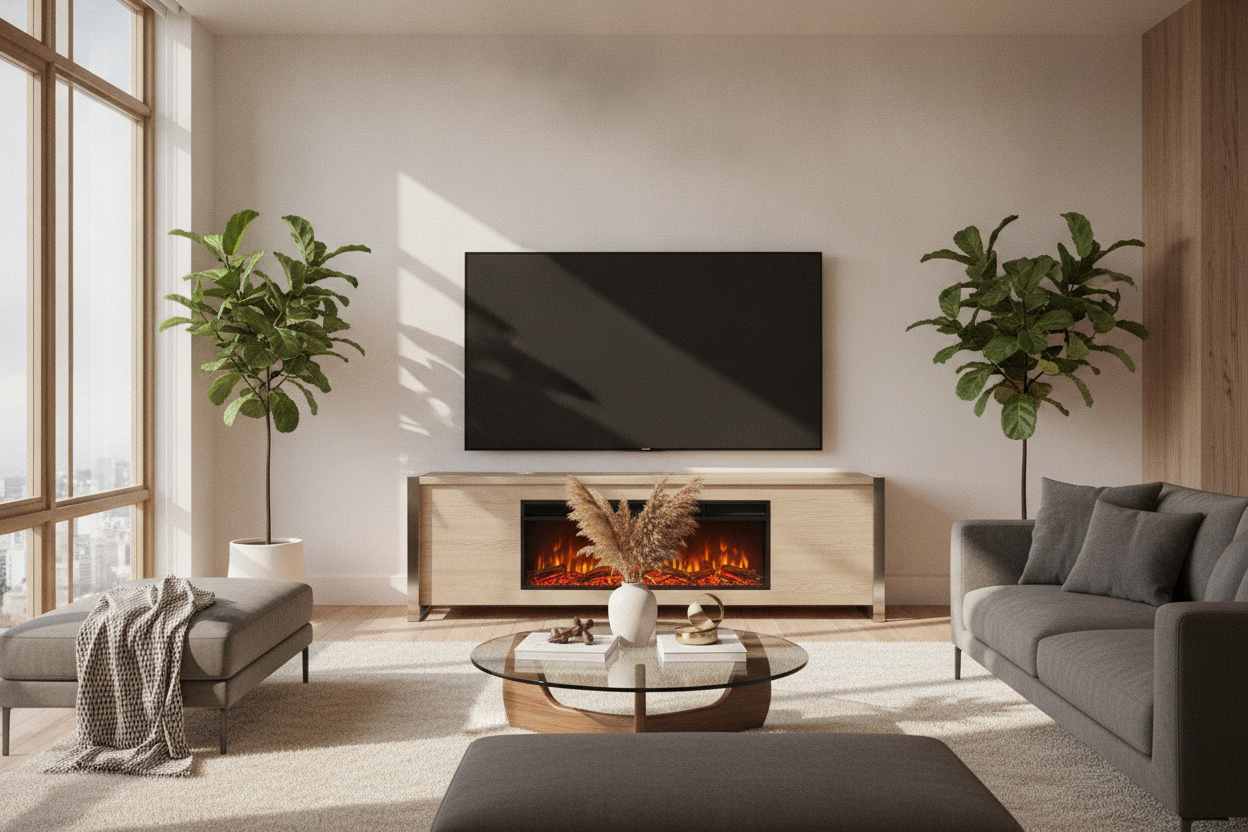
I’ve spent too many late nights staring at 47 browser tabs, trying to figure out why my living room looks like a tech warehouse instead of a home. We’ve all been there: you buy the massive 75-inch TV, get it home, and realize your existing console makes the screen look like a giant mushroom cloud. It’s top-heavy, awkward, and frankly, a little stressful to look at. Finding a 68 inch tv stand with fireplace isn't just about heat; it's about solving the geometric nightmare of modern screen sizes.
Quick Takeaways
- A 75-inch TV is actually about 65.4 inches wide, making a 68-inch stand the perfect fit.
- The 1.3-inch margin on each side creates a high-end, custom-built appearance.
- 80-inch consoles often swallow standard-sized rooms, leaving no space for decor.
- The fireplace element grounds the 'black void' of a large screen when it's turned off.
We Need to Talk About the Diagonal vs. Horizontal Trap
The biggest lie in home electronics is the way we measure screens. When you buy a 75-inch TV, you aren't buying something 75 inches wide. That number is the diagonal. If you go browsing standard TV stands with that 75-inch number in your head, you’re going to end up with a piece of furniture that is either comically oversized or dangerously small. Most people panic and buy a stand that is way too short, leading to the 'overhang' look that makes a room feel cluttered and unstable.
I’ve seen it a dozen times. Someone buys a 60-inch console for their 75-inch TV because they think 'it's close enough.' It isn't. You end up with the edges of your expensive tech hanging out over thin air. It’s a visual disaster that ruins the flow of your wall and makes your expensive television look like an afterthought.
Why a 68 inch fireplace tv stand is the mathematical sweet spot
Let’s do the actual math that the big-box retailers won't tell you. A standard 75-inch TV (with a 16:9 aspect ratio) has a horizontal width of approximately 65.4 inches. If you place that on a 68 inch fireplace tv stand, you are left with exactly 2.6 inches of total extra space. That means you get a 1.3-inch margin on each side of the screen. This is the 'Goldilocks' zone of interior design.
That tiny sliver of space on either side is what creates the 'built-in' look. It’s enough of a buffer that the TV doesn't look like it's falling off the edge, but it's narrow enough that the console doesn't look like it's wearing a shirt three sizes too big. It’s a clean, intentional line that makes your living room look like you hired a professional designer instead of just clicking 'add to cart' on the first thing you saw.
Wait, Why Not Just Buy an 80-Inch Console?
The common advice is to go as big as possible to 'anchor' the room. I disagree. Unless you live in a literal cavern, an 80-inch or 84-inch media unit is a massive footprint. It dictates the entire wall. It eliminates your ability to put a floor lamp in the corner or a tall fiddle-leaf fig next to the window. It’s a space-hog that makes average living rooms feel cramped.
I remember when I upgraded from a 55-inch unit to something larger. I initially looked at the 80-inch monsters and realized they would hit my door frame. The 68-inch width gives you the heft you need for the big screen without sacrificing the breathing room your walls need. It’s about balance, not just maximum surface area.
How the Fireplace Glow Cures the 'Giant Tech Shrine' Vibe
The problem with a 75-inch TV is that when it’s off, it’s just a massive, cold, black rectangle. It’s a void that sucks the life out of a room. This is where the fireplace element becomes a design tool rather than just a heater. The flickering light from the firebox draws the eye downward, grounding the tech and adding a layer of organic movement to the space.
I’ve found that having that amber glow underneath the screen effectively fixed the giant black void in my own house. It turns the TV area into a hearth. If you realize your space is actually smaller and you're rocking a 65-inch screen instead, you might look at a 59 W white fireplace heater TV stand to keep this same ratio. The goal is always to make the technology feel like part of the furniture, not a foreign object that landed in the middle of your home.
Styling the 1-Inch Margin (Minimalism is Your Friend)
With only about an inch of space on either side of your TV, you have to be smart about decor. This isn't the place for bulky vases or tall candlesticks that will clip the corners of your screen. I suggest keeping the top surface almost entirely clear. Let the fireplace do the visual heavy lifting.
If you must add something, go for low-profile items like a small tray for remotes or a single, trailing succulent. The 68-inch width is designed to frame the TV, not to act as a bookshelf. Trust the math—the tight margins are what make it look expensive.
Personal Experience: The Overhang Regret
A few years ago, I tried to save $100 by keeping my old 60-inch stand when I bought a 75-inch TV. Every time I walked into the room, I felt a low-level sense of anxiety. The TV looked like it was balancing on a toothpick. I eventually caved and got a 68-inch fireplace unit, and the difference was instant. The room felt 'settled.' Don't make my mistake; the scale of your furniture matters as much as the resolution of your screen.
FAQ
Will a 75-inch TV be stable on a 68-inch stand?
Yes, as long as the TV's legs (the distance between them) are narrower than 68 inches, which they almost always are. Most 75-inch TV legs are set about 55-60 inches apart.
Does the fireplace put out enough heat for a large room?
Most of these units are rated for 400 to 1,000 square feet. They won't replace your furnace, but they’ll take the chill off a basement or a drafty living room while you're watching a movie.
What if my TV has a center pedestal stand?
Even better. A center pedestal makes the 68-inch width look even cleaner, as you won't have to worry about the 'feet' of the TV being too close to the edges of the console.


Laisser un commentaire
Ce site est protégé par hCaptcha, et la Politique de confidentialité et les Conditions de service de hCaptcha s’appliquent.