


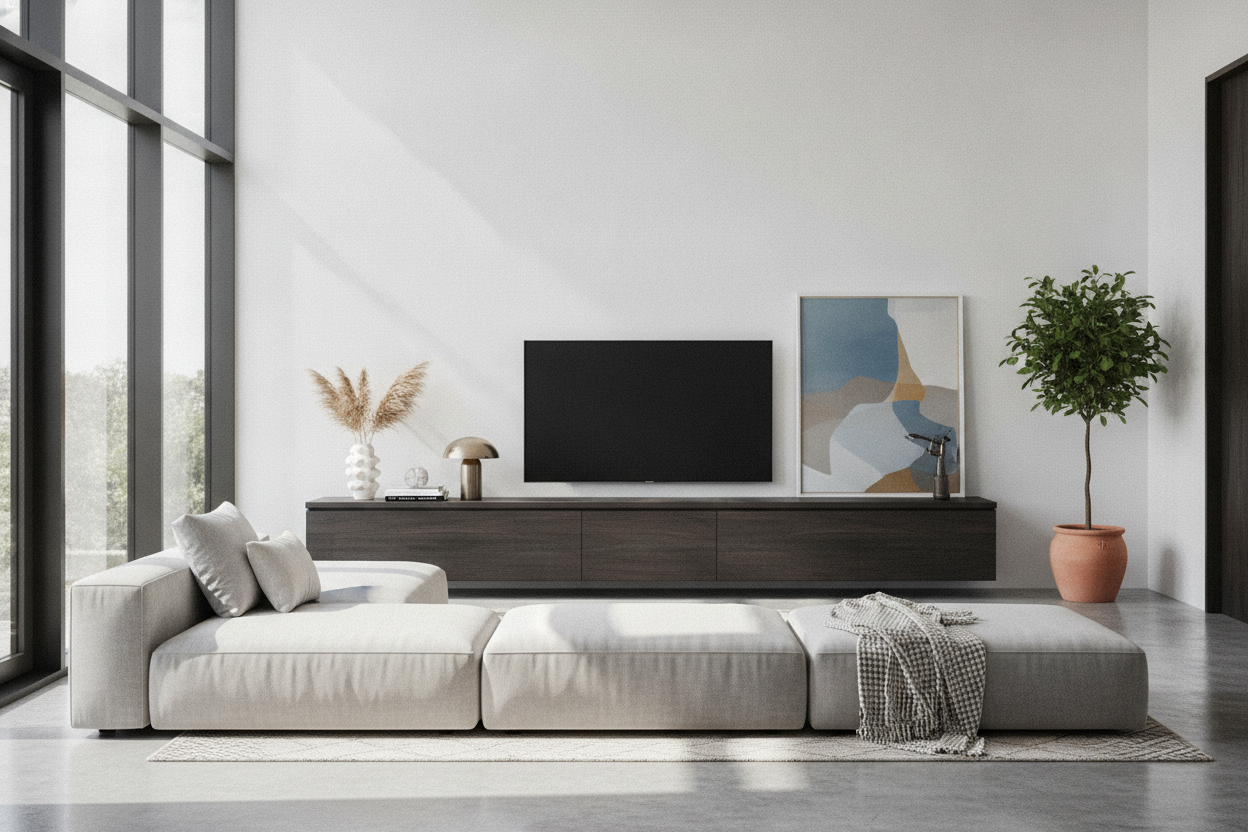
I spent three months scouring every corner of the internet for a sofa that didn't feel like a waiting room bench. When my low-slung, deep-seated modular sectional finally arrived, I felt like I'd won at interior design. Then I sat down to watch a movie. Within twenty minutes, my neck was craned at an angle that felt more like a front-row seat at an IMAX theater than a relaxing evening at home. The culprit wasn't the sofa; it was my chunky, standard-height console. If you've embraced the 'low and slow' furniture trend, you absolutely need a low cabinet for tv to keep your eye line—and your style—in check.
- Ideally, your eyes should hit the top third of the screen when seated.
- Standard 30-inch consoles are designed for upright, traditional sofas with 19-inch seat heights.
- Low-profile media units (under 20 inches) create a 'gallery' look that makes small rooms feel expansive.
- Always measure your actual seat height before clicking 'buy' on a console.
The Cloud Couch Dilemma (Why Standard Stands Fail)
The modern living room has undergone a massive shift. We aren't sitting primly on high-backed Victorian settees anymore. We’re lounging in deep, 40-inch-wide cushions that sit barely 15 inches off the floor. When you pair that kind of seating with a traditional media stand, you're essentially looking up at a 45-degree angle. It’s ergonomically exhausting and, frankly, looks a bit amateur.
A standard 30-inch console plus a 65-inch TV means the center of your screen is hovering somewhere around 50 inches high. If your butt is only a foot off the ground, you're in for a world of neck strain. Switching to a tv unit low solves this by dropping the screen to your natural horizon. It turns the TV from a looming monolith into an integrated part of the wall, making your movie nights feel like a cozy lounge experience rather than a visit to the chiropractor.
I’ve seen too many people drop three grand on a designer sofa only to ruin the vibe with a bulky, chest-high cabinet. Proportions matter. If your seating is low, your storage has to follow suit or the room will feel top-heavy and cramped. It’s about creating a cohesive line that doesn't force your eyes to jump all over the wall.
What Actually Qualifies as a 'Low' Media Unit?
In the furniture world, 'low' isn't just a vibe—it’s a measurement. Generally, you’re looking for something between 12 and 20 inches tall. Anything higher, and you’re back in 'standard' territory. The sweet spot for most modern homes is about 15 to 18 inches. This height allows the TV to sit low enough that your neck remains neutral while you’re buried in cushions.
When you're shopping for a modern tv console cabinet, look for pieces that prioritize horizontal lines. You want something that stretches across the wall rather than climbing up it. To find your perfect height, sit on your sofa and have someone hold a measuring tape. Your eyes should naturally rest on the top third of the screen. If you have to tilt your chin up, the low television cabinet you’re eyeing is still too tall for your setup.
The Visual Trick That Makes Your Ceilings Look Higher
Here’s a design secret: the lower your furniture, the taller your walls feel. It’s all about the 'horizon line' of the room. When you use a low long tv cabinet, you’re creating a strong horizontal anchor that draws the eye across the space rather than up and down. This is a lifesaver in apartments with standard 8-foot ceilings where a tall cabinet can make the room feel like a shoebox.
By keeping the bulk of your furniture below the halfway point of the wall, you leave a massive amount of 'negative space' above. This makes the air in the room feel lighter. If you have a massive 75-inch or 85-inch screen, grounding it with a large tv cabinet that is significantly wider than the TV itself creates a sense of stability. It prevents the 'lollipop effect,' where a giant screen looks like it’s about to tip over a tiny, narrow stand.
I once worked with a client who had 7-foot ceilings in a basement. They were convinced they needed a tall unit to 'fill the space.' We did the opposite—went with a 14-inch high, 90-inch long console—and the room instantly felt twice as big. It’s counterintuitive, but it works every single time to combat that claustrophobic feeling.
But Will My Receiver and Cords Still Fit?
The biggest pushback I get is about storage. 'How am I supposed to fit my PS5 and my chunky AV receiver in something that's only 14 inches high?' It’s a fair question. Many tv cabinets low are designed with slim profiles that don't always accommodate vintage, oversized tech. However, modern low media cabinets are getting smarter about this, often featuring open-back designs or ventilated mesh fronts to keep things cool.
If you're worried about the cable bird's nest, consider a media cabinet for wall mounted tv strategy. Even if your TV is on the stand, mounting it just an inch or two above the cabinet and using an in-wall cable kit can save you from the 'cord waterfall' look. For the gear itself, look for units with adjustable shelving. A PS5 needs about 4 inches of clearance for airflow; most tv cabinets low can handle that if you lay the console horizontally. Just don't cram it into a sealed wooden box without holes, or you'll be buying a new console in six months.
The Exception: When You Actually Shouldn't Go Low
Look, I love the low-profile look, but it’s not a universal law. If you’re rocking a vintage Lawson-style sofa or a formal Chesterfield with a standard 19-inch seat height, a 12-inch console is going to feel like you’re sitting at the kids' table. You’ll be looking down at the screen, which is just as bad for your neck as looking up.
Similarly, if your primary TV viewing happens from the kitchen island while you’re prepping dinner, a low stand is a disaster. You’ll be staring at the back of your sofa. In those cases, you need to ignore the trend and get a tall media cabinet that brings the screen to eye level for a standing or high-seated position. Design should always serve your lifestyle, not the other way around.
My Own 'Too High' Disaster
A few years ago, I fell in love with a mid-century sideboard. It was 34 inches tall, gorgeous walnut, and totally wrong for my living room. I tried to make it work as a TV stand for a year. I spent every Sunday night rubbing my neck after watching football. I finally swapped it for a 16-inch low-profile unit, and the relief was instant. I lost some vertical storage for my board game collection, but I gained a living room that actually felt comfortable to live in. Don't prioritize a 'cool' piece of furniture over your physical comfort.
FAQ
What is the best height for a TV stand?
For most modern, low-profile sofas, aim for 15 to 20 inches. The goal is to have your eye level hit the top third of the screen while you are relaxed in your typical seating position.
Can I put a large TV on a low cabinet?
Yes, but make sure the cabinet is at least 6-10 inches wider than the TV on both sides. A low, wide base provides the visual weight needed to support a large screen without it looking top-heavy.
Do low cabinets have enough airflow for gaming?
Some do, some don't. Always check for cord cutouts or 'breezeway' slats. If you have high-heat electronics like a gaming PC, look for a unit with an open back or removable panels.

Laisser un commentaire
Ce site est protégé par hCaptcha, et la Politique de confidentialité et les Conditions de service de hCaptcha s’appliquent.