


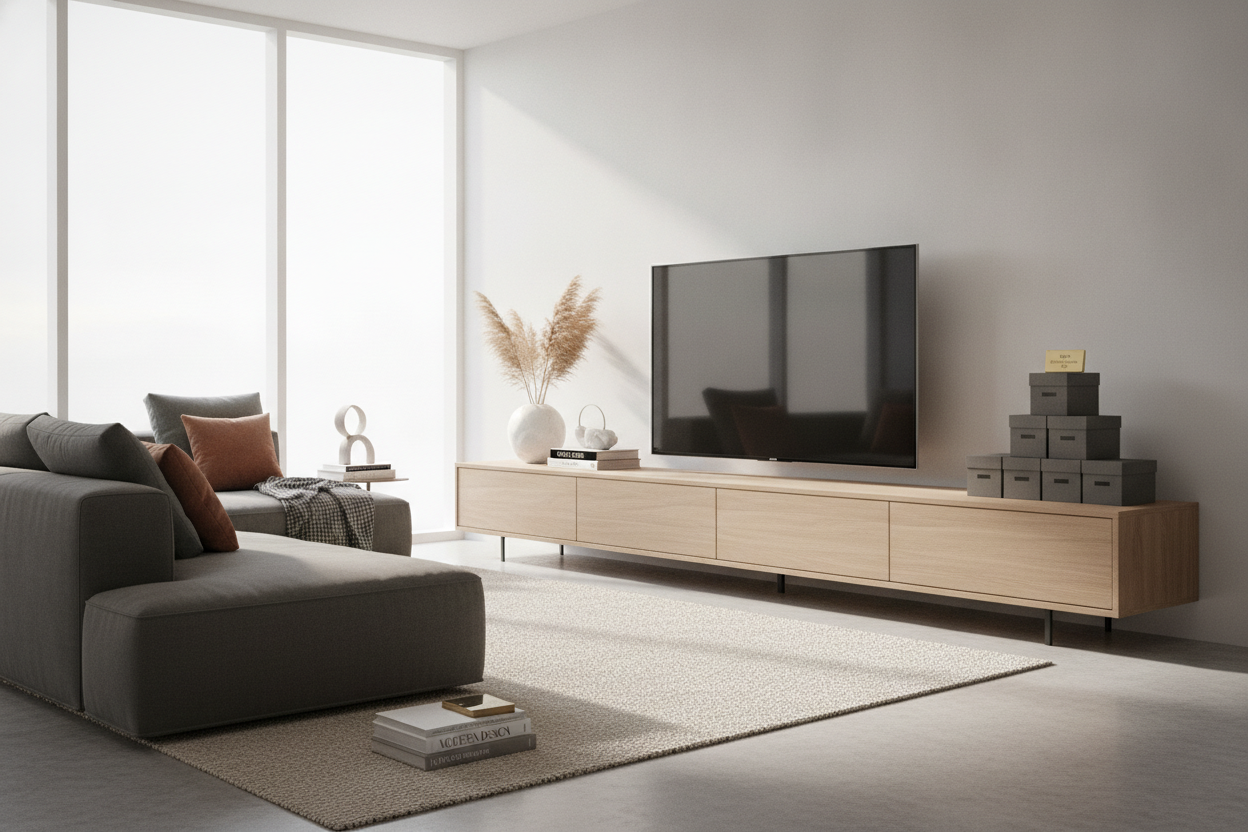
I spent last Tuesday night in a deep-seated state of furniture-induced madness. I had 14 tabs open, all showing what looked like the exact same fluted wood media console. One site listed it for $899, another for $540, and a third—with a name that sounded like a generated password—had it for $320. If you have ever felt like you are losing your mind while comparing tv stand brands, I have some news for you: You are not crazy. You are just seeing the white-label furniture industry in its purest, most chaotic form.
- Most online furniture is 'white-labeled,' meaning one factory makes it and dozens of brands sell it.
- Price gaps are often due to marketing budgets, not material quality.
- Weight is the biggest 'tell' for quality—if it’s under 70 lbs, it’s probably paper-thin MDF.
- Real designers usually have smaller catalogs and more transparent material lists.
The Great Online Furniture Illusion
The fluted-door trend is the perfect example of the current state of the industry. You see a 'luxury' piece on a high-end site, then see the same silhouette on a discount marketplace. This happens because the majority of online retailers don't actually design or build their own inventory. They browse catalogs from massive overseas factories, pick a design, and have their own logo slapped on the box.
It’s a shell game. You might think you are buying from a boutique curator, but you are actually just paying for their Instagram ad spend. I once bought a 'mid-century' console that looked like solid walnut in the photos. When it arrived, it was so light I could lift the box with one hand. It wasn't wood; it was essentially heavy-duty cardboard with a sticker on top. That is the reality of the drop-shipping model that dominates the market today.
Who Actually Makes These Things? (Meet the TV Stands Manufacturers)
The real players are the tv stands manufacturers located primarily in Vietnam, Malaysia, and China. These factories are massive. They produce tens of thousands of units a month. When a specific look—like slatted doors or cane inserts—starts trending, these factories pivot instantly. They create one 'base' model and offer it to any retailer with a credit card.
This is why you see identical specs across five different websites. To avoid this trap, I always suggest you browse dedicated TV stands from companies that actually vet their supply chain. If a brand cannot tell you exactly which factory or region their furniture comes from, they are likely just a middleman with a fancy website. These middlemen don't care about the longevity of the piece; they care about the margin between the factory price and your checkout price.
The Flat-Pack Giants vs. Original Design
There is a massive gulf between the anonymous tv stand makers churning out particle board and the workshops that actually care about joinery. The flat-pack giants rely on cam-locks and wood glue to hold everything together. It’s fine for a dorm room, but it’s not 'forever' furniture. The moment you try to move that console to a new apartment, the joints will likely crumble.
If you are looking for something that won't sag under the weight of a 65-inch OLED, look for pieces with a solid wood base or kiln-dried frames. For example, a high-quality mid-century modern TV stand should weigh significantly more than its cheap clones. I’ve seen 'lookalikes' that weigh 60 pounds, while the original design weighs 130 pounds. That weight is the difference between real timber and sawdust held together by resin.
How to Spot a Re-Branded Console Before You Buy
Before you hit 'buy,' do a reverse image search on the product photos. If the same staged living room photo pops up on four different sites with four different brand names, you’ve found a white-label special. This is the easiest way to find the lowest price for the exact same item, but it’s also a warning sign that the 'brand' has zero control over quality.
Check the hardware specs. Cheap tv stand manufacturer outfits use plastic handles painted to look like brass. They use friction slides instead of ball-bearing drawer glides. If the description is vague—using terms like 'wood-like finish' or 'engineered accents'—run. Those are code words for 'we didn't use real wood anywhere on this thing.'
Why Buying Direct From a TV Stand Manufacturer Matters
When you cut out the layers of middlemen, you usually get better support. If a piece arrives with a cracked leg (a classic flat-pack tragedy), a direct-to-consumer brand can actually send you a replacement part. A random reseller on a massive marketplace will often just tell you to ship the whole 100-pound box back, which is a logistical nightmare.
Focus on the functional details when choosing the perfect TV stand for your space. Does it have ventilated back panels for your consoles? Are the shelves adjustable? A brand that actually designs its furniture thinks about these things. A brand that just buys from a factory catalog doesn't. I once bought a stand that had zero cable management holes. I had to use a hole-saw bit on a brand-new piece of furniture just to plug in my Xbox. That’s what happens when the designer has never actually used the product.
Personal Experience: The $200 Mistake
I once fell for a 'flash sale' on a console that looked identical to a $1,200 West Elm piece. It was $249. I thought I was a genius. When it arrived, the 'oak finish' was a literal vinyl sticker that started peeling at the corners within three months. The doors never hung straight because the pre-drilled holes were nearly a quarter-inch off. I ended up spending more money at the hardware store trying to 'fix' a brand-new piece of furniture than I saved on the initial purchase. Now, I check the shipping weight first. If it’s too light to be real wood, I don't buy it.
FAQ
Can I trust 'Solid Wood' claims on cheap sites?
Usually, no. Often, they mean the legs are solid wood (usually cheap rubberwood) while the rest of the body is MDF with a veneer. Read the 'Materials' section very carefully. If it says 'Solid Wood and MDF,' assume it is 90% MDF.
Why is the price difference so huge for the same item?
Marketing and overhead. A big-name retailer has to pay for showrooms and expensive TV ads. A smaller 'ghost' brand on a marketplace has almost no overhead, so they can undercut everyone else on price, even for the same factory-sourced item.
How much should a good TV stand weigh?
For a standard 60-inch console, look for something north of 100 lbs. If it’s 50 or 60 lbs, it’s made of low-density particle board that will eventually bow in the middle under the weight of your TV.


Laisser un commentaire
Ce site est protégé par hCaptcha, et la Politique de confidentialité et les Conditions de service de hCaptcha s’appliquent.