


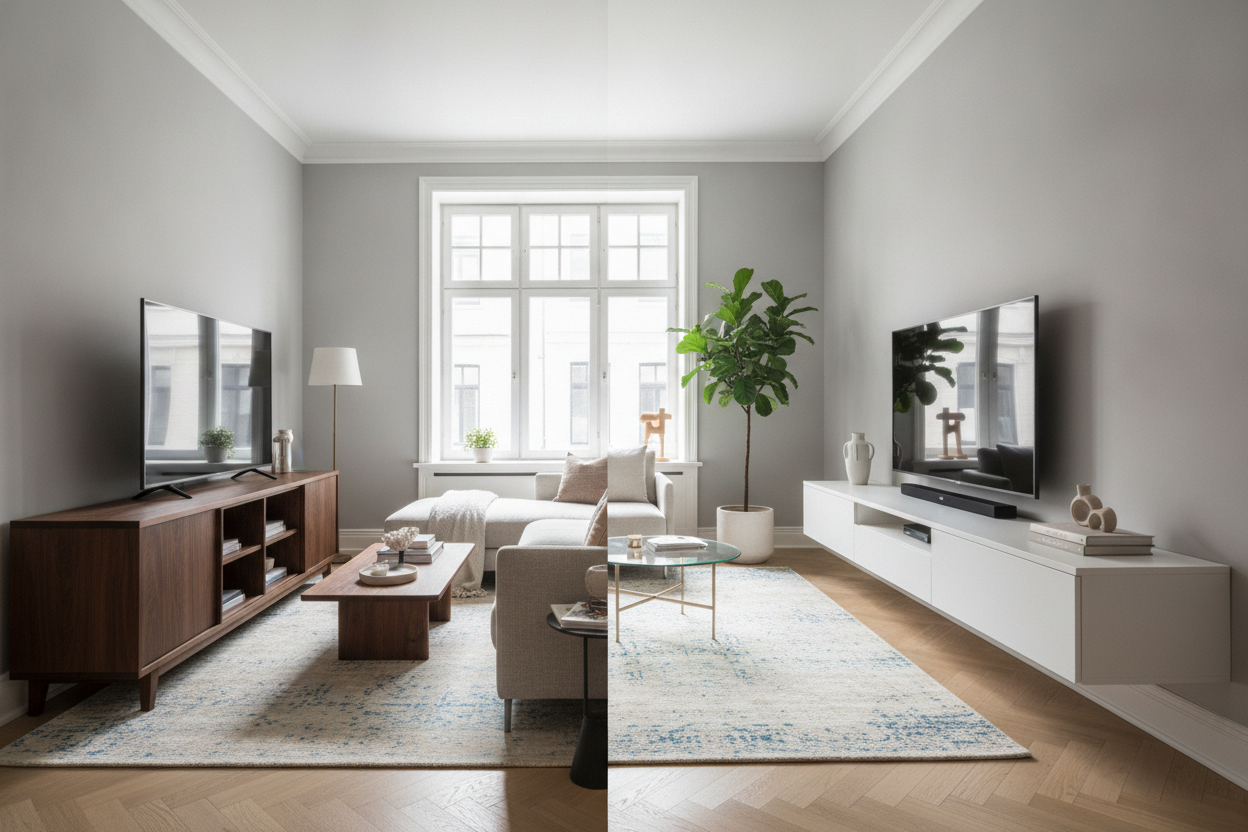
I once spent three weeks obsessively measuring my living room only to realize I had bought a media console that looked like a coffin. It was a solid, dark walnut block of MDF that sat flat on the floor, effectively eating four feet of floor space and making my 12x15 room feel like a walk-in closet. It’s a mistake I see everywhere: people pick television stand models based on storage capacity without realizing they are creating a visual black hole in their home.
The truth is, your furniture shouldn’t feel like it’s fighting the room for air. When a piece is too bulky, it stops being a functional surface and starts being a wall. I’ve assembled enough flat-pack disasters and heavy hardwood credenzas to know that the silhouette of the piece matters just as much as the dimensions. If you choose the wrong scale, no amount of 'minimalist' styling will save you from a cramped-feeling apartment.
Quick Takeaways
- Leg height is everything; seeing the floor underneath furniture creates the illusion of more square footage.
- Avoid 'to-the-floor' cabinetry in small rooms unless you want the piece to disappear into the wall.
- Glass doors provide depth where solid wood creates a hard visual boundary.
- Width matters: your stand should be at least 6-10 inches wider than your TV to avoid the 'top-heavy' look.
The 'Heavy Box' Effect (And Why It Ruins Your Space)
In interior design, we talk a lot about visual weight. This isn't about how many pounds the box weighs when it arrives on your doorstep; it’s about how much space it occupies in your brain when you look at it. A solid, boxy console that sits directly on the carpet has a massive visual weight. It creates a hard stop for your eyes, making the floor plan look like it ends exactly where the wood begins.
I’ve seen 70-inch TVs perched on 60-inch boxes, and it’s a recipe for a room that feels cluttered, even if the floor is clean. When furniture has no 'breathability,' it makes the ceiling feel lower and the walls feel closer. I once helped a friend swap a chunky, floor-sitting unit for something with a slimmer profile, and the difference was like opening a window in a stuffy room. You want a tv stand model that feels like it’s floating, not like it’s anchored for a storm.
If your living room is under 200 square feet, avoid the 'plinth' base at all costs. Those solid bases are meant for massive, high-ceilinged lofts where you actually need to ground the furniture. In a standard suburban living room or a city apartment, they just look like a curb you’re going to trip over eventually.
Legs Matter: Elevating Your Console Off the Floor
The easiest trick in the book to make a room feel bigger is showing more floor. It’s a psychological hack: if your eye can see the floorboards extending all the way to the baseboard, your brain registers that space as 'open.' This is why I almost always steer people toward a mid century modern tv stand. The tapered legs on these pieces usually offer 6 to 8 inches of clearance, which is just enough to let light pass under the unit.
I personally tested a unit with 8-inch spindly legs last year, and while I was worried about stability, the kiln-dried hardwood held up my 65-inch OLED without a wobble. The slatted doors are another bonus; they hide the ugly cable boxes and PS5s but still feel light and airy because they aren't solid slabs of timber. It’s about breaking up the surface area so the piece doesn't look like a monolithic block.
When you’re shopping, look for legs that are at least 5 inches tall. Anything shorter and you’re just creating a dust bunny sanctuary that you can’t reach with a vacuum. Plus, that extra height makes the piece look more like a curated furniture choice and less like a temporary storage solution you found in a clearance bin.
Glass Doors vs. Solid Wood: A Visual Weight Debate
I’m a big advocate for texture. If you have a room full of wood—hardwood floors, wood coffee table, wood side tables—adding a massive wood TV stand is overkill. It’s too much of the same density. This is where glass comes in. A credenza with sliding glass doors is my go-to recommendation for people who need closed storage but hate the 'heavy' look of traditional cabinets.
Glass doors allow the eye to travel *into* the piece rather than bouncing off the front of it. It adds a layer of depth that mimics a window. I used to think glass doors were a nightmare because they show off messy wires, but if you buy a unit with fluted or smoked glass, you get the best of both worlds. You get the lightness of the material without having to see every tangled HDMI cable inside.
I once owned a solid oak sideboard that I used as a TV stand, and I hated it within a month. It felt like a boulder in my living room. I swapped it for a metal-framed unit with glass inserts and suddenly, the room felt five feet wider. Don't underestimate the power of transparency. Even a little bit of glass can break up a massive block of wood and make the whole setup feel intentional.
What If You Can't Wall Mount Anything?
I’ve lived in three different rentals where the lease explicitly stated that putting a hole in the drywall was a fast track to losing my security deposit. It’s frustrating because wall mounting a TV is the ultimate space-saver. But if you’re stuck with a freestanding unit, you have to be smarter about your television stand models. You can't just pick the first thing you see at a big-box store.
When my lease forbids TV mounts, I look for units that are taller and thinner. Instead of a deep, 20-inch console that sticks out into the walking path, I look for something around 14 to 16 inches deep. You’d be surprised how much those 4 inches matter in a narrow room. Look for 'media towers' or consoles with integrated mounting brackets that don't actually touch the wall.
The goal for a renter is to find a piece that has a vertical presence without a thick footprint. I once used a ladder-style shelf system for my media center, and it was a revelation. It utilized the vertical space all the way to the ceiling, which made my 8-foot ceilings feel like 10-foot ceilings. If you can't go into the wall, go up toward the ceiling.
How to Finally Pick the Right TV Stand Model
Before you hit 'buy' on that tv stand model you’ve been eyeing, do a quick gut check. Is the unit at least 20% wider than your TV? If not, it’s going to look cramped. Does it have legs that allow you to see the floor? If it’s a solid block, you’re losing visual square footage. I’ve made the mistake of buying for 'storage' first and 'scale' second, and I always regretted it.
I now stick to a simple rule: if I can't fit my vacuum head under it, I don't buy it. That ensures the piece has enough lift to keep the room feeling open. Also, pay attention to the material mix. A blend of wood, metal, and glass is always going to look more expensive and less 'heavy' than a single-material piece. You can browse our television stands to find models that actually respect the scale of a modern home.
Personal Experience: The 18-Inch Mistake
A few years ago, I bought a stunning industrial-style console. It was heavy, gorgeous, and 18 inches deep. In the showroom, it looked perfect. In my 11-foot-wide living room, it was a disaster. It sat so far out from the wall that I had to shimmy past it to get to the kitchen. I eventually sold it on Marketplace for half what I paid and replaced it with a 14-inch deep mid-century unit with 7-inch legs. The room instantly felt twice as big. Measure your walking paths, not just your walls.
FAQ
How much wider should a stand be than the TV?
Your stand should ideally have 3 to 6 inches of space on either side of the TV. This prevents the 'overhang' look and makes the whole setup feel balanced. If the TV is wider than the stand, it looks unstable and cheap.
What is the ideal height for a TV stand?
For most sofas, you want the center of the TV to be at eye level. This usually means a stand height of 22 to 28 inches. If you go higher, you’ll be craning your neck like you’re in the front row of a movie theater.
Do I really need cable management?
Yes. Nothing ruins a high-end furniture piece faster than a 'rat’s nest' of black cables hanging out the back. Look for models with pre-drilled holes or slatted backs that hide the mess while allowing for airflow.

Laisser un commentaire
Ce site est protégé par hCaptcha, et la Politique de confidentialité et les Conditions de service de hCaptcha s’appliquent.