


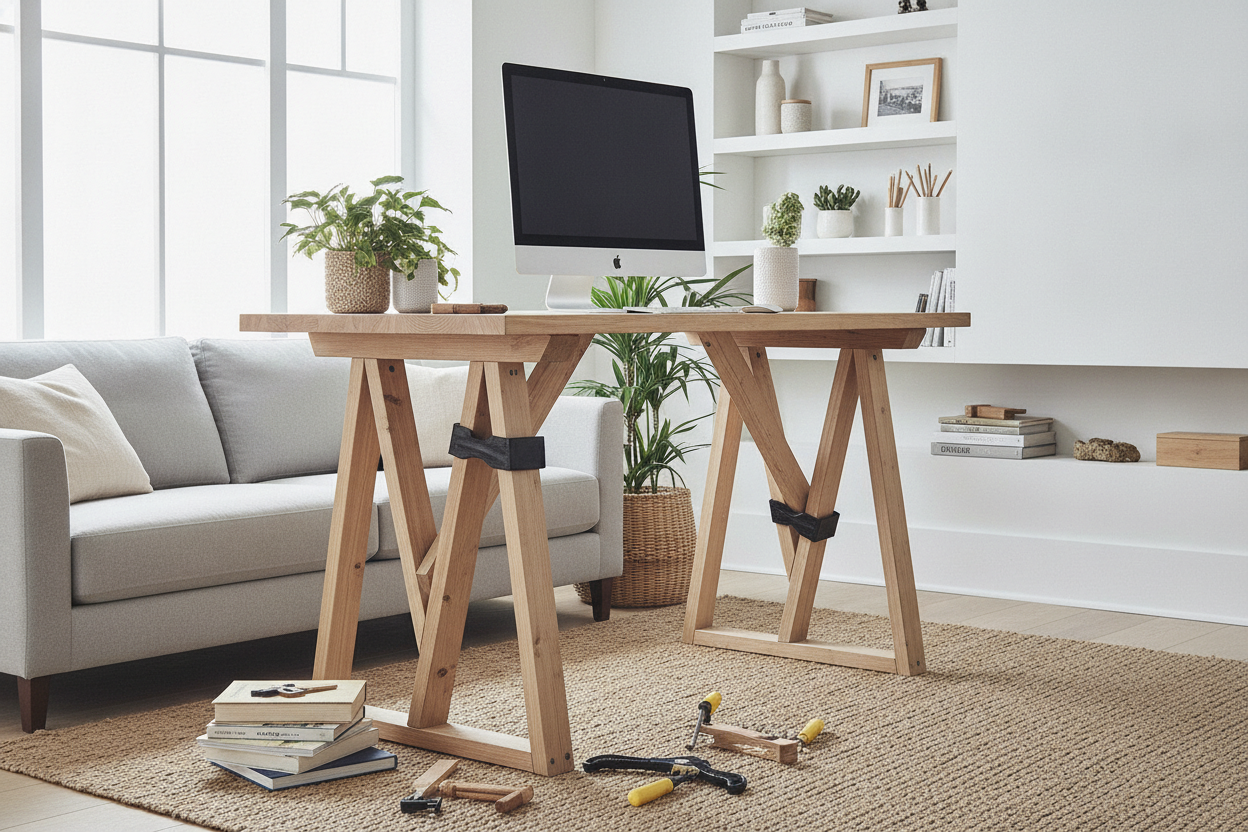
I once spent three hours balancing my 27-inch iMac on a precarious stack of coffee table books and empty Amazon boxes. I wanted to see if I’d actually like standing while I worked. Spoiler: I liked the standing; I hated the constant fear that my hardware was one sneeze away from a floor-shattering death. That’s the gateway drug to diy standing desks.
We all start with the same fantasy. We see a gorgeous live-edge slab on Pinterest and think, 'I can build that.' Then we see the price of high-end motorized frames and think, 'I can engineer that for half the price.' I’m here to tell you that unless you have a degree in mechanical engineering and a lot of patience for linear actuators, you probably can't—at least not if you want to make your own standing desk that actually stays level.
- Engineering a custom lift mechanism from scratch is a recipe for a 3-inch wobble.
- The 'Hybrid Build' (pro frame + custom top) gives you the best of both worlds.
- Butcher block is the DIYer's best friend for a sturdy, warp-free surface.
- If your desk is hard to adjust, you will eventually just leave it in one position forever.
The Allure of the 100% Homemade Standing Desk
There’s something incredibly satisfying about the idea of a 100% do it yourself stand up desk. You imagine black iron pipes, reclaimed barn wood, and maybe a clever pulley system that makes you look like a Victorian inventor. It’s a great aesthetic for a static photo, but a nightmare for a Tuesday afternoon Zoom call where your camera shakes every time you hit the 'Enter' key.
Most people searching for stand up desk ideas end up looking at fixed-height builds or a diy desktop standing desk that sits on top of an existing table. While a diy standing table made of 2x4s is sturdy, it locks you into one posture. After four hours of standing, your lower back will be screaming for a chair. That’s when the sit stand desk diy dream hits a wall: how do you make it move without it falling apart?
Why Engineering Your Own Mechanism is a Trap
Trying to build standing desk components like a diy desk lift using car jacks or threaded rods is a hobby, not a productivity solution. The physics are brutal. When you extend a desk to 45 inches, every millimeter of play in your joints is magnified. A tiny gap in a wooden sleeve becomes a two-inch sway at the top. I once tried to build a diy adjustable stand using a hand-cranked system from an old drafting table; it worked for a week before the gears stripped under the weight of my monitors.
I’ve seen dozens of stand up desk plans that involve complex counterweights or manual cranks. They almost always jam. If your setup is clunky, you’ll stop using it. I’ve found that if you don't have a smooth stand up desk automatic, you’ll likely stay seated 95% of the time because the effort to transition is just too high. When you're making standing desk history in your garage, don't let your ego get in the way of a functional motor.
The Hybrid Approach: Buy the Legs, Build the Top
The actual secret to how to create a standing desk that doesn't feel like a middle school science project is to outsource the heavy lifting. You want a commercial-grade standing desk mechanism diy enthusiasts can actually trust. By purchasing a motorized base, you ensure the safety of your gear and the stability of your surface. This is how to build your own standing desk without losing your mind.
I highly recommend starting with a sit stand up desk with memory preset controller as your foundation. You get the dual motors and the stability crossbars that are nearly impossible to replicate with plans for stand up desk wood frames alone. This allows you to focus your diy wood standing desk energy on what actually matters: the part you touch and look at every day. It's the best way to make your own adjustable standing desk while keeping the 'pro' feel.
Picking the Right Wood for Your Custom Desktop
Once you have the frame, you need to build your own adjustable standing desk top. This is where you get to be creative. A 1.5-inch thick birch or walnut butcher block is the gold standard here. It’s heavy enough to dampen vibrations and won't warp like a single wide slab of pine might. If you are following wood standing desk plans, remember that the top needs to be rigid enough to support its own weight across the frame's span.
When you're making standing desk tops, you aren't limited to the 48x24 dimensions of a standard writing computer desk. You can go 72 inches wide or 30 inches deep if you have the space. Just ensure your stand up desk plans wood choice includes a finish that can handle a sweaty coffee mug—three coats of water-based polyurethane usually does the trick and keeps the diy standing computer desk looking fresh for years.
Is the Hybrid Build Actually Cheaper?
Let’s talk numbers. A high-end motorized frame might run you $250-$400. A solid wood top can be $100 for unfinished birch or $500 for a custom walnut slab. You’re looking at $350 to $900 total. Compared to a budget standing motorized desk from a big-box store, you might actually spend more on the hybrid version. But you're getting a standing desk blueprint that actually lasts.
However, the difference in quality is massive. A cheap all-in-one desk often uses particle board that crumbles within two years or a motor that sounds like a dying blender. Your diy sit and stand desk uses real timber and a motor that can actually lift a triple-monitor setup without groaning. How to build a stand up desk is as much about longevity as it is about the initial build. You aren't just saving money; you're building a piece of furniture that outlives your current laptop.
How do I stop my DIY desk from wobbling?
Weight is your friend. A heavier desktop lowers the center of gravity. Also, make sure all your bolts on the metal frame are tightened with a socket wrench, not just the flimsy Allen key that came in the box. If you're how to make a stand up desk sturdy, check your floor leveling feet too.
Can I use a solid core door as a desktop?
Yes, and it’s a classic hack for a diy desk stand. They are heavy, flat, and cheap. Just make sure it’s a 'solid core' and not a 'hollow core' door, or your monitor mount will eventually crush through the surface like a foot through thin ice.
What’s the best height for a standing desk?
Your elbows should be at a 90-degree angle when typing. For most people, that’s somewhere between 40 and 45 inches. This is why an adjustable frame is better than a fixed standing desk plan; you can't always predict exactly where your 'perfect' height will land until you're actually working.

Laisser un commentaire
Ce site est protégé par hCaptcha, et la Politique de confidentialité et les Conditions de service de hCaptcha s’appliquent.