


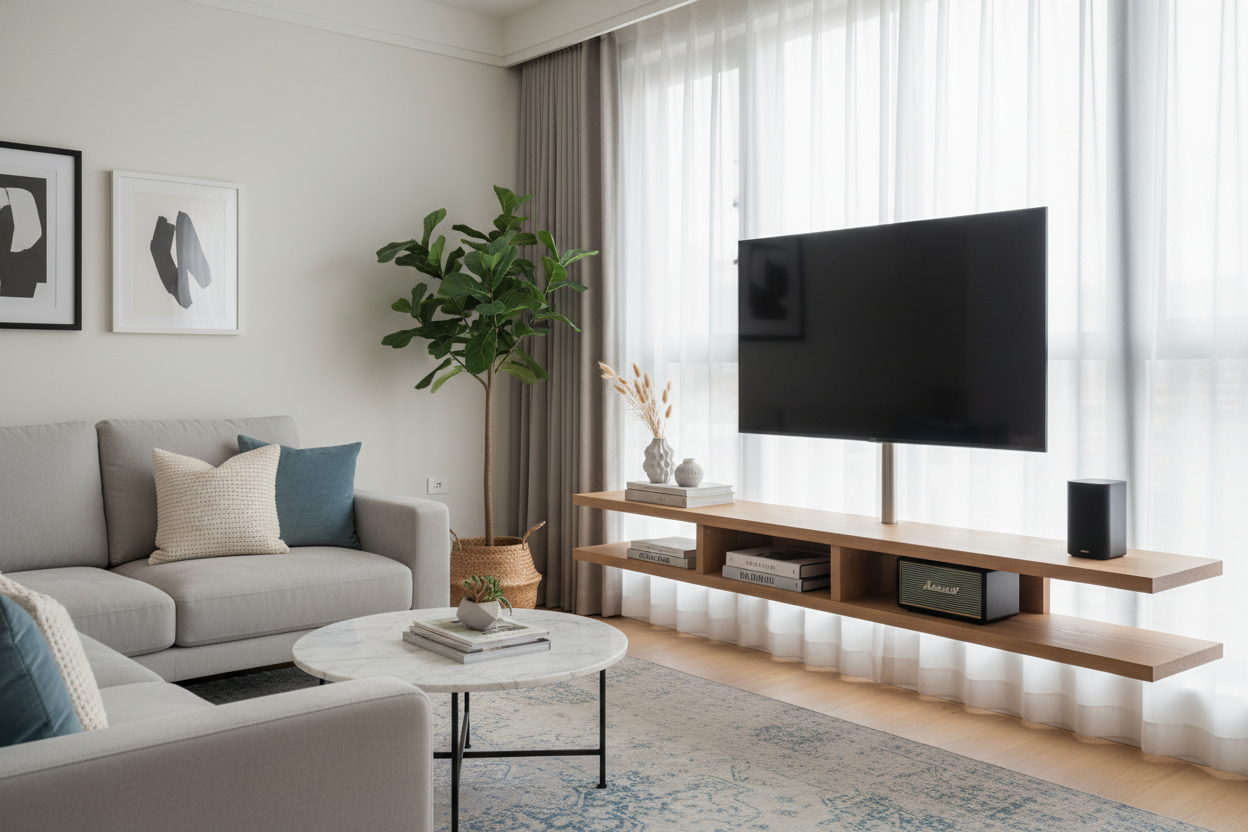
J'avais l'habitude de poser ma télévision de 55 pouces sur une console bon marché et basse que j'avais achetée en catastrophe lors de mon emménagement. Chaque fois que j'entrais dans mon salon, j'avais l'impression que la télévision dévorait littéralement le mur. Ce n'était pas seulement la taille de l'écran ; c'était le chaos absolu des câbles HDMI, les moutons de poussière s'accumulant derrière le boîtier et l'absence totale de hauteur visuelle. Mes yeux étaient toujours attirés vers le sol, ce qui est un excellent moyen de rendre un petit appartement encore plus exigu.
Après six mois passés à fixer ce cimetière technologique, j'ai réalisé que le problème n'était pas la télévision, mais le meuble. J'avais besoin de quelque chose qui utilise l'espace vertical de mon mur sans avoir à percer d'énormes trous dans le placoplâtre (mon propriétaire est particulièrement sensible à sa caution). C'est alors que j'ai décidé de me tourner vers un meuble TV avec support et étagères, et honnêtement, je ne reviendrai jamais à une commode standard.
- Verticalité : attire le regard vers le haut, donnant l'impression que les plafonds sont plus hauts.
- Aucun dommage mural : parfait pour les locataires qui veulent un look "mural" sans percer.
- Gestion des câbles : les colonnes intégrées cachent instantanément le "spaghetti" de fils.
- Espace d'exposition : les étagères permettent une décoration personnalisée juste à côté de la technologie.
Le dilemme du "mur vide" que j'essayais de résoudre
Le problème de la plupart des salons est l'effet "trou noir". Vous avez ce rectangle massif et sombre qui domine la pièce lorsqu'il est éteint. Lorsque vous placez cet écran sur un meuble TV plat standard avec support, vous avez enfin la possibilité de briser ce poids visuel. Dans mon ancienne installation, le mur au-dessus de la télévision était juste... vide. Il semblait inachevé, mais accrocher de l'art autour d'une télévision est une compétence spécialisée que je n'ai clairement pas maîtrisée.
Je voulais un meuble qui ressemble plus à une bibliothèque intégrée qu'à un équipement technologique. J'avais besoin de rangement pour ma collection croissante de livres de design et d'un endroit pour mettre mes plantes où elles recevraient réellement de la lumière. Une unité verticale fournit ce cadre. Au lieu d'un lourd bloc de bois posé sur la moquette, vous obtenez une structure élégante et élancée qui équilibre l'écran. Elle transforme la télévision d'un point focal unique en une partie d'un ensemble mural plus grand et plus intéressant.
En choisissant une unité avec des étagères intégrées, j'ai pu superposer différentes textures – des vases en céramique, des livres reliés en cuir et du lierre grimpant – ce qui a adouci les lignes dures de la télévision. J'ai enfin eu l'impression d'avoir un espace de vie organisé plutôt qu'une chambre d'étudiant centrée autour d'une console de jeux.
Pourquoi une crédence basique ne suffisait plus
Les armoires multimédias standard conviennent si vous vivez dans une vaste maison de banlieue de 2500 pieds carrés. Mais dans un appartement en ville, l'espace au sol est la chose la plus chère que vous possédiez. J'ai passé trois nuits à parcourir toutes les collections de meubles TV que j'ai pu trouver, mais elles avaient toutes le même problème : elles étaient trop profondes et trop basses. Elles occupaient 20 pouces de profondeur au sol mais n'offraient aucune possibilité de stylisme vertical.
Les consoles traditionnelles ont également la fâcheuse habitude de devenir des « aimants à désordre ». Parce que la surface supérieure est plate et large, elle finit inévitablement recouverte de courrier, de clés, de tasses à café à moitié vides et de télécommandes. En passant à un système de montage, vous récupérez cette surface supérieure pour une décoration intentionnelle. Vous ne vous contentez pas de placer un téléviseur sur une boîte ; vous encadrez votre espace de divertissement. La verticalité vous oblige à être plus intentionnel sur ce que vous exposez, et l'encombrement réduit permet à toute la pièce de respirer.
Voici la solution tout-en-un (mon avis honnête)
J'ai finalement opté pour un meuble TV mural en bois avec des étagères en chêne foncé et une colonne de support noir mat. La différence a été immédiate. Contrairement à un meuble TV moderne du milieu du siècle encombrant qui peut paraître magnifique mais reste près du sol, cette unité verticale avait une allure architecturale. On aurait dit que j'avais engagé un charpentier pour installer des étagères sur mesure, même si cela ne m'a pris qu'environ 45 minutes pour l'assembler un mardi soir.
La finition en bois a apporté une chaleur à la pièce que mon ancien meuble en métal et verre n'avait pas. C'est une erreur courante de tout miser sur la technologie pour son mobilier TV, mais l'utilisation de matériaux naturels comme le bois aide à ancrer l'électronique. Les étagères sont suffisamment solides pour supporter mes lourds livres de table basse sans plier — ce qu'il faut surveiller avec les unités en MDF moins chères. Un inconvénient ? Il faut être attentif à la répartition du poids. J'ai mis mes livres les plus lourds sur l'étagère du bas pour maintenir le centre de gravité bas, juste au cas où mon chat déciderait d'utiliser l'unité comme mur d'escalade personnel.
Comment fonctionne réellement le support intégré
Si vous êtes nerveux à l'idée d'accrocher un téléviseur OLED de plusieurs milliers de dollars sur un meuble, je comprends. Je l'étais aussi. Mais un meuble TV avec support intégré est étonnamment sur-conçu. Le système de support s'accroche généralement à un rail en acier robuste, sécurisé par des boulons de sécurité. C'est la même technologie que celle utilisée pour les supports muraux, simplement fixée à une base de meuble lestée au lieu de vos montants muraux.
J'ai déjà écrit à propos de la façon dont j'ai utilisé un meuble TV avec support parce que mes montants muraux m'ont trahi, et la stabilité de ces unités n'est pas une blague. La plupart sont évaluées pour plus de 45 kg, ce qui est le double du poids de la plupart des écrans plats modernes. Le meilleur ? Vous pouvez généralement faire pivoter le support. Je peux maintenant orienter l'écran vers la cuisine lorsque je cuisine, puis le faire pivoter pour une soirée cinéma. Vous ne pouvez pas faire ça avec un téléviseur posé sur ses propres pieds.
Styliser les étagères sans les surcharger
La clé pour que le combo meuble TV et support ait l'air haut de gamme est la retenue. Ne remplissez pas chaque centimètre carré. Je suis la « règle de trois » : regrouper les objets par trois de hauteurs différentes. Sur une étagère, j'ai un grand vase, une bougie de taille moyenne et un petit bol décoratif en laiton. Cela crée un « triangle » visuel agréable à l'œil.
Utilisez les étagères inférieures pour les « laides » choses. J'utilise des paniers en jonc de mer tressés pour cacher mon routeur, les manettes de PlayStation et un fouillis de câbles de chargement. Depuis le canapé, tout ce que vous voyez est une texture nette et organique. Sur les étagères à hauteur des yeux, gardez l'espace aéré. Quelques livres préférés empilés horizontalement peuvent servir de piédestal pour une petite succulente. L'objectif est de faire en sorte que la télévision ressemble à un choix intentionnel dans une pièce décorée, et non seulement à un appareil que vous n'avez pas encore réussi à cacher.
Les avantages surprenants de cette installation verticale
Une chose à laquelle je ne m'attendais pas, c'est l'effet « flottant ». Comme j'ai choisi un meuble TV noir avec support, la colonne de support disparaît pratiquement dans l'ombre du mur. Cela crée un look incroyablement épuré où la télévision semble flotter dans les airs. C'est une amélioration majeure par rapport aux pieds en plastique encombrants qui accompagnent la plupart des écrans.
Ensuite, il y a l'ergonomie. La plupart des gens ont leur téléviseur bien trop bas. En utilisant un support, j'ai pu placer l'écran à mon niveau des yeux. Fini les douleurs au cou après un marathon Netflix de trois heures. Cela semble être un détail, mais une fois que vous avez votre écran à la bonne hauteur, vous réalisez à quel point vous vous avachissiez auparavant. C'est un changement total dans la façon dont vous vivez votre salon.
Devriez-vous faire le changement ?
Si vous êtes locataire, un meuble TV à écran plat avec étagères est une évidence. Vous obtenez l'esthétique d'un téléviseur mural sans le casse-tête du « patch et peinture » lorsque vous déménagez. C'est aussi le choix ultime pour toute personne vivant dans un studio ou un petit appartement d'une chambre où chaque mètre carré d'espace au sol est un luxe.
Cependant, si vous avez un écran de cinéma massif de 85 pouces, vous voudrez peut-être vous en tenir à une console basse et robuste ou à un support mural professionnel. Mais pour un écran moyen de 55 à 65 pouces, l'ensemble vertical tout-en-un est l'échange de meubles le plus intelligent que j'aie fait depuis des années. Il a résolu mon problème de câbles, m'a donné un endroit pour mes plantes et a finalement donné à mon salon l'impression d'être un espace adulte.
FAQ
Est-il difficile d'assembler un meuble TV avec support ?
Pas vraiment, mais c'est un travail à deux personnes lorsqu'il s'agit de soulever le téléviseur et de le poser sur le support. Le reste n'est qu'un travail de base avec une clé Allen. Si vous pouvez monter une bibliothèque IKEA, vous pouvez le faire.
Va-t-il basculer si j'ai des enfants ou des animaux ?
La plupart des unités sont livrées avec un kit anti-basculement qui ancre l'arrière du meuble au mur. Même sans cela, elles sont conçues avec une base lourde et large pour être incroyablement stables. Gardez simplement les objets lourds sur les étagères inférieures.
Puis-je cacher tous mes fils dans le meuble ?
Oui ! C'est le principal argument de vente. Le pilier central est généralement creux ou dispose de clips à l'arrière spécialement conçus pour acheminer vos câbles d'alimentation et HDMI vers la prise cachée derrière la base.

Laisser un commentaire
Ce site est protégé par hCaptcha, et la Politique de confidentialité et les Conditions de service de hCaptcha s’appliquent.