


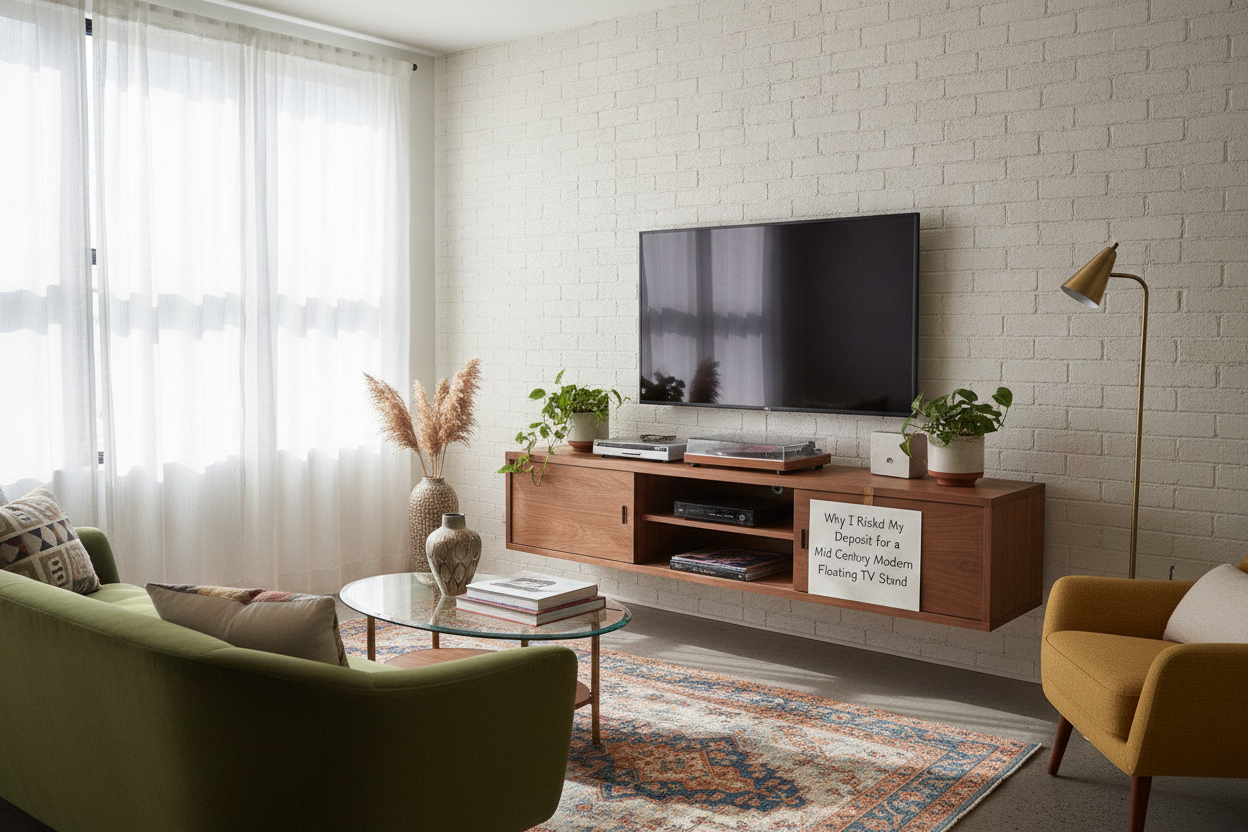
I spent three hours staring at my living room wall with a stud finder in one hand and a level in the other, sweating through my t-shirt. I had just unboxed a heavy, walnut-veneered mid century modern floating tv stand, and all I could hear was the imaginary sound of forty pounds of furniture ripping through my landlord’s questionable drywall. It felt like a high-stakes gamble with my security deposit.
- Studs are non-negotiable; never mount a heavy console into just drywall.
- Walnut and oak finishes bring warmth that glossy modern units lack.
- Cable management determines whether the unit looks 'designer' or 'dorm room.'
- Spackling four bolt holes is a small price to pay for the floor space you regain.
The Wall-Mounting Paranoia (And How I Got Over It)
I used to think mounting anything heavier than a picture frame was a death sentence for my lease. But here is what stores won't tell you: most of these units are surprisingly manageable if you understand the physics of your wall. Drywall is basically compressed chalk, but the wooden studs behind it are rock solid. I spent $20 on a decent stud finder and realized I could hit two studs perfectly with a 60-inch console.
If your studs don't line up with the pre-drilled holes, don't panic. I used a combination of lag bolts into the studs and heavy-duty 1/4-inch toggle bolts for the 'floating' ends. A floating tv stand mid century modern style is often built with lightweight MDF cores and thin veneers specifically to keep the weight down, so you aren't actually hanging a solid 200-pound log on your wall. It’s about distributed weight, not brute force.
Why I Chose the Retro Route Over a Basic Box
Most floating units on the market look like sterile, white-gloss boxes that belong in a futuristic dentist's office. I wanted soul. I wanted that 1960s warmth that only comes from tapered lines and rich wood grains. A mid century floating tv stand acts as a bridge between 'modern convenience' and 'lived-in comfort.' It stops the room from feeling like a cold tech cave.
When you compare these to standard floor-resting TV stands, the difference in 'visual weight' is staggering. Traditional stands are dust-bunny magnets that chop your floor plan into smaller pieces. By lifting the unit six inches off the ground, the floor continues all the way to the wall, tricking your brain into thinking the room is much larger than it actually is. It’s the oldest design trick in the book for a reason.
The 'Floating' Illusion Only Works if You Hide the Cords
Nothing kills the vibe of a floating mid century tv stand faster than a black waterfall of HDMI cables and power strips dangling underneath. It looks like your TV is being kept alive by a messy life-support system. To keep the illusion, I bought a $15 paintable cord channel and matched it to my eggshell walls. It’s nearly invisible from the sofa.
I also prioritized finding a unit with slatted doors and cable management. The slats are a lifesaver because they allow infrared signals from my remote to reach the cable box while keeping the actual plastic junk hidden. My router, power strip, and PS5 are all tucked away, leaving only the clean lines of the wood visible. If you can't hide the wires, don't bother floating the stand.
Styling the Space Underneath (Without Cluttering It)
The best part of a mid century modern floating entertainment center is the floor space you win back. In my old setup, my robot vacuum would get stuck in the legs of my media console every single day. Now? It glides right under there like a dream. It’s the ultimate lazy-person hack for keeping a clean house.
For styling, keep it minimal. I tucked a low-profile jute basket under one side for throw blankets and left the rest open. It makes the mid century modern entertainment center feel like a built-in feature of the apartment rather than a piece of furniture I just dragged in from a warehouse. The goal is 'airy,' not 'empty storage space.'
Was the Security Deposit Anxiety Worth It?
Looking back, the two hours of measuring and the mild panic attack were totally worth it. When I eventually move out, I’ll have to spend thirty minutes with a tub of spackle and a putty knife to fill those bolt holes. That’s a tiny price to pay for a living room that feels twice as big and ten times more expensive than it actually is.
How much weight can a floating TV stand actually hold?
If you hit the studs, most can easily support 50 to 75 pounds. Check your specific manufacturer’s rating, but remember that the TV usually sits on top of the stand, adding to the load. If you're mounting the TV separately on the wall above it, the stand only needs to hold your decor and media boxes.
Can I install this on a plaster wall?
Yes, but it's trickier than drywall. You’ll definitely need to find the lath or studs. Avoid using standard plastic anchors; toggle bolts or specialized masonry anchors are your best bet to prevent the plaster from cracking under the pressure.
What is the ideal height for a floating stand?
Most people mount them too high. You want the center of your TV to be at eye level when you are sitting on your sofa. Usually, this means the bottom of your floating stand will be between 8 and 12 inches off the floor.

Laisser un commentaire
Ce site est protégé par hCaptcha, et la Politique de confidentialité et les Conditions de service de hCaptcha s’appliquent.