


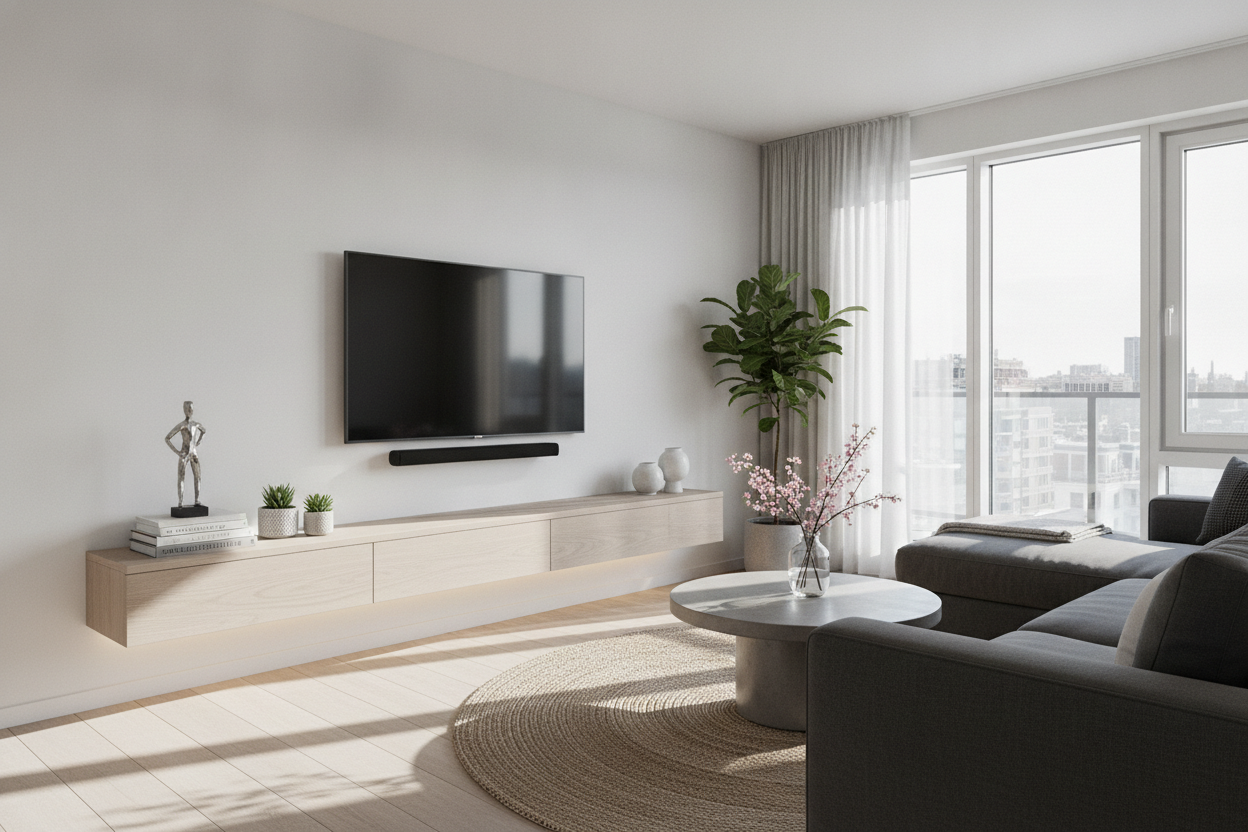
I was staring at my living room, or what was left of it. My 60-inch media console—a heavy beast of MDF and faux-oak—took up nearly three feet of depth in a room that is barely 11 feet wide. Every time I walked past it to get to the window, I had to do a weird sideways shuffle. It was a floor-space thief.
That is when I decided to ditch the bulk for a wall shelf tv stand. I realized I did not need a piece of furniture that weighed 150 pounds just to hold a soundbar and a remote. Moving everything off the floor was the single best decision I have made for my apartment's flow.
Quick Takeaways
- Reclaims significant floor space, making small rooms feel instantly larger.
- Eliminates 'dust bunny traps' by allowing vacuums to reach the baseboards.
- Offers total control over height for better ergonomics.
- Requires minimal DIY skills for cord management and mounting.
The Day I Realized My Console Was Ruining the Room
I spent $400 on my old console thinking I needed 'storage.' In reality, those cabinets just became a graveyard for old HDMI cables and a Wii controller I haven't touched since 2014. It was a black hole for junk. One Tuesday, I stubbed my toe on the corner of the wooden plinth for the tenth time and finally snapped.
The console sat about three inches away from the wall to accommodate plugs, creating a gap that my vacuum couldn't reach. It was a breeding ground for allergens and cat hair. My living room felt like a storage locker with a TV in it rather than a place to actually relax. I needed my floor back.
What Actually Is a Wall Shelf TV Stand?
Do not confuse this with those flimsy floating shelves you buy for $15. A real wall shelf tv stand is engineered to actually hold weight. We are talking about a sleek, horizontal plane—usually made of solid wood or high-density metal—that mounts directly into your wall studs.
Unlike a full-sized wall shelf tv unit that might have bulky side cabinets or a heavy back panel, this setup is all about the profile. It is meant to be slim. Most are only 10 to 12 inches deep, which is plenty for a PlayStation or a soundbar, but narrow enough that it does not intrude on your walking path. It is the minimalist's answer to the media center.
Three Reasons I'm Never Going Back to Floor Consoles
First, there is the visual weight. When you can see the floorboards go all the way to the baseboard, the room feels double the size. It is a literal magic trick for small apartments. My 12x14 living room suddenly felt like it had breathing room.
Second, my robot vacuum can finally do its job. It used to treat my old console like a brick wall. Now, it glides right under the shelf without getting stuck or leaving a ring of dust. It is the cleanest my floors have been in years.
Third, you get to choose your exact height. Most floor consoles are 20-24 inches high, which might be too low if you have a taller sofa. With a wall-mounted setup, you can mount it at the perfect eye level. If your tech needs change, you can even look into Adjustable Shelf Storage options that let you swap heights for a new receiver or a taller plant as your collection grows.
The Cord Hiding Dilemma (And How I Solved It)
Everyone's biggest fear with open shelving is the 'spaghetti' of wires hanging down. I'll be honest: if you just mount a shelf and leave the cords, it looks terrible. But the fix is cheap. I used a paintable cord raceway that cost me less than $20 at the hardware store.
I painted the raceway the exact shade of white as my walls, and it practically disappeared. For the router and the power brick, I used a ceramic vase and a stack of heavy coffee table books on the shelf to block the view. You do not need to be an electrician to make it look professional; you just need a little bit of tactical decor.
Should You Make the Switch?
If you are a renter, check your lease before drilling into studs. But for most of us, a few holes in the drywall are a small price to pay for a room that feels twice as big. This setup is perfect for minimalists who have moved away from physical media and just need a spot for a soundbar and a few small devices.
If you have a massive collection of 4K discs or three different gaming consoles, a single shelf might feel a bit tight. In that case, you might want to read about How I Faked Custom Built-Ins With a Modular TV Wall Shelf Unit to get that floating look with way more storage capacity. For me, the single shelf was the reset my living room desperately needed.
FAQ
Can a wall shelf hold a heavy TV?
Usually, the TV is mounted to the wall separately using a VESA mount; the shelf just holds the accessories. If the TV must sit on the shelf, ensure you are screwed into at least two studs with heavy-duty lag bolts.
Is it hard to move later?
Not at all. It leaves four to six holes that take ten minutes to fill with spackle. It is much easier than hauling a 150-pound dresser down three flights of stairs.
Will my soundbar fit on a 10-inch shelf?
Most soundbars are between 3 and 5 inches deep. A 10-inch or 12-inch shelf provides more than enough room for the bar and the cables behind it.

Laisser un commentaire
Ce site est protégé par hCaptcha, et la Politique de confidentialité et les Conditions de service de hCaptcha s’appliquent.