


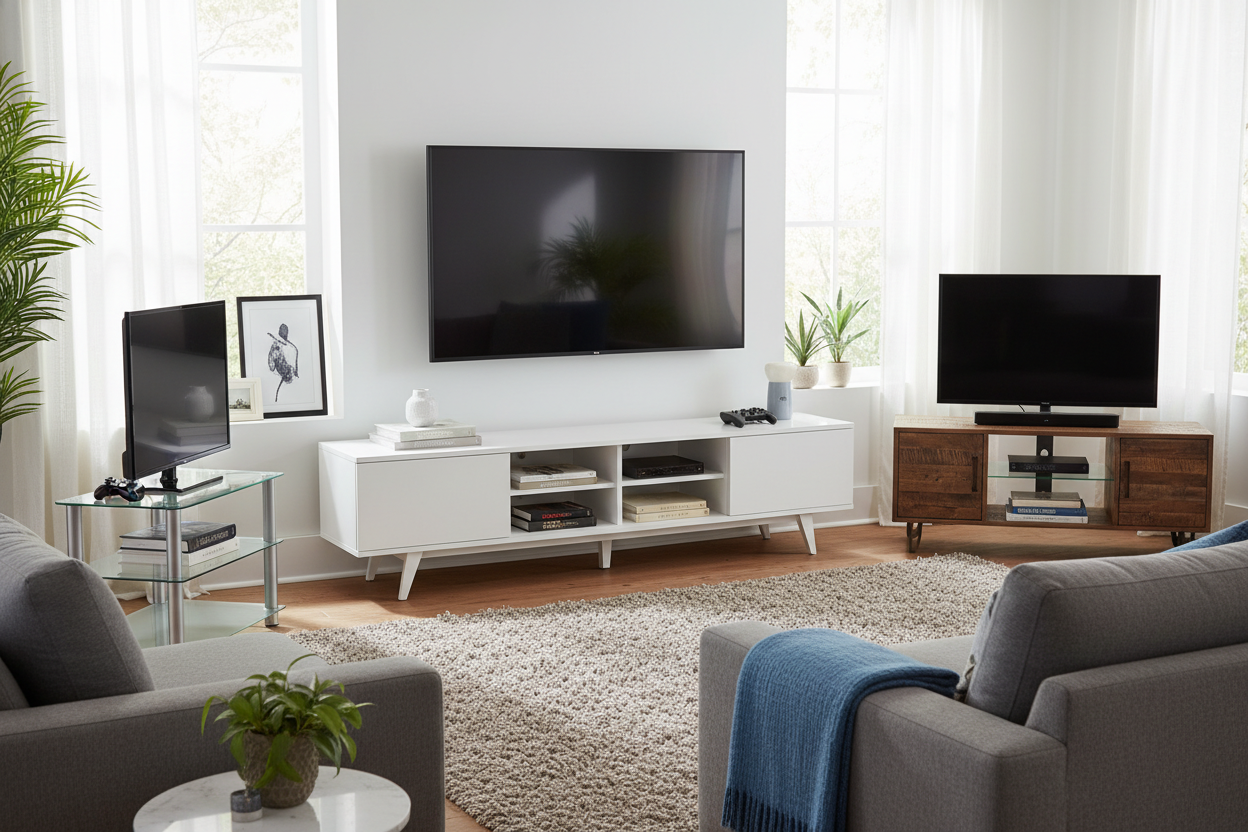
I spent three years as a professional flat-pack assembly tech, which is a fancy way of saying I spent my weekends in strangers' living rooms wrestling with Allen wrenches and cryptic diagrams. I’ve seen tv stands under 200 that looked like a million bucks on the product page but turned into a sad, frowning U-shape within six months of holding a 55-inch screen. It’s a classic budget furniture heartbreak.
The reality is that most affordable media consoles aren't made of solid oak. They are made of MDF or particleboard, which is essentially compressed sawdust. It’s great for your wallet, but it has a memory for gravity. If you don’t have support in the dead center, physics is going to win every single time.
Quick Takeaways
- Never buy a budget stand wider than 48 inches without a fifth center leg.
- Avoid plastic cam locks; they snap under the tension required to keep a heavy console stable.
- Cardboard back panels aren't just for looks—they provide essential lateral stability.
- You can retrofit a sagging stand with an adjustable metal leg for under $15.
The Gravity Problem With Budget Particleboard
MDF is heavy, dense, and surprisingly brittle. When you buy a tv console under 200, you are buying a material that is prone to 'creep'—the slow, permanent deformation of a material under constant stress. Even if your TV only weighs 40 pounds, that weight is concentrated in the center of a long span. Over time, the fibers in the board stretch and settle into a permanent bow.
I’ve seen this happen even with brand names. There are certain IKEA stands that won't bow, but they usually have a vertical divider or a reinforced base. Most cheap entertainment centers under $200 rely on four spindly legs at the corners. It looks airy and modern, but it’s a structural disaster waiting to happen. Once that middle sags just a quarter of an inch, your doors won't close right, and your drawers will start to stick.
Why the Fifth Leg is the Ultimate Litmus Test
When you shop for tv stands, the first thing you should do is scroll to the 'assembly' or 'underside' photos. If you see four legs at the corners and a vast, unsupported wasteland in the middle, keep scrolling. That fifth leg—the center support—is the hallmark of a manufacturer that actually cares about the longevity of their product.
That extra leg acts as a direct line of support from the heaviest part of your setup straight to the floor. It stops the 'frown' before it starts. Even if the leg is tucked back and invisible from the front, it’s doing 80% of the heavy lifting. When I’m browsing for a tv console under 200, I treat that center leg like a seatbelt. Sure, you might be fine without it for a while, but why take the risk?
Other Hardware Red Flags to Watch Out For
Beyond the lack of a center leg, look at the hardware. If the listing mentions 'plastic cam locks,' run away. Cam locks are those little circular pieces you turn with a screwdriver to lock the panels together. Plastic ones strip out the second you apply real pressure. You want zinc or steel hardware that can actually bite into the board.
Another red flag is the 'folding' back panel. Many cheap units use a piece of literal cardboard that you nail into the back. While it feels flimsy, it’s actually there to stop the unit from 'racking' (leaning side to side). If the back panel is held on by just four tiny screws instead of a full perimeter of nails, the whole stand will eventually feel like it’s made of Jell-O.
Can You Just Add Your Own Support Leg?
If you already bought a tv console under $200 and it’s starting to dip, don't panic. You can buy adjustable furniture legs at any big-box hardware store. Look for a heavy-duty metal leg that adjusts from 4 to 8 inches. Flip your stand over, find the dead center, and screw it into the bottom panel. It won't be pretty, but it will save your $500 TV from a $150 mistake.
Styles That Naturally Hide Extra Support
If you hate the look of a center leg, go for a blocky, 'plinth' style base. A high gloss entertainment center often features a solid base that sits flush against the floor. This distributes the weight across the entire footprint of the unit rather than focusing it on four small points. It’s the most stable design you can get for cheap.
When you start looking at tv stands under $250, you'll see more mid-century modern designs with those iconic tapered legs. These are the most dangerous for sagging. If you love that look, just make sure there is a hidden support leg set back an inch or two from the front edge. It’s much better than the structural integrity you get with most tv stands for under $100, which are often just glorified bookshelves turned on their side.
My Personal Assembly Nightmare
I once assembled a 70-inch wide console for a client who refused to use the provided center support because they 'didn't like the silhouette.' Three months later, they called me back because their soundbar was sliding toward the middle of the unit like it was in a half-pipe. The particleboard had bowed so badly the top panel had actually cracked. We ended up having to replace the whole thing. Lesson learned: The engineers put that leg there for a reason.
Frequently Asked Questions
Will a center leg scratch my floors?
Most come with a plastic or felt pad. If yours doesn't, just stick a heavy-duty felt slider on the bottom. Since that leg carries a lot of weight, it’s the most likely one to leave a mark if you slide the furniture.
How much weight can a $200 TV stand actually hold?
Usually between 50 and 75 pounds on the top shelf. If you have an older 'heavy' TV or a massive 75-inch screen, you are pushing the limits of budget MDF. Always check the 'weight capacity' in the specs.
Is metal better than wood for budget stands?
In the under $200 range, a metal frame with wood-look shelves is almost always more stable than an all-wood unit. Metal doesn't 'creep' or bow over time like particleboard does.


Laisser un commentaire
Ce site est protégé par hCaptcha, et la Politique de confidentialité et les Conditions de service de hCaptcha s’appliquent.