


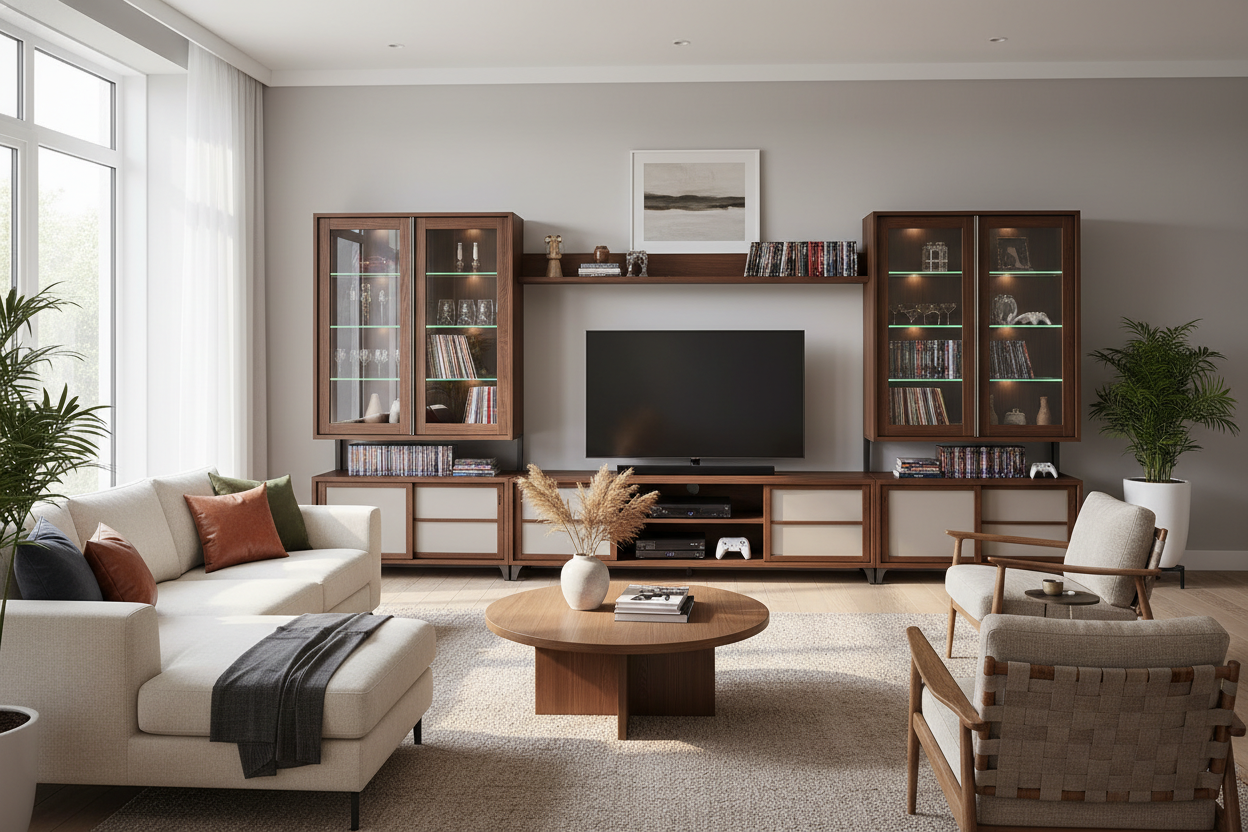
I sat on my living room floor for three months staring at a wall so big it felt like it was mocking me. My 55-inch TV, perched on a standard 60-inch console, looked like a postage stamp stuck to a billboard. It wasn't just empty; it was awkward. The sound echoed, the scale was completely off, and the whole room felt like a temporary staging area rather than a home.
That is when I realized a standalone stand wasn't going to cut it. I needed a 6-piece entertainment center to actually anchor the room and stop the visual bleeding. It felt like a massive commitment—both in floor space and assembly time—but it was the only way to make my open-concept floor plan feel intentional.
Quick Takeaways
- Fills massive walls that make smaller furniture look like dollhouse accessories.
- Provides the look of expensive custom built-ins for a fraction of the price.
- Modular design means you can actually get it through a front door, unlike a 100-inch sofa.
- Offers enough storage to hide everything from gaming consoles to that collection of board games you never play.
The Giant, Echoing Wall Problem
Modern open-concept homes are a blessing for light, but a curse for furniture placement. When you have a 15-foot or 20-foot blank wall, a standard media console looks like a tiny toy stranded in the middle of a desert. It leaves these weird, dead zones on either side that people try to fill with spindly floor lamps or sad-looking silk plants.
I tried the 'gallery wall' approach first, surrounding my TV with framed prints. It just looked cluttered. The real issue was volume. A large wall needs weight. A multi-piece unit provides the verticality and width necessary to draw the eye up and across, effectively 'framing' your living area and making the ceiling height feel like a feature rather than a vacuum.
Wait, What Actually Makes Up a 6-Piece Set?
Before you clear out your living room, you need to understand the footprint. These aren't just 'big stands.' A typical set is a modular puzzle. You usually get a central TV console, two tall side 'pier' cabinets (basically bookshelves), a top bridge that connects the towers, and often an additional shelf or a back panel system.
When you start browsing modular entertainment center collections, pay close attention to the total width. We are talking about units that often span 110 to 130 inches. The beauty of the 6-piece setup is that it creates a cohesive 'wall of furniture.' It’s not just a place for the TV; it’s a library, a display case, and a storage locker all in one.
Why I Chose Modular Over Custom Built-Ins
I actually called a local carpenter to quote me for custom built-in shelving. He laughed—politely—and gave me a 'starting at' price of $7,500, not including paint. Beyond the eye-watering cost, custom work is permanent. If you decide to rearrange the room or move to a new house, that $7k investment stays with the property.
Choosing a modern entertainment center wall unit gave me that high-end, floor-to-ceiling look for about 20% of the cost of a contractor. Plus, it’s flexible. If I move, I can take the pieces with me. If I get bored of the bridge, I can take it down and just use the towers and console. It’s the smart way to get a 'rich' look without the permanent commitment of a construction crew in your house for two weeks.
How to Keep It From Looking Like a 90s Monolith
We all remember those massive, honey-oak entertainment centers from 1994 that took up half the basement. To avoid that 'monolith' vibe, you have to be intentional with styling. Don't jam every shelf full of stuff. Leave breathing room. Use the side towers for curated decor—think heavy ceramic vases, a few stacks of books, or a singular piece of art.
If a full 6-piece unit feels too heavy for your specific lighting, you might look into a 4-piece entertainment center with fireplace. It offers a similar scale but breaks up the visual mass with the glow of the hearth. Also, look for units with open backs or glass shelving; they let the wall color peek through, which prevents the furniture from feeling like it's closing in on you.
The Assembly Reality Check
Let’s be real: when the delivery truck arrives, you are going to see six massive boxes and feel a moment of pure regret. My hallway looked like a Tetris nightmare. The assembly is not necessarily hard, but it is a marathon. You need to pace yourself. Do the console on Friday night, the towers on Saturday morning, and save the bridge for when you have a friend over.
You absolutely need a second person to lift the bridge into place. I tried to DIY it with a ladder and a prayer, and I nearly took out my ceiling fan. Organize your hardware into muffin tins or bowls before you start. Most of these units use cam-locks and dowels, which are easy enough, but after 200 of them, your hands will be cramped. It’s a one-day project that pays off for a decade.
FAQ
Will a 6-piece unit make my room look smaller?
Counter-intuitively, no. One large, cohesive piece of furniture often makes a room look bigger and more organized than five small, mismatched pieces scattered around. It creates a single focal point rather than visual chaos.
How do I know if it will fit my TV?
Always measure the 'TV opening' width, not just the console width. Most 6-piece sets are designed for 65 to 75-inch TVs, but the bridge or side towers can limit you. Give yourself at least 2-3 inches of clearance on each side so the TV doesn't look 'choked.'
Is it hard to move once it is assembled?
Since it is modular, it is actually easier to move than a single large piece. You just remove the bridge, and then you have five manageable cabinets that can be dollied out one by one. Just don't try to slide the whole thing while it's fully connected, or you'll snap the connectors.


Laisser un commentaire
Ce site est protégé par hCaptcha, et la Politique de confidentialité et les Conditions de service de hCaptcha s’appliquent.