


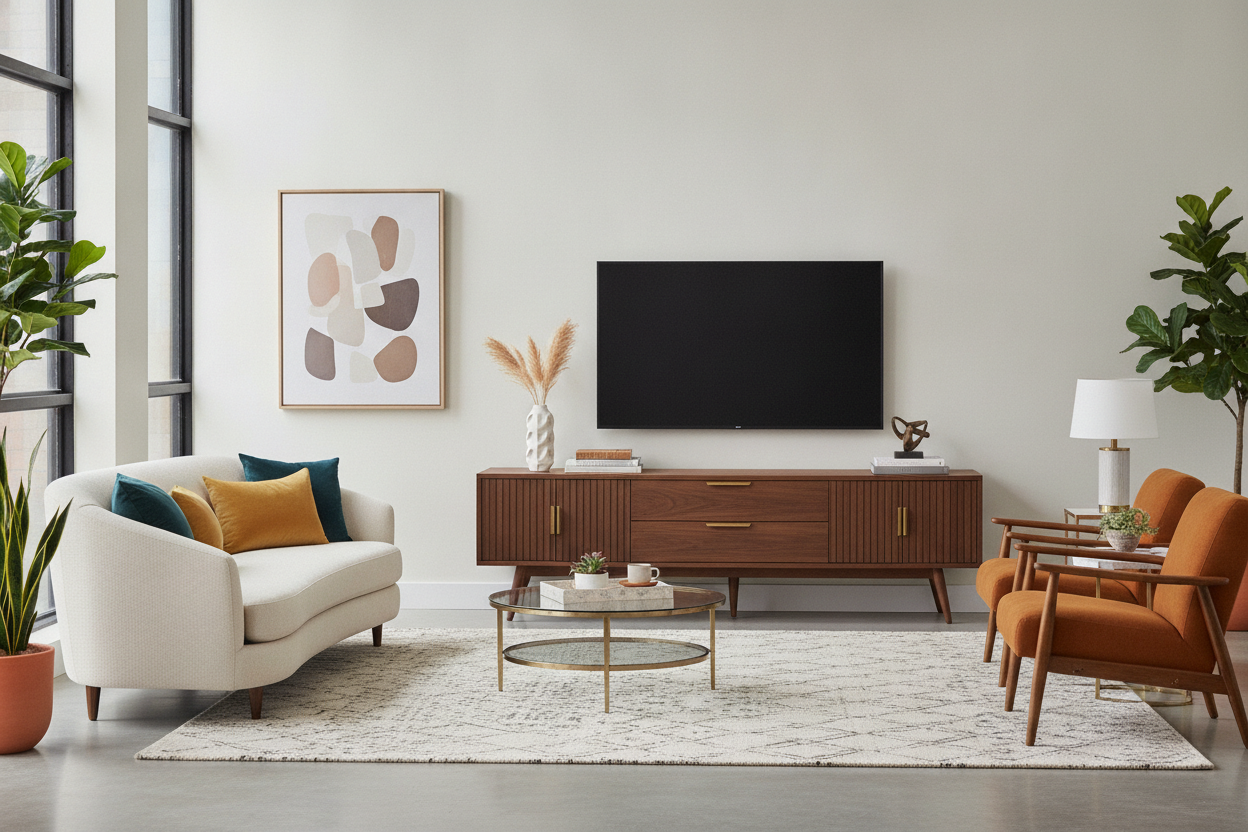
I spent three weeks staring at a 65-inch OLED sitting on a hand-me-down IKEA Lack table that was literally bowing in the middle. It looked like a high-tech spaceship had crash-landed into a 1960s time capsule. I finally bit the bullet on a 70 inch tv stand mid century piece, and it was the first time my living room didn't feel like a college dorm room.
Quick Takeaways
- Your stand should be at least 4-6 inches wider than your TV to avoid a 'top-heavy' look.
- Tapered legs create negative space, making a large piece of furniture feel lighter in a small room.
- Walnut and acorn finishes are the best for warming up the cold, black glass of a modern screen.
- Slatted doors are a lifesaver for hiding consoles while keeping them cool.
The 'Big Screen in a Cute Room' Dilemma
We all want the theater experience, but nobody wants their living room to look like a Best Buy showroom. There is a massive aesthetic clash when you drop a 2024 flat screen onto a piece of furniture that was clearly designed for a 32-inch tube TV. If the proportions are off, the whole room feels tilted. I see it constantly: people buy a beautiful 75-inch screen and then try to squeeze it onto a console that is exactly the same width. It makes the room feel cramped and the TV look like a mistake.
You have to stop making sizing mistakes if you want your space to feel intentional. A 70-inch stand gives you those crucial extra inches on either side of the screen. This creates a visual 'buffer' that grounds the TV. Instead of a floating black rectangle, you get a balanced focal point that actually looks like it belongs in a home, not a sports bar.
Why I Swapped My Bulky Cabinet for a Retro Silhouette
My old media console was a heavy, floor-to-ceiling particle board monstrosity. It blocked the baseboards and made my 12×14 living room feel half its actual size. When I started looking for modern TV stands, I realized that the mid-century silhouette is the ultimate cheat code for renters. Those iconic tapered legs lift the bulk of the unit off the floor, letting light pass underneath. It’s a simple trick of the eye, but it makes the furniture feel like it’s floating.
Switching to a mid-century modern 70 inch tv stand changed the 'visual weight' of my wall. Even though the stand is wider than my old one, the room feels twice as airy. I opted for a piece with a low profile—about 22 inches high. This keeps the TV at eye level when I'm on the sofa, which is a detail most people forget until they’re nursing a neck cramp after a three-hour movie marathon. Don't buy a tall dresser and call it a TV stand; your cervical spine will thank you later.
Nailing the Wood Tone (Without Going Full Brady Bunch)
The danger with mid-century design is accidentally making your home look like a dusty antique shop. You want the warmth of the wood to counter the coldness of the TV, but you don't want 'orange' oak. I spent a lot of time looking at finishes before settling on a deep walnut. It’s rich enough to look expensive but neutral enough to play nice with my grey sofa and jute rug.
If you're worried about the wood looking too 'retro,' look for a modern TV stand with cabinets that features clean, handle-less doors. The lack of hardware keeps the look contemporary. I’ve found that a matte finish is much more forgiving than a high-gloss one. Glossy wood reflects the light from the TV, which is incredibly distracting when you’re trying to watch a dark, moody thriller. A soft, kiln-dried walnut finish absorbs that light and stays in the background where it belongs.
Will a Mid Century Modern 70 Inch TV Stand Actually Hold My Gear?
This is where I get picky. A lot of 'aesthetic' furniture looks great but has zero functionality for a PS5 or a bulky router. I’ve owned stands that had no cable management holes, forcing me to take a hole saw to the back panel myself. It’s a mess. When you’re shopping, you need to look for integrated cord cutouts and enough depth to actually fit your electronics. A standard 15-inch depth is the bare minimum; 18 inches is the sweet spot.
I specifically looked for a unit with slatted doors and open shelves. The slats are a total win because they allow infrared signals from your remote to pass through, and more importantly, they let your gear breathe. I once fried a receiver because I kept it behind solid wood doors with no airflow. It was a $400 mistake I don't plan on repeating. The slatted look hides the ugly blinking lights of your modem while keeping everything at a safe operating temperature.
My 3 Rules for Styling Around a Vintage-Inspired Console
Once the stand is assembled and the TV is centered, the job isn't done. You have this long surface area on either side of the screen that usually ends up covered in mail or loose change. My first rule: use height. I put a tall, trailing Pothos on one end to soften the sharp corner of the TV. The green leaves against the dark walnut wood is a classic combo for a reason.
Second, manage your audio. I hid my ugly soundbar by choosing a stand with an open middle shelf. It keeps the sound clear but removes that plastic-looking bar from my line of sight. Finally, add a touch of brass or matte black in the form of a small tray or a candle. It bridges the gap between the 'old school' wood vibes and the 'new school' tech. It’s all about making the TV feel like one part of a curated vignette rather than the only thing in the room.
FAQ
Should my TV stand be wider than my TV?
Yes, absolutely. A TV stand should be at least 4 to 10 inches wider than the actual width of the TV. This prevents the screen from looking like it’s about to fall off the edges and provides space for speakers or decor.
Is walnut or acorn better for mid-century furniture?
Walnut is typically darker and more formal, while acorn (or teak) has a warmer, more orange-honey tone. If your room gets a lot of natural light, walnut looks incredibly sophisticated. If the room is dark, acorn can help brighten it up.
How do I hide cables on a stand with tapered legs?
Use adhesive cable clips to run the wires down the back of one of the legs. If you have a lot of cables, a simple cable management box tucked behind the stand can keep the 'spider web' off your floor.

Laisser un commentaire
Ce site est protégé par hCaptcha, et la Politique de confidentialité et les Conditions de service de hCaptcha s’appliquent.