


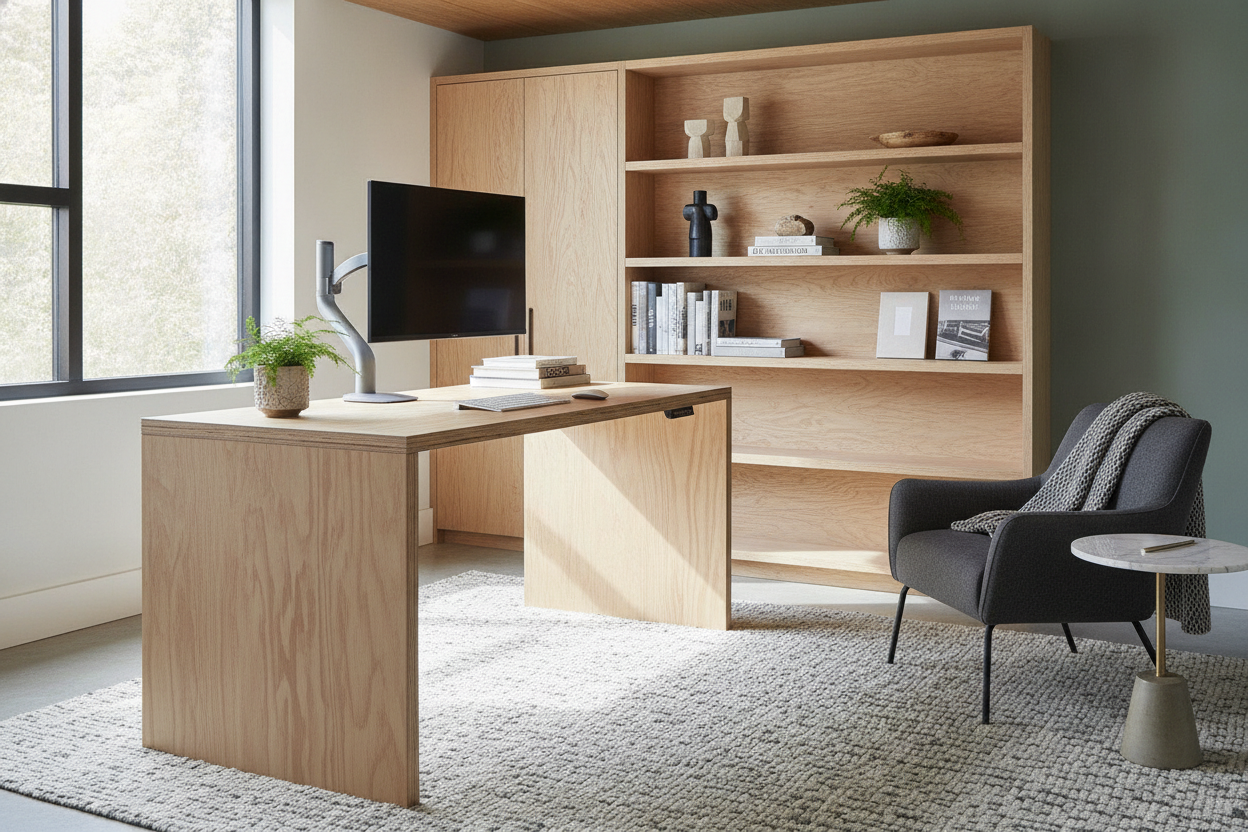
I was sitting at my desk at 2 AM, mindlessly picking at a jagged piece of plastic that used to be the 'wood grain' finish. My favorite cashmere sweater had a fresh snag from the corner, and my wrist was red from the sharp, peeling edge. That was the moment I realized my home office deserved better than a glorified piece of compressed sawdust.
I finally made the jump to a ply standing desk, and honestly, I feel like I’ve been lied to by big-box furniture stores for years. There is a massive difference between a desk that looks good in a rendered photo and one that actually survives the daily grind of a remote career. Transitioning to real wood—even in layered form—completely changed how I feel about my workspace.
- Laminate is a temporary fix; plywood is a long-term investment.
- Baltic birch is structurally superior and won't sag under heavy monitors.
- The exposed 'striped' edge is a legitimate design feature, not a flaw.
- Weight matters: You need a heavy-duty frame to handle a solid ply top.
Confession: I Was Slowly Losing My Mind Over Peeling Laminate
For years, I settled for a standard writing computer desk made of MDF with a thin veneer. It looked fine for the first six months. But then the humidity hit, or maybe I spilled one too many glasses of water, and the edges started to swell. Once that plastic edge banding starts to pull away, it’s over. You can’t glue it back effectively, and it looks cheap.
I spent more time worrying about damaging the surface than actually working. Every time I moved my keyboard, I was terrified of scratching the paper-thin finish. I wanted something that didn't feel like a disposable prop. I wanted material that could handle a little life—and a lot of coffee.
Wait, Isn't Plywood Just Cheap Construction Material?
When I told my partner I was buying a plywood standing desk, they thought I was heading to the local hardware store to buy a splintery sheet of underlayment. Let’s clear this up: there is a world of difference between construction-grade ply and furniture-grade Baltic birch. The stuff you want has 13 or more thin layers of birch pressed together with zero internal voids.
This isn't the hollow-core stuff that feels like a drum when you tap it. Premium ply is incredibly dense and heavy. It’s actually more stable than some solid hardwoods because the alternating grain of the layers prevents it from warping or cupping when the seasons change. It’s the secret weapon of high-end Scandinavian furniture makers for a reason.
The Architectural Appeal of the Exposed Edge
The best part of a ply standing desk isn't the top surface—it’s the side profile. While most desks try to hide their 'insides' with plastic strips, a plywood desk celebrates them. Those clean, horizontal stripes of light and dark wood give the desk an architectural, intentional look that fits perfectly with minimalist or industrial vibes.
I’ve found that this raw aesthetic makes the desk feel less like a piece of office equipment and more like a piece of art. If you're looking for designer ideas for standing desk layouts, you'll notice that the pros often use these exposed edges to break up the monotony of a white-walled room. It adds texture without being cluttered.
The Heavy Reality: Frames That Won't Buckle Under Real Wood
Here is the mistake I almost made: trying to put a heavy plywood standing desk top on a cheap, single-motor frame. A 1-inch thick piece of Baltic birch is significantly heavier than the hollow laminate tops most standing desks ship with. If your frame is flimsy, your desk is going to wobble like a Jenga tower every time you type.
I ended up pairing my top with a heavy-duty base. If you're going big—like a 6-foot setup—you absolutely need something like a 71 w height adjustable standing desk frame. You want dual motors and a high weight capacity. My setup weighs nearly 80 pounds before I even put my dual monitors on it. A cheap frame would have groaned its way to an early grave, but a solid base keeps everything rock-steady even at full height.
The Coffee Spill Test: Living with a Plywood Desk
I am a chronic coffee spiller. My desk usually has at least two mugs and a sparkling water on it at all times. The 'raw' look of plywood can be scary, but as long as it’s finished with a high-quality matte polyurethane, it’s bulletproof. I went with a water-based poly that keeps the wood looking pale and natural but creates a seal that prevents condensation rings.
Maintenance is basically zero. I wipe it down with a damp cloth, and that’s it. Unlike my old laminate desk, if I do manage to get a deep scratch in this, I can actually sand it down and refinish it. You can't do that with plastic. It’s a desk that actually gets better with age rather than slowly disintegrating.
Is plywood better than solid wood?
For a standing desk, often yes. It is more resistant to warping and cracking due to temperature changes, and it offers a more modern, 'striped' aesthetic at a slightly lower price point than solid walnut or oak.
Will the edges of a ply standing desk be sharp?
Not if it's finished correctly. A good maker will 'break' the edges with a router or sandpaper, giving them a slight radius that feels smooth under your forearms while you type.
How do I stop my plywood desk from staining?
You must ensure it has a clear coat of polyurethane or a hard-wax oil like Rubio Monocoat. Never leave a plywood standing desk completely unfinished, or it will soak up oils from your skin and ink from your pens instantly.


Laisser un commentaire
Ce site est protégé par hCaptcha, et la Politique de confidentialité et les Conditions de service de hCaptcha s’appliquent.