


I remember the night I finally upgraded to a 65-inch 4K OLED. I spent three hours unboxing it, only to realize my vintage mid-century credenza—the one I spent six months hunting for—made the whole setup look like a giraffe standing on a footstool. The TV was wider than the furniture, and the screen sat so low I felt like I was watching a movie from a basement window.
The truth is, tv stand furniture design hasn't really kept pace with how fast our screens have evolved. We went from heavy, deep boxes to paper-thin glass sheets in a decade, but most furniture still feels like it was built for a 2005 plasma. If you're tired of staring at a living room that feels 'off,' you aren't alone.
Quick Takeaways
- Your stand should always be at least 6 to 10 inches wider than the actual TV frame.
- Closed storage is the only way to hide the 'tech clutter' of routers and cables.
- Eye level is key—the middle of the screen should align with your seated gaze.
- Massive TVs on narrow stands are a major tipping hazard and a visual disaster.
The Day Our TVs Outgrew Our Living Rooms
About ten years ago, the 'big TV' was 42 inches. It lived in a bulky armoire or a deep corner unit. Today, a 65-inch is considered standard, and 85-inch monsters are becoming common. But while screens got wider, they also got thinner. This created a massive problem for manufacturers who were used to building deep, heavy cabinets.
Most furniture designers are still stuck in the past, creating pieces that are too deep for modern living rooms. When you put a two-inch-thick screen on a 22-inch-deep console, you lose nearly two feet of floor space to nothing but empty wood and dust bunnies. It makes small apartments feel cramped and large rooms feel disjointed.
Why Standard Proportions Look Ridiculous Now
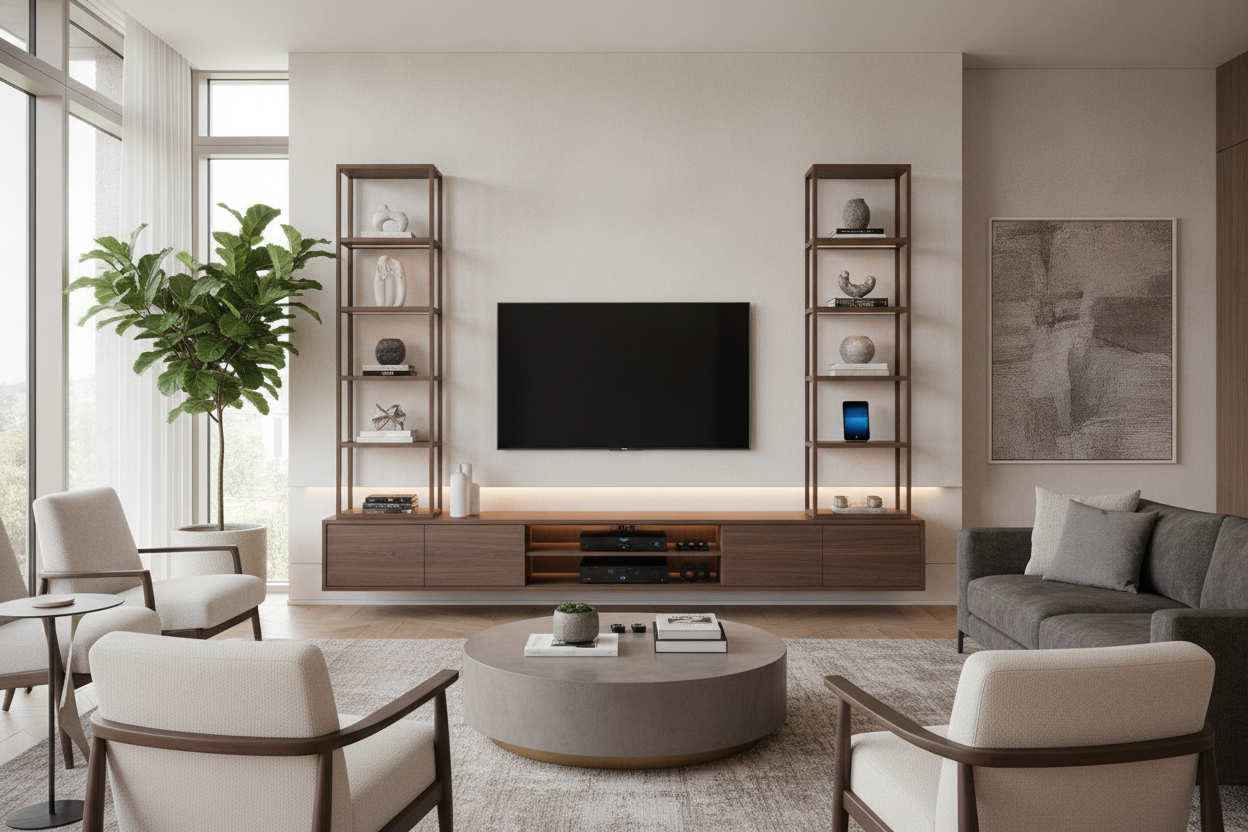
The visual 'weight' of a room depends on balance. When your TV is wider than the furniture it sits on, it creates a top-heavy look that screams 'I bought this at a big-box store without measuring.' Proper furniture design for tv requires the base to be the anchor. You need that horizontal runway on either side of the screen to give your eyes a place to rest.
Ideally, you want a 3:2 ratio where the stand is significantly longer than the screen. This allows you to place a lamp or a small plant on the ends, blending the tech into your actual decor rather than letting the black rectangle swallow the wall. If the stand is too deep, the TV sits too far forward, making the screen feel aggressive and the furniture feel like an obstacle.
Closed Storage Is Non-Negotiable for Ugly Tech
I will die on this hill: open shelving is the enemy of a peaceful home. Unless you enjoy looking at the blinking blue lights of a router, the tangled nest of HDMI cables, and the matte plastic of a gaming console, you need doors. Good tv design furniture should treat the 'brains' of your entertainment system like a secret.
I personally look for a modern TV stand with cabinets because it allows you to shove all that plastic nonsense behind a solid panel. Just make sure there is some ventilation in the back—I’ve fried a cheap receiver before because I tucked it into a cabinet with zero airflow. Don't make my $400 mistake.
A Sneaky Fix if Your Current Console Is Just Too Low
If you already have a piece of furniture you love, like a low-profile bench or a vintage sideboard, but your new TV makes you feel like you’re slouching to see the screen, don't panic. You don't necessarily have to start over. You can get a TV stand riser to add those crucial few inches of height.
This is a lifesaver for people who want to keep their aesthetic but need to save their neck from strain. It also creates a little 'nook' underneath the TV where you can slide a soundbar or a slim media player, keeping the top of your console looking clean and intentional rather than cluttered.
How to Shop for the Right Specs (Without Losing Your Mind)
Before you hit 'buy' on that 47th browser tab, check the weight capacity. I once saw a cheap particle-board stand bow in the middle after just two weeks under a heavy 75-inch screen. Look for kiln-dried hardwoods or reinforced steel frames. A stylish black TV stand is a great 'safe' bet because it mimics the bezel of the TV, making the whole unit feel like one cohesive piece of tech-integrated furniture.
Measure your TV diagonally, but measure your stand horizontally. A '65-inch TV' is actually about 57 inches wide. That means you need a stand that is at least 65-70 inches long to look right. If you’re ready to stop guessing, browse TV stands that explicitly list their width and weight limits so you don't end up with a sagging center or a lopsided layout.
Frequently Asked Questions
Should my TV stand be wider than my TV?
Yes, always. A stand that is narrower than the TV looks unstable and cheap. Aim for at least 3-5 inches of clearance on each side of the screen.
What is the best height for a media console?
Most people buy stands that are too high. For a standard sofa, look for a console between 20 and 24 inches tall. Your neck will thank you.
Do I really need cord management?
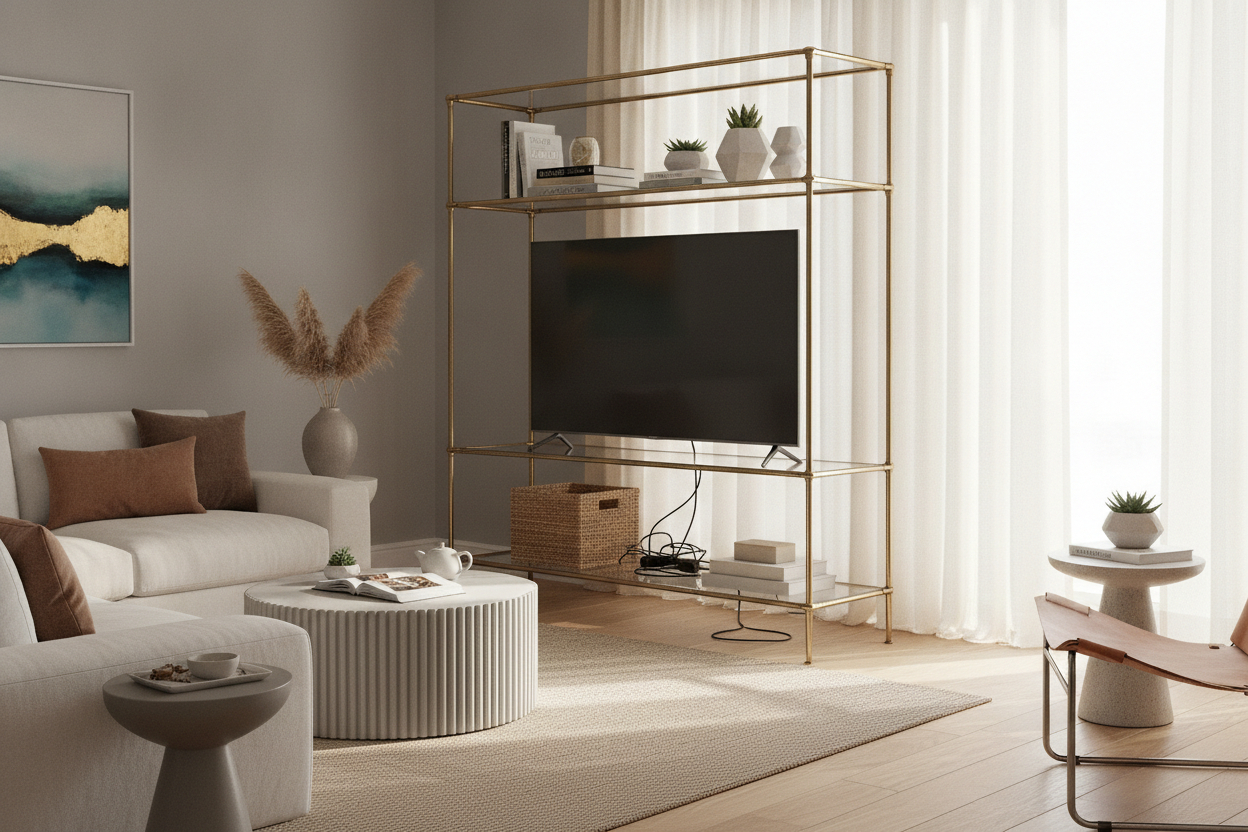
If you don't want your living room to look like a server room, yes. Look for pre-drilled holes or 'scalloped' backs that let you run wires down the center without pinching them against the wall.

Laisser un commentaire
Ce site est protégé par hCaptcha, et la Politique de confidentialité et les Conditions de service de hCaptcha s’appliquent.