


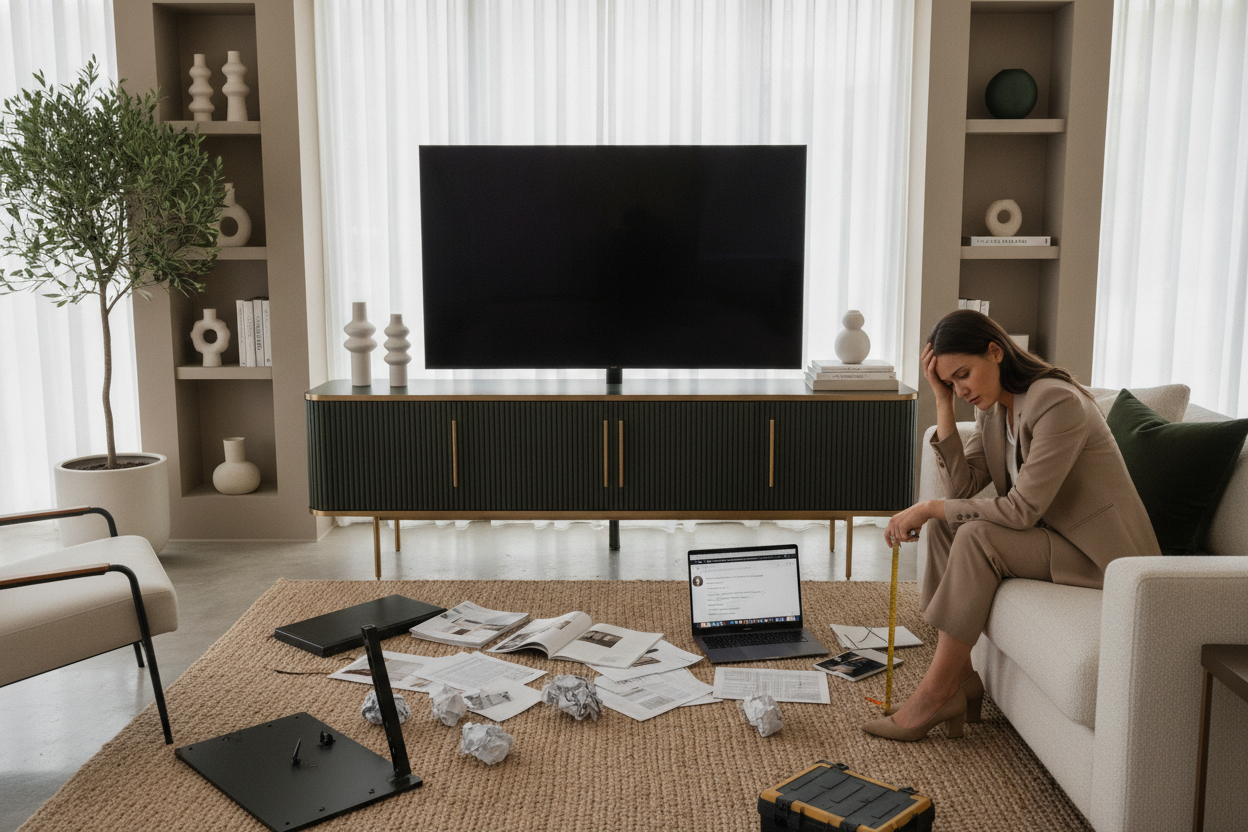
I remember the day my 65-inch OLED arrived. I spent forty-five minutes carefully unboxing it, terrified I’d crack the screen, only to realize my existing mid-century console looked like a dollhouse accessory underneath it. The TV hung off the edges by two inches on each side, making the whole room feel like a temporary dorm setup rather than a grown-up living room. Finding the best 65 inch tv stand isn't just about weight capacity; it's about preventing your home from looking like the back wall of a Best Buy.
- Width is King: Your stand should be at least 5-10 inches wider than the actual TV frame.
- Support Legs: Look for a fifth 'center' leg to prevent the dreaded middle-sag.
- Depth Matters: 65-inch stands are often deeper; ensure you have 15-18 inches of clearance.
- Cable Chaos: Prioritize closed-back units with pre-drilled grommets.
The 'Giant Black Box' Dilemma
A 65-inch screen is a massive piece of visual real estate. When it’s off, it’s just a giant black rectangle that sucks the light out of the room. I’ve seen so many people spend three grand on a high-end panel only to set it on a flimsy, $80 particle board shelf that looks like it’s screaming for mercy. The stand is the only thing standing between a cozy, curated living space and a sterile electronics showroom. It needs to have enough visual 'weight' to anchor the screen.
In my experience, if the stand is too leggy or thin, the TV looks like it’s hovering awkwardly. You want something with a bit of bulk—think thick wood veneers or solid frames. I once tried a minimalist glass stand, and it was a disaster. Not only did it show every spec of dust, but the reflection of the TV’s bottom bezel on the glass was distracting every time I watched a movie. You want the furniture to ground the tech, not compete with it for attention.
The Essential Math for the Best Stand for 65 Inch TV Layouts
Here is where most people trip up: a 65-inch TV is not actually 65 inches wide. It’s usually around 57 or 58 inches wide. If you buy a 60-inch stand, you only have an inch of breathing room on either side. It looks cramped and top-heavy. To get the best stand for 65 inch tv setup, you really want a console that is at least 65 to 70 inches wide. This creates a visual 'buffer' that makes the screen look intentional rather than oversized for the room.
Proportions get even trickier when you're dealing with odd room shapes. If you're tucking your setup into a corner, you have to account for the depth of the unit pushing the TV further out into the room. I've seen a rustic corner TV stand for 65 inch TV work wonders in smaller apartments, but you have to be careful. If the wood is too dark or the piece is too tall, it can swallow the entire corner and make the ceiling feel lower than it actually is. Measure twice, buy once—and then measure again just to be safe.
The Flimsy Furniture Warning (Don't Risk Your Screen)
Let’s talk about the 'sag.' Most cheap furniture is made of MDF or honeycomb-filled cardboard. While that might hold a lamp just fine, a 65-inch TV weighs anywhere from 50 to 75 pounds. Over six months, that weight will slowly but surely bow the top of a cheap console. I learned this the hard way when I noticed the cabinet doors on my old media unit wouldn't stay shut. The frame had warped so much that the hinges were no longer aligned. It’s a slow-motion disaster.
If you're looking at a budget TV stand with mount, pay close attention to the weight rating of the bracket and the base. You want a unit that includes a center support leg—that little fifth leg in the middle of the frame is the unsung hero of home theater furniture. Without it, you're basically playing a long-term game of Jenga with your expensive electronics. I always tell my friends: if you can’t stand on the unit yourself without it creaking, don't put your OLED on it.
Desperate Measures: When You Just Want to Hide the Thing
Sometimes, the best 65-inch TV stand is the one that makes the TV disappear entirely. I have a friend who spent a fortune on an original Eames chair and a beautiful rug, and she hated that the room's focal point was a plastic screen. For people like her, the standard console just won't cut it. You need something that camouflages the tech when you're hosting a dinner party or just want to read a book without the temptation of Netflix.
This is where things get fancy. An electric vertical lift TV cabinet is the ultimate power move for design purists. It looks like a high-end sideboard or a buffet, but with the push of a button, the TV emerges from the top. It’s expensive, sure, but it solves the 'giant black box' problem permanently. Plus, there is something undeniably satisfying about watching your TV glide silently back into a cabinet like a Bond villain’s secret computer.
3 Aesthetic Details That Elevate Your Living Room
Once you've got the size and the weight capacity figured out, it's time to look at the details that separate 'furniture' from 'tech accessories.' First, prioritize closed storage. Open shelving is a lie sold to us by people who don't own routers, gaming consoles, or tangled HDMI cables. Unless you want to spend your life dusting your PlayStation, get some doors. Slatted doors are my personal favorite because they allow IR signals from your remote to pass through while keeping the clutter hidden.
Second, look for real wood textures. Even if it’s a high-quality veneer over plywood, the grain adds warmth that balances out the cold, hard glass of the screen. Finally, check the height. A 65-inch TV should be at eye level when you're seated. If your stand is 30 inches tall, you’re going to have a neck ache by the end of the first season of whatever you're bingeing. Aim for a stand height between 18 and 24 inches. If you're ready to stop staring at 47 browser tabs of mediocre options, take a look at this collection of TV stands that actually understand the assignment. Trust me, your living room—and your neck—will thank you.
FAQ
How wide should a stand be for a 65-inch TV?
Your TV is roughly 58 inches wide. You want a stand that is at least 65 inches wide to avoid looking top-heavy. A 70-inch stand is the sweet spot for a balanced look.
Can I put a 65-inch TV on a 55-inch stand?
Physically? Maybe, if the legs are centered. Visually? No. The overhang looks precarious and cheap. It’s a major design faux pas that makes the room feel cramped.
What is the best height for a TV stand?
For a 65-inch screen, look for a stand that is 20 to 24 inches high. This keeps the center of the screen at eye level when you're sitting on a standard sofa.

Laisser un commentaire
Ce site est protégé par hCaptcha, et la Politique de confidentialité et les Conditions de service de hCaptcha s’appliquent.