


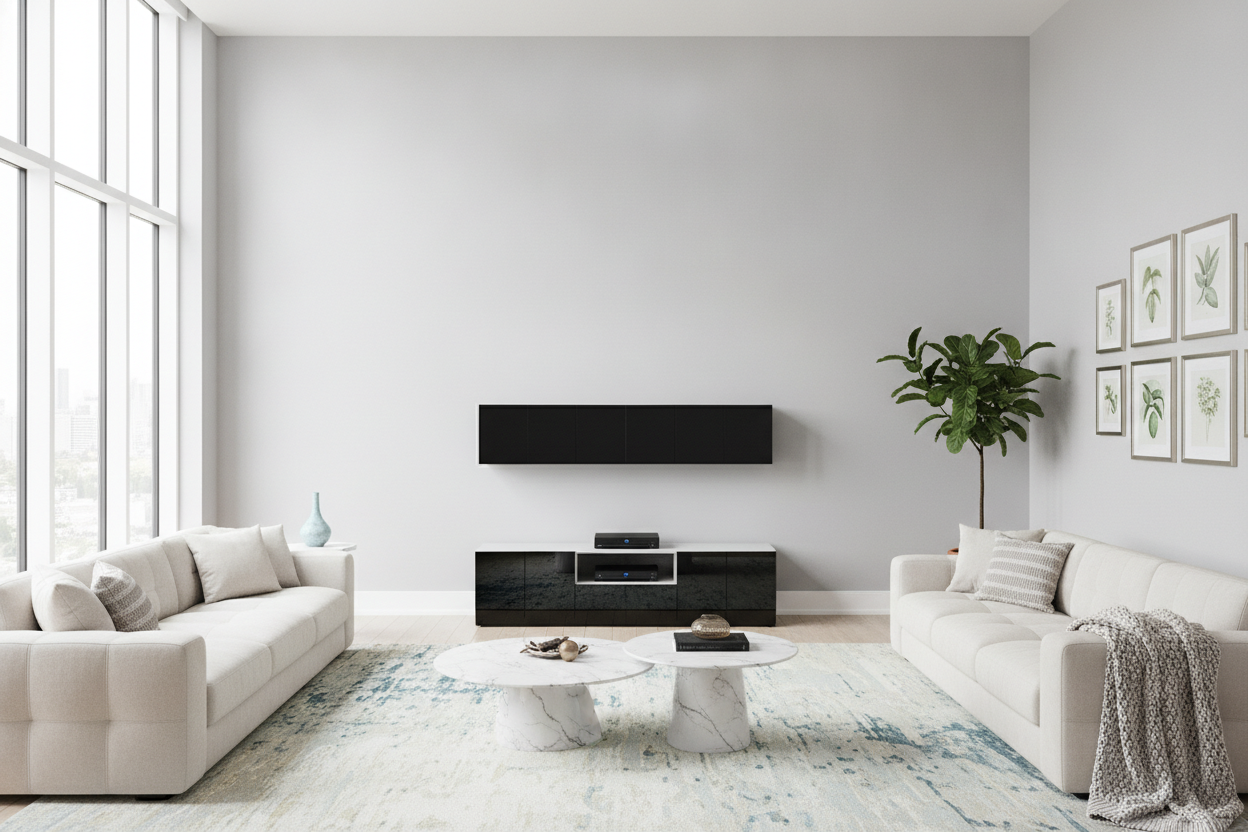
I remember the first time I moved into a place with a 'great room.' It had 12-foot ceilings and a wall so long I could have parked three SUVs against it. I proudly unboxed my new tv stand 60 inch long, spent forty minutes tightening cam bolts, and slid it into the center of the room. I stepped back, and my heart sank. It looked like a postage stamp stuck to the side of a skyscraper.
We spend so much time worrying if the TV will fit the stand that we forget to ask if the stand fits the room. If you are staring at a lonely console that seems to be floating in a sea of drywall, you aren't alone. It is one of the most common scale mistakes I see in modern living rooms.
- Scale Over Size: A 60-inch stand is often too narrow for walls longer than 12 feet.
- Verticality Matters: Low-profile consoles leave too much dead air above the TV.
- Visual Weight: Darker finishes like black or charcoal help 'ground' a small piece on a large wall.
- Layering is Key: You can fix a small stand by flanking it with plants or shelving.
The 'Floating Island' Living Room Mistake
The 'floating island' effect happens when your furniture is too small for the architecture surrounding it. When you start to browse different TV stands, the 60-inch mark feels like a 'safe' medium. But on a large wall, that safety backfires. A living room 60 inch tv usually has a footprint of about 53 inches wide. If your stand is only 60 inches, you only have 3.5 inches of 'breathing room' on either side of the screen.
This tight margin makes the whole setup look cramped on the furniture but tiny on the wall. It creates a visual disconnect where the eye doesn't know where to land. Instead of the media area feeling like a destination, it feels like a temporary holding cell for your electronics.
Why You Might Actually Need a Hutch
If you have high ceilings—anything over the standard 8 feet—a low-slung console is going to look squat. This is where a 60-inch entertainment center with hutch becomes a lifesaver. By adding vertical shelving or a bridge above the TV, you’re drawing the eye upward and filling that awkward 'dead zone' of drywall.
I used to be a hutch-hater because they felt very 1990s-bulky-oak, but modern designs have changed my mind. A slim, matte-finished hutch provides a frame for your TV that makes the 60-inch width feel intentional rather than accidental. It’s the difference between a standalone picture and a matted, framed piece of art.
Using Visual Weight to Anchor the Room
Color choice is your secret weapon for fixing scale issues. A light, airy oak or white console tends to disappear against a neutral wall, making the 'floating' problem worse. A black tv console 60 inch model, however, has enough visual gravity to actually hold its own. It creates a high-contrast focal point that tells the eye, 'Yes, this is where the room begins.'
I recently tested a modern black TV stand in a client's whitewashed loft. Even though the stand was technically smaller than I usually recommend for the space, the dark finish provided enough 'weight' to anchor the entire seating arrangement. If the piece is dark, it feels more substantial than its physical dimensions suggest.
How to Fake a Built-In Look
You don't need to spend $4,000 on custom cabinetry to fix an entertainment center 60 wide that looks too small. The trick is to extend the visual footprint. I love flanking a 60-inch console with two tall, thin bookcases or even two large potted fiddle-leaf figs. This trick 'stretches' the furniture horizontally without requiring you to buy a new 100-inch unit.
It is a much more forgiving layout than trying to solve corner entertainment center issues, where you're fighting against weird angles. On a flat wall, you can use leaning art or a gallery wall surrounding the TV to make the 60-inch stand feel like just the base of a much larger, more cohesive design installation.
When to Upgrade the Whole Setup
Sometimes, styling tricks are just a band-aid. If you find yourself constantly adding more 'stuff' around your TV just to make the wall look less empty, it’s a sign the furniture is fundamentally the wrong size. If your room is massive, you might need a full entertainment unit for 60 inch tv screens that spans 80 or 90 inches.
If you aren't ready to commit to a massive, heavy unit, look for an adjustable wide TV stand. These modular pieces allow you to slide the top surface out to create a wider footprint when you have the space, or tuck it back in if you move to a smaller apartment later. It’s the most 'future-proof' way to handle the ever-changing scale of rental living.
My Personal Take: The 'Rule of Thirds' Mistake
I once bought a beautiful mid-century 60-inch walnut console for a huge living room. I thought it was perfect because it was 'real wood' and cost a fortune. But because it sat on thin, tapered legs, it looked like it was tip-toeing across the room. I ended up selling it at a loss six months later because I couldn't stand how 'leggy' and small it looked. Now, I always tell people: if the wall is big, go for a solid base, not legs. You need that floor-to-furniture contact to make the piece feel permanent.
FAQ
Is a 60-inch stand big enough for a 65-inch TV?
Technically, yes, because most 65-inch TVs are about 57 inches wide. However, the TV will overhang the edges or sit right at the lip, which looks top-heavy and unstable. I always recommend a stand that is at least 4-6 inches wider than the TV screen itself.
How do I stop my TV stand from looking cluttered?
Use the 70/30 rule. 70% of the storage should be closed (doors or drawers) to hide the 'ugly' stuff like wires and routers, and 30% can be open for styling. If your 60-inch stand is all open shelving, it will always look messy.
What is the best height for a 60-inch TV stand?
For most sofas, you want the center of the TV at eye level, which usually means a stand height of 22 to 28 inches. If you go shorter, the 'floating' effect on a big wall gets even worse.

Laisser un commentaire
Ce site est protégé par hCaptcha, et la Politique de confidentialité et les Conditions de service de hCaptcha s’appliquent.