


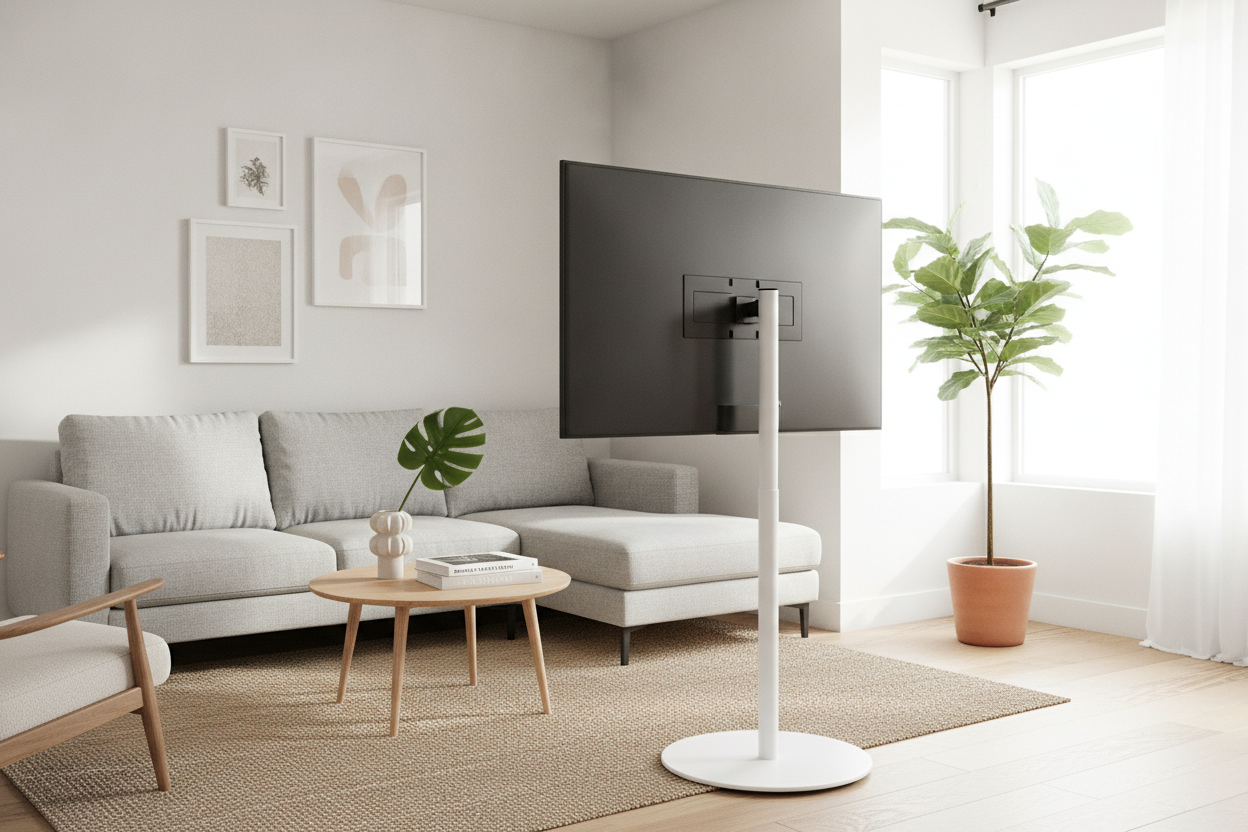
I spent three hours moving my modular sofa in circles last Tuesday, trying to find a single configuration that didn't feel like a waiting room. My new apartment is beautiful, but it was clearly designed by someone who hates technology. It has three doors, a non-functional decorative fireplace, and floor-to-ceiling windows that take up two entire walls. I realized I had exactly zero inches of usable wall space for a 55-inch screen. I didn't want to block the light, and I certainly didn't want a giant wooden box sitting in the middle of the room. That is when I pivoted to a tv floor stand white.
Quick Takeaways
- Pedestal stands allow you to 'float' a TV in front of windows or in corners without blocking the entire view.
- A white finish blends into light walls and trim, making the hardware almost disappear.
- Cable management is the biggest hurdle; you will need a white power strip and some zip ties.
- Great for renters who cannot drill into walls or have weird, non-linear floor plans.
The Curse of the 'No Wall Space' Living Room
If you live in an older building or a hyper-modern 'glass box' condo, you know the struggle. You have a 12x14 foot room that looks great in a real estate listing, but the moment you try to place a TV, the logic falls apart. In my case, the only solid wall was occupied by a massive fireplace mantel. Putting a TV above it would have given me permanent neck strain, and putting a console in front of it felt like a design crime. I was stuck staring at my floor plan like it was a Rubik's cube I couldn't solve.
Traditional furniture assumes you have a flat, windowless wall to lean things against. When you don't, you end up with a sofa shoved into a corner and a TV sitting on a wobbly table that blocks a walkway. I needed something with a tiny footprint that could sit at a 45-degree angle in the corner without looking like a temporary fix. I needed the screen to feel like it was hovering, not anchored to a bulky piece of medium-density fiberboard.
Why I Didn't Just Buy a Black Rolling Cart
My first thought was a mobile AV cart. You see them in offices and schools all the time. But let’s be honest: those black metal poles look like they belong in a corporate conference room or a high school biology class. They scream 'temporary' and 'utilitarian.' When you are trying to make a home feel cozy, the last thing you want is 40 pounds of industrial black steel dominating your aesthetic. This is where the floor tv stand white wins every single time.
By choosing a white finish, the stand visually recedes into the background. Most of us have white baseboards, white window trim, or light-colored walls. A matte white pole doesn't draw the eye the way a black one does. It feels more like a piece of gallery hardware than a piece of tech equipment. However, you have to be careful with the finish. You want a powder-coated matte look to keep your modern white TV stand from looking cheap. Glossy plastic finishes tend to catch the light and look like 'dorm room' furniture, whereas a heavy, matte steel feels intentional and high-end.
Wait, Where Do the Cords and Cable Boxes Go?
The biggest fear everyone has with a pedestal stand is the 'spaghetti monster' effect. Since there is no cabinet to hide your gear, your cords are out in the open. I’ll be honest: if you just let the black power cords hang loose, it looks terrible. But it is a solvable problem. Most high-quality white stands have a hollow center pole. I spent forty minutes fishing my HDMI and power cables through that tube, and the result was worth the frustration. One white cord coming out of the base looks a lot better than five black ones dangling from the screen.
For the peripherals, I had to get creative. I don't use a cable box anymore, but I do have an Apple TV and a small router. I used heavy-duty Command strips to mount the Apple TV directly to the back of the television. It’s completely invisible from the front. For the power, I bought a dedicated white power strip with a flat plug. I zip-tied the strip to the back of the VESA mount. It takes some patience and a few trial-and-error attempts to get the tension right so the cords don't pull when you swivel the TV, but once it's set, you never have to touch it again.
The Footprint Test: Did It Actually Save Space?
Let's talk numbers. A standard console for a 55-inch TV is usually about 50 to 60 inches wide and at least 15 inches deep. That is a massive chunk of floor real estate. My white pedestal stand has a base that is roughly 20x20 inches. By switching, I reclaimed about 6 square feet of floor space. In a small apartment, that is the difference between a cramped walkway and a room that actually breathes.
Because the base is so much smaller than traditional wide TV stands, I was able to tuck the TV into a corner that was previously 'dead space.' I can now walk past the TV to get to my balcony without shimmying sideways. The swivel function is the real MVP here—I can point the screen toward the kitchen while I'm prepping dinner, then rotate it back toward the sofa for a movie. You just can't do that with a 100-pound wooden cabinet.
When You Should Just Stick to a Console
I’m not going to tell you this is the perfect solution for everyone. If you are a hardcore gamer with a PS5, an Xbox, and a collection of physical discs, a floor stand is going to drive you insane. You simply don't have the shelf space for multiple consoles and controllers. Likewise, if you have a massive high-end soundbar and a dedicated subwoofer, a thin pole isn't going to support that weight or hide those thick audio cables effectively.
If you actually have a long, empty wall and you need storage for board games, blankets, or tech clutter, go with a cabinet. Something like a white fireplace heater TV stand provides that cozy focal point and hides a multitude of sins behind its doors. But if your floor plan is a puzzle of windows and doors, and you want your living room to feel light and airy, the white pedestal is the only way to go.
FAQ
Is a floor stand stable enough for kids or pets?
Most are made of heavy-duty steel and have a weighted base. I have a 15-pound cat who likes to use the base as a launching pad, and it hasn't budged. However, if you have a 100-pound dog or a toddler, you should look for a model with a wider, flatter base for extra security.
Will it fit any TV?
Check the VESA pattern on the back of your TV (the four screw holes). Most stands are 'universal,' but if you have a very old, heavy plasma TV or an ultra-wide screen, you need to double-check the weight capacity. Most modern LEDs are light enough that it isn't an issue.
Can I put a soundbar on it?
Some stands come with an optional shelf, but they are usually small. If your soundbar is heavy, I recommend mounting it to the TV itself using a VESA soundbar bracket. It keeps the 'floating' look intact without needing extra furniture.


Laisser un commentaire
Ce site est protégé par hCaptcha, et la Politique de confidentialité et les Conditions de service de hCaptcha s’appliquent.