


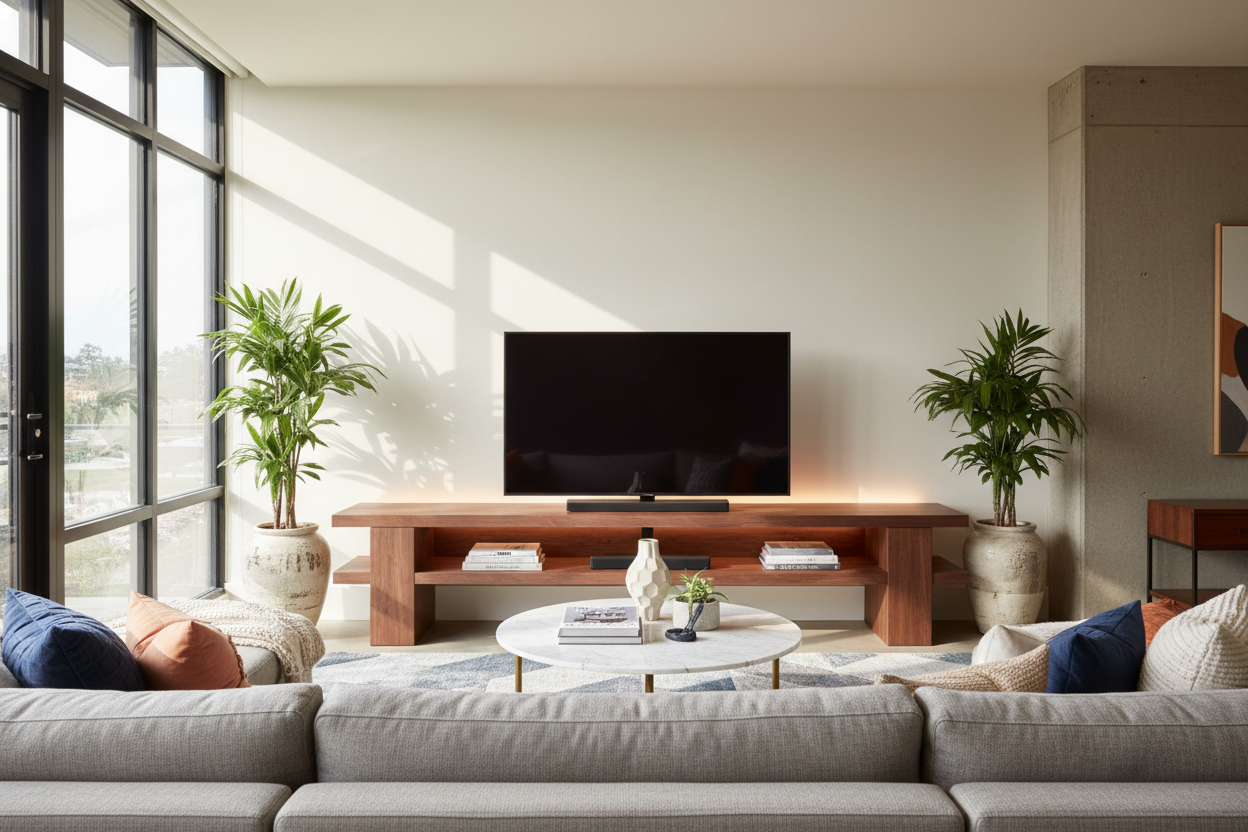
I once bought a mid-century modern 'steal' that looked incredible in the studio photos—tapered legs, warm acorn finish, the whole bit. Six months later, I noticed my screen was leaning inward like it was trying to fold the console in half. Finding the best tv stand for 55 inch tv setups isn't just about matching your rug or finding a piece that fits your wall; it is a lesson in structural engineering that most big-box retailers hope you never learn.
Quick Takeaways
- Always look for a 'fifth leg' in the center of the unit to prevent sagging.
- The stand should be at least 5-10 inches wider than the TV for visual and physical balance.
- High-density MDF with real wood veneer is often more stable than cheap solid pine.
- Avoid 'hairpin' legs on consoles made from thin particle board.
The Dreaded 'Middle Bow' (And Why It Happens)
It’s basic gravity, but we ignore it because we want the sleekest look possible. Most 55-inch TVs weigh between 30 and 50 pounds. That doesn't sound like a lot until you realize that weight is concentrated on two small feet or a single center pedestal. Over time, the materials in your console undergo something called 'creep'—a slow, permanent deformation under constant stress. If your console is made of low-density fiberboard, those wood fibers start to compress and pull apart.
I’ve seen beautifully styled rooms ruined by a console that has developed a two-inch dip in the center. Why Your New Tv Stand For 55 Inch Tv Probably Feels Too Short often comes down to this: people buy for the width but ignore the depth and structural integrity needed to keep the top flat. When the span between the legs is too wide without support, physics eventually wins. You aren't just looking for a shelf; you're looking for a bridge that can hold a heavy load without buckling.
What Makes the Best TV Stand for 55 Inch TV Screens Actually Stable?
Stability comes down to three things: center support, back-panel bracing, and material thickness. First, the 'fifth leg.' If a stand is wider than 48 inches—which it should be for a 55-inch screen—it needs a support leg in the dead center. This leg transfers the weight of the TV directly to the floor rather than forcing the top board to carry the load across a long, unsupported span.
Second, look at the back panel. A thick, screwed-in back panel acts as a 'shear wall.' It prevents the unit from 'racking,' which is that scary side-to-side wobbling you feel when you nudge a cheap dresser. If the back of the unit is just a piece of folded cardboard held on by tiny finish nails, keep walking. You want a panel that is integrated into the frame.
Finally, check the top board thickness. For a 55-inch screen, I look for a top that is at least 1 inch thick. This provides enough internal mass to resist bending. If you see a top that looks thin and airy, it better be made of reinforced steel or high-grade plywood, or it’s going to 'smile' at you within a year.
Do You Actually Need Solid Wood?
Here is a hot take from someone who builds furniture: solid wood isn't always the winner. While a solid oak beam is incredibly strong, cheap solid woods like pine or rubberwood can warp and twist as the humidity in your house changes. High-grade engineered wood—like Baltic birch plywood or high-density MDF—is actually more dimensionally stable.
The real enemy is 'particle board.' That’s the stuff that looks like compressed oatmeal and crumbles if it gets wet. When you are browsing Tv Stands, check the materials list carefully. 'Engineered wood with real wood veneer' is a workhorse that looks like the real deal but won't warp. It’s the sweet spot for most living rooms. I’ve owned a high-end veneer unit for eight years that still looks brand new, while a 'solid' pine unit I bought for my guest room has already developed a noticeable twist in the top plank.
Red Flags I Look for When Shopping Online
Shopping for furniture online is a minefield of deceptive photography. I’ve learned to ignore the lifestyle shots with the perfectly placed plants and look straight at the spec sheets. If a listing doesn't explicitly state a weight capacity, assume it’s dangerously low. For a 55-inch TV, you want a unit rated for at least 75 pounds, even if your TV only weighs 40. That extra headroom accounts for the weight of your soundbar, gaming consoles, and the inevitable 'stuff' that accumulates.
Another red flag is the 'zoom-in' test. Zoom into the joints in the product photos. Are there visible gaps? Does the hardware look like it’s made of plastic? I Spent Months Hunting For A 55 Inch Tv Stand That Wasnt Hideous and found that the best indicators of quality are the small details, like soft-close hinges and adjustable feet. If a manufacturer cares enough to include levelers for uneven floors, they probably cared about the internal bracing too.
The 'Hairpin Leg' Warning
I love the MCM aesthetic, but hairpin legs are the natural enemy of stability on cheap furniture. These legs put all the stress on four tiny points on the bottom of the unit. If the base board is made of soft MDF, those screws will eventually pull out or the board will dip between the legs. If you must have the hairpin look, ensure the legs are attached to a solid wood frame or a very thick, high-density base. Otherwise, you’re just waiting for a collapse.
My Go-To Styles That Won't Cave In
If you want a piece that will last through three different TV upgrades, look for a plinth base. This is a base where the entire bottom of the unit sits flush against the floor. It’s impossible for these to sag because the weight is distributed across the entire footprint of the furniture. It’s the ultimate 'set it and forget it' design.
If you prefer a leggy look, go for a continuous metal frame that runs the full length of the unit. This creates a 'cradle' for the wood box to sit in. A Modern Tv Stand With Cabinets And Drawers For Tvs Up To 70 9 is a great example of smart design because the vertical dividers for the cabinets and drawers act as internal pillars. These dividers transfer the weight of the TV directly down to the base, preventing the top board from having to do all the heavy lifting alone.
FAQ
How much wider should my stand be than my 55-inch TV?
A 55-inch TV is actually about 48 inches wide. You want at least 3-5 inches of breathing room on each side, so look for a stand that is 55 to 60 inches wide. Anything smaller looks top-heavy and 'pinched.'
Can I put a 55-inch TV on a stand rated for 50 inches?
Physically, it might fit if the feet are close together, but it’s a bad idea. The overhang is a safety hazard—one accidental bump and the whole thing is going down. Plus, it looks like your TV is wearing a shirt two sizes too small.
Is a wall mount better than a stand?
Wall mounting is great for height control, but you usually still need a console underneath for your cable box, PS5, and to hide the wires. A stand provides the visual anchor that a floating TV lacks.


Laisser un commentaire
Ce site est protégé par hCaptcha, et la Politique de confidentialité et les Conditions de service de hCaptcha s’appliquent.