


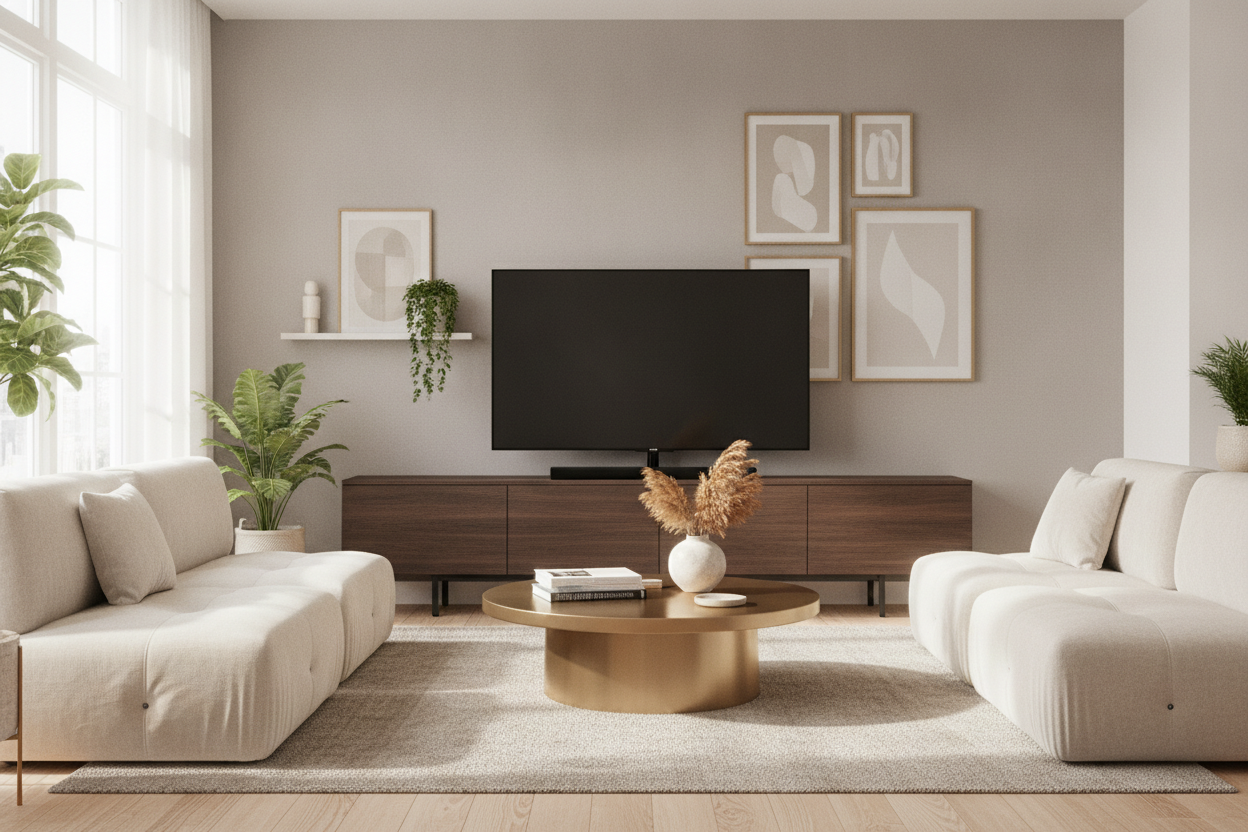
I remember staring at a 65-inch OLED sitting on my living room floor for three days because I was paralyzed by the thought of the drill. When I finally worked up the nerve to mount it, I realized my wall studs were exactly four inches off-center from where my couch actually sat. It was a disaster of asymmetrical proportions. After three 'exploratory' holes and a frantic trip for drywall patch, I realized a center stand for tv wasn't just a backup plan; it was the superior choice all along.
Quick Takeaways
- Wall mounts are permanent and unforgiving; stands offer layout flexibility.
- In-wall cord management is a nightmare of fire-rated cables and fishing tools.
- A solid console anchors a room's design, preventing the 'floating black void' look.
- Modern stands provide essential ventilation for high-heat smart devices and consoles.
The Day My Drywall Crumbled (And I Gave Up)
I bought a $40 stud finder that lied to me. It beeped with the confidence of a seasoned contractor, but every time I drove a pilot hole, I met nothing but empty air and crumbling gypsum. In a rental, this is more than just a nuisance—it’s a security deposit killer. Even if you hit the studs perfectly, you’re committed. If you decide next year that the sofa looks better on the opposite wall, you’re left with a Swiss-cheese situation that requires a weekend of sanding and painting.
I’ve assembled and returned more 'low-profile' mounts than I care to admit. Most of them claim to be universal, but they rarely account for the specific bump-out of a power cord or the placement of an HDMI port. After one particularly stressful evening trying to level a heavy screen while my partner held it up until their arms shook, I threw in the towel. I went back to a grounded unit, and the relief was instantaneous. No more measuring to the millimeter; I just put the stand where I wanted it and set the TV down.
The Hidden Nightmare of In-Wall Cord Management
The photos of wall-mounted TVs in magazines are a lie. Notice how there are never any wires? That’s because they’ve either been Photoshopped out or a professional electrician spent four hours routing cables through a fire-rated conduit. For the rest of us, it’s a mess of dangling black snakes. If you try to do it yourself, you’re battling insulation, cross-beams, and the sheer physics of gravity. I once lost an expensive 8K HDMI cable inside a wall cavity because it got snagged on a rogue nail.
When I started asking is a tv stand and entertainment center worth the space, the answer became clear: yes, if only to preserve my sanity. A center stand allows you to drop cables directly behind a solid back panel. You don’t need a permit to add a new device. If I want to plug in a vintage Nintendo or a new soundbar, I just reach behind the console. There’s no fishing, no drywall saws, and no specialized 'in-wall' rated power kits that cost $60 a pop.
Why a Center Stand for TV Actually Anchors the Room
There is a specific interior design 'coldness' that comes with a floating TV. Without a piece of furniture beneath it, the screen looks like a giant black rectangle that just happened to crash-land on your wall. It lacks intention. A substantial console provides a visual 'ground' for the technology. It allows the TV to exist as part of a curated vignette rather than a clinical display monitor. I’ve seen people use a wide, low-slung unit to fake the look of built-ins by flanking the stand with matching bookshelves, and the effect is stunning.
From a scale perspective, a TV should never be the widest thing on a wall. It needs a base that is at least 6 to 10 inches wider than the screen to maintain balance. When you mount a TV on a bare wall, you lose the opportunity to add texture—a stack of coffee table books, a ceramic vase, or a small lamp to provide bias lighting. These small touches soften the 'tech' feel of the room and make it feel like a home rather than a showroom. Plus, you get actual storage for the stuff you don't want to see, like routers and messy power strips.
Upgrading to a Smart TV Center Stand
Modern furniture is finally catching up to the heat and connectivity needs of our gadgets. A dedicated smart tv center stand isn't just a cabinet; it’s a ventilated housing unit. I’ve learned the hard way that shoving a PlayStation 5 into a closed cabinet with no airflow is a recipe for a $500 paperweight. Look for units that feature mesh doors or slatted fronts that allow infrared signals from your remote to pass through while keeping the hardware hidden.
If you're looking for something that won't show every speck of dust but still looks high-end, I’m a fan of the stylish black TV stand entertainment center. It has the depth required for a high-end soundbar—which, by the way, often looks awkward and 'shelf-like' when mounted to a wall. Having a dedicated surface for your audio gear ensures the tweeters are at the correct ear height without needing to buy separate, ugly speaker stands.
Making the Switch: What to Look For
If you’re ready to ditch the wall mount, you need to measure more than just the screen. Many new TVs come with 'duck feet'—wide-set legs at the very edges of the frame. If your console is even an inch too narrow, those legs will hang off the side. This is why I always recommend sturdy modern TV stands that offer a wide top surface or a built-in internal pedestal mount. A pedestal mount gives you the 'floating' look without the holes in the wall, and it lets you swivel the screen if you’re watching from the kitchen.
Material quality is the final frontier. Avoid the ultra-cheap particle board that sags under the weight of a 50-pound screen within six months. You want a unit with a central support leg if it’s over 60 inches wide. Look for real wood veneers or high-density MDF with a weight rating of at least 100 pounds. It might cost a bit more upfront, but it’s cheaper than replacing a cracked screen because a flimsy shelf gave way in the middle of the night. Trust me, your drywall—and your stress levels—will thank you.
FAQ
How high should my TV stand be?
For the best viewing experience, the middle of your TV screen should be at eye level when you're seated. For most standard sofas, this means your stand should be between 22 and 28 inches tall. If you're looking up at the screen, it's too high.
Is a center stand safe for homes with kids or pets?
Yes, but you must use an anti-tip kit. Even the heaviest furniture can be pulled over. Most quality stands come with a small nylon strap or metal bracket that anchors the back of the stand to a single stud—one tiny hole is much easier to patch than a full wall mount setup.
Will my soundbar fit on a center stand?
Most modern consoles are designed with a wide, open shelf specifically for soundbars. If yours isn't, make sure the stand is deep enough to place the soundbar in front of the TV's base without it hanging over the edge.

Laisser un commentaire
Ce site est protégé par hCaptcha, et la Politique de confidentialité et les Conditions de service de hCaptcha s’appliquent.