



Short answer: most TV stands hold about 75 to 150 pounds on the top surface, and heavy-duty consoles are rated 250 to 300 pounds or more. Since a modern 65-inch TV weighs only about 35 to 55 pounds, most stands have plenty of margin. The safe rule is to choose a stand rated for at least 1.5 times the combined weight of your TV and everything else that sits on top.
This guide is for anyone pairing a new or larger TV with a stand, or checking whether an existing stand can take a heavier setup. It covers what a TV stand weight capacity number actually means, typical TV weights by screen size, how materials and construction change the rating, and how to account for a soundbar, AV receiver and gaming consoles. The figures for FUFU&GAGA stands come from the specs on our TV stands and entertainment centers pages.
How Much Weight Can a TV Stand Hold?
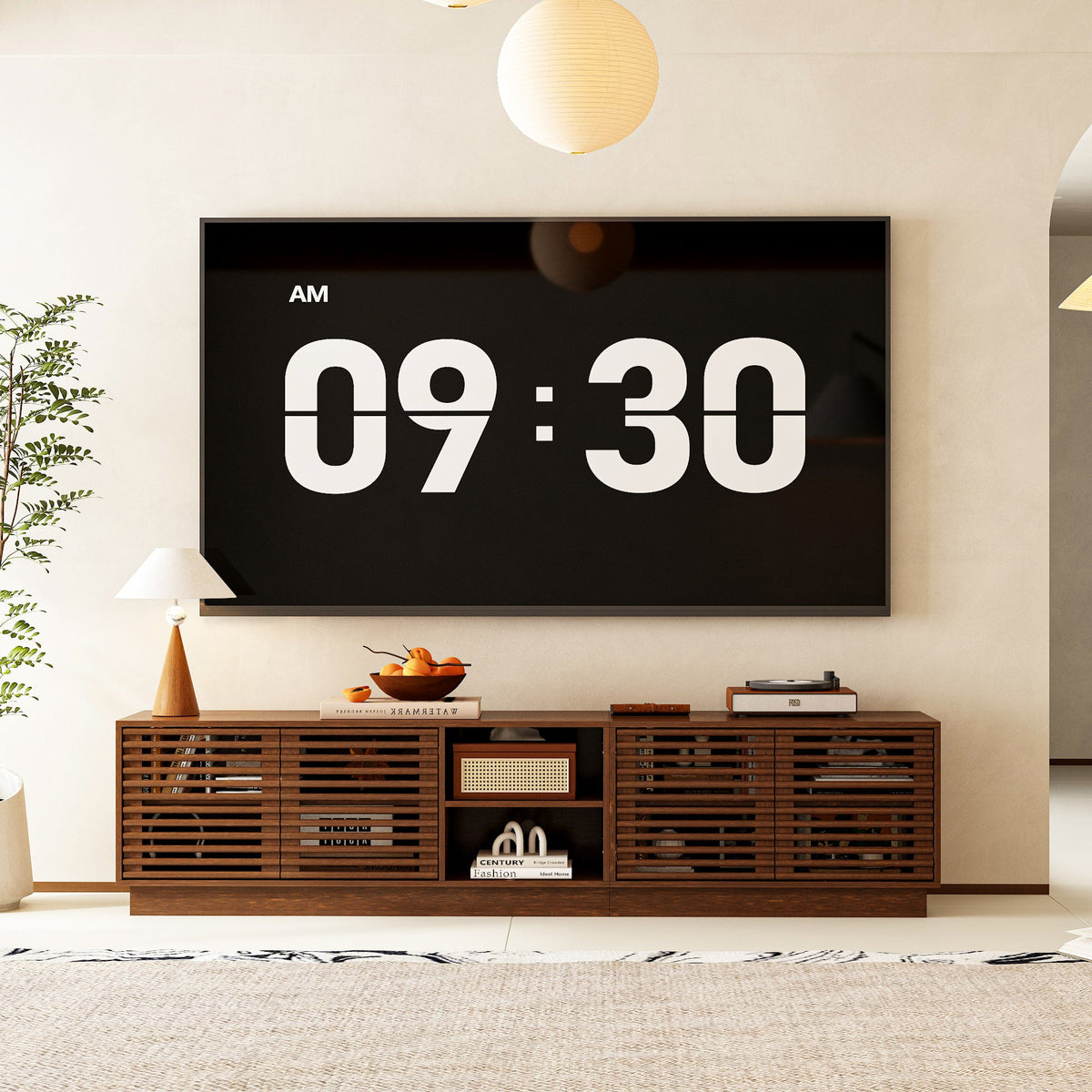
It depends on size, materials and design. Across the 50 FUFU&GAGA TV stands and entertainment centers that list a weight capacity, the typical rating is 100 to 150 lb, with a median of 150 lb. The range breaks down like this:
| Stand type | Typical weight capacity | Good fit for |
|---|---|---|
| Floating (wall-mounted) TV stand | 55–150 lb | Soundbar, devices, smaller TVs on top or a wall mounted TV above |
| Standard media console | 80–150 lb | Most 43- to 75-inch TVs plus a soundbar |
| Heavy-duty or wide console | 200–300 lb | Large TVs, 85-inch sets, full AV setups |
| Multi-piece entertainment center | Varies by unit; check each shelf's rating | TV plus books, decor and media equipment across many shelves |
Entertainment center ratings are usually for the whole unit, spread over many shelves, so do not read an 800-lb figure as the load the TV opening alone can carry.
Start With Your TV's Actual Weight, Not Its Screen Size
Screen size tells you about width, not weight. TV weights vary significantly even among similar sizes because panel technology, frame materials and built-in speakers differ. Always check the TV's actual weight "without stand" and "with stand" on the manufacturer's specifications, then use the "with stand" number if the TV will sit on its feet.
| Screen size | Typical weight without stand |
|---|---|
| 43-inch | about 12–20 lb |
| 50-inch | about 20–30 lb |
| 55-inch | about 25–40 lb |
| 65-inch | about 35–55 lb |
| 75- to 77-inch | about 50–80 lb |
| 83- to 85-inch | about 60–100 lb |
These are typical ranges for current flat-panel TVs without their own stand. Exact weights vary by model and panel type, so check the "weight without stand" line on your TV's spec sheet before you compare it with a stand's rating.
Feet or a pedestal add a few pounds; the TCL 75QM7L, for example, goes from about 54 lb without its stand to about 59 lb with it (published specifications). Older plasma and CRT TVs are far heavier per inch of screen, so if you are moving an older TV onto a new stand, weigh it or look up its spec sheet.
Calculate the Total Weight of Your Full Setup
The stand has to carry more than the TV. Add every item, and split the total into what sits on the top surface and what sits on the shelves:
- TV with feet or pedestal: from the table above or your spec sheet.
- Soundbar: often 5 to 15 lb; a center speaker can be heavier.
- AV receiver: full-size units commonly weigh 15 to 30 lb.
- Gaming consoles: current consoles weigh roughly 7 to 10 lb each.
- Cable boxes, streaming devices and routers: light, but they add up.
- Decor, books and media: books are dense, and a full shelf of them can outweigh a TV.
A Worked Example
A 65-inch TV with feet (about 42 lb) plus a 10-lb soundbar and 5 lb of decor puts about 57 lb on the top surface. Multiply by 1.5 for a safety margin and you get about 86 lb. A stand rated for 100 to 150 lb handles this comfortably. Inside, an AV receiver and a gaming console add about 35 lb, spread over the lower shelves.
Now swap in an 85-inch TV at about 95 lb with its stand. The top load is about 110 lb, and with a 1.5 margin you want a rating of roughly 165 lb or more. That points to a heavy-duty console, not an 80-lb unit.
Weight Capacity vs. Maximum TV Size: Check Both
A stand can fit a TV by width and still not be rated for its weight. FUFU&GAGA product pages list both "Maximum TV Screen Size Accommodated" and "Weight Capacity", and the two answer different questions. For example, the 78.7" white media console fits TVs up to 85 inches wide, but its 80-lb weight rating suits lighter OLED or LED sets; a heavier 85-inch TV belongs on a stand rated higher. This is the honest answer to "How big of a TV can my TV stand hold?": the TV must pass both the size check and the weight check.
For width, depth and height, use our TV stand size chart.
Materials and Construction Quality
Materials set the baseline, but construction quality decides what a stand can really hold. Commonly quoted ranges for well-built furniture are:
- Solid wood: about 100 to 200 lb or more. Strong and repairable, but heavier and more expensive.
- MDF: about 80 to 150 lb when well built. Most FUFU&GAGA stands combine solid wood parts with MDF panels, which resist warping and take a smooth paint or high-gloss finish.
- Particleboard: about 50 to 120 lb. Budget-friendly but more prone to sagging under heavy loads over time.
- Steel or metal frames: about 200 to 400 lb when well built, often paired with wood tops.
- Tempered glass: often 80 to 100 lb, depending on thickness and support.
Construction Details That Raise the Weight Limit
- Center leg or center panel: long consoles over about 70 inches need support in the middle, or the top panel can bow.
- Full panel base: a plinth or full panel base spreads the load to the floor better than four thin legs.
- Thick top panel: a thicker top surface resists sagging between supports.
- Tight joints and hardware: loose joints from rushed assembly reduce capacity. Re-tighten screws after the stand settles.
- Back panel: a fixed back panel stops the cabinet from racking side to side.
Glass TV Stands
A glass TV stand can be perfectly strong if it uses tempered glass of the right thickness and is rated for your TV. Avoid point loads, such as narrow TV feet near an unsupported glass edge, and never stand on or lean on glass shelves. Tempered glass is designed to break into small, blunt pieces rather than sharp shards, but it should never be loaded past its rating.
Which TV Stands Hold 100, 200 or 300 Pounds?
If you have a large TV or a full home theater setup, filter by the weight capacity spec. A few FUFU&GAGA models with high ratings:
- 70" natural wood L-shaped TV stand media console: rated 300 lb, fits TVs up to 75 inches, with a soundbar shelf.
- 106.3" wide TV stand with adjustable width: rated 300 lb, fits TVs up to 85 inches.
- 94" white TV cabinet with cable management: rated 250 lb with a 94-inch top for large TVs.
- 70.8" high-gloss LED TV stand: rated 198 lb, fits TVs up to 78 inches.
For "What TV stands can hold 100 pounds?", the answer is most of them: the majority of our consoles are rated 100 lb or more. Just add your devices before you decide.

Where the Weight Sits Matters More Than the Total
Weight distribution affects both stability and how much a shelf can hold. A TV's weight should be centered over the stand's supports, with the full footprint on the top surface. Uneven weight, such as a heavy TV pushed to one end, can make a stand sag or tip.
- Separate weight limits: shelves and drawers usually have lower limits than the top surface. Keep heavy items like an AV receiver low and centered.
- Top surface first: treat the listed weight capacity as the limit for the TV and everything on top, unless the product lists a separate total or shelf figure.
- Uneven floors: thick carpet or a sloping floor shifts load to two legs. Use leveling feet or shims so the stand sits flat.
- Warning signs: a sagging top panel, doors that no longer close, or wobbling all suggest an overloaded stand. Remove weight and check the joints.
Anchoring and Wall Mounting
A stand rated for your TV can still tip if a child pulls on it or climbs open drawers. The U.S. Consumer Product Safety Commission estimates that emergency departments treated an average of 17,800 tip-over injuries a year from 2020 to 2022, and it recommends anchoring TVs and furniture securely to the wall (CPSC). If you cannot anchor, CPSC advises placing TVs on a sturdy, low base, pushing the TV back as far as possible and keeping heavier items on lower shelves. The Anchor It! site walks through installing wall anchors with a bracket, strap and stud finder.
Anchoring prevents tipping; it does not raise the stand's weight limit. A tip-over restraint is included with many FUFU&GAGA stands, but not all, so check the product specs and buy a kit if needed.
If you would rather mount the TV, the weight moves to the wall. A 100-pound TV is not too heavy to mount when the mount is rated above the TV's weight and is screwed into studs or masonry with the right hardware. Floating TV stands, like the 63" floating TV stand with LED lights (rated 55 lb), are designed for devices and a soundbar rather than a heavy TV on top, so a wall mounted TV above a floating console is the usual pairing.
Pre-Purchase Checklist
- Find your TV's actual weight with its feet on the spec sheet.
- Add the soundbar, decor and anything else on the top surface.
- Multiply by 1.5 and compare with the stand's weight capacity.
- Confirm the maximum TV size and that the TV feet fit the top.
- Check where shelves and drawers will hold heavy devices.
- Plan to anchor the stand and the TV to the wall.
Comparing a console with a larger piece? See TV stand vs. entertainment center for how storage and load ratings differ. When you have your numbers, browse the FUFU&GAGA TV stand collection and filter by width, then compare each model's weight capacity before you order.
FAQ
What happens if I put 105 pounds on a stand rated for 100 pounds?
It may not fail right away, but you have no safety margin. Over time the top panel can sag, joints can loosen and the stand becomes easier to tip. Stay below the rating, ideally with a 1.5 times margin.
Which TV stand can hold 300 pounds?
Look for heavy-duty consoles and check the listed weight capacity, not just the size. FUFU&GAGA's 70-inch L-shaped media console and 106.3-inch wide TV stand are both rated 300 lb.
Is a 100 pound TV too heavy to mount?
No, as long as the wall mount is rated above 100 lb and is fixed into studs or masonry. Use a mount listed by a recognized testing lab and follow its installation instructions.
Do TV stand shelves have separate weight limits?
Usually, yes. Shelves and drawers carry less than the top surface. Keep heavy devices on lower shelves, spread the load evenly and avoid stacking books on a single shelf.
Does anchoring a TV stand increase its weight capacity?
No. Anchoring stops the stand and TV from tipping forward, but the weight rating stays the same. You still need a stand rated for your full setup.


Laisser un commentaire
Ce site est protégé par hCaptcha, et la Politique de confidentialité et les Conditions de service de hCaptcha s’appliquent.