
A TV lift cabinet is a piece of furniture with a motorized column inside that raises a flat-screen TV out of the top at the press of a button and lowers it out of sight when you are done. To choose one, match three numbers: the lift's maximum screen size (50 and 65 inches are common limits), the cabinet's interior width and height against your TV's real panel size, and the lift's height range against your seated eye level. The lifts in this guide travel about 39 inches, so the TV goes from hidden to full viewing height in one smooth motion.
Key takeaways
- Buy by the lift's rated maximum screen size, not by cabinet width: a lift made for 50-inch TVs will not take a 55-inch TV.
- A 16:9 screen is about 87% of its diagonal wide and 49% of it tall, before the bezel. Compare that with the cabinet interior.
- Anchor the cabinet and use the TV anti-tip kit. The CPSC reports that 71% of child tip-over deaths involved a television.
- At the foot of a bed or in the middle of a room, choose a cabinet that is finished on all sides.
You can compare every lift and hidden-TV model in our TV stands and media consoles collection. This guide explains what to measure before you pick one.
What is a TV lift cabinet and how does it work?
A TV lift cabinet hides a television inside a cabinet, console or dresser and raises it on a motorized vertical column. The TV bolts to an integrated mount on top of the column, and the motor moves the mount up through an opening in the top of the cabinet.
You control the lift with a remote or with buttons on the cabinet. Better models let you save several heights as memory presets, so one press takes the screen to your usual viewing position. A safety sensor stops the lift if something blocks it, and soft start and stop keep the TV from jolting.
The cabinet plugs into a wall outlet, and some designs add a built-in outlet and cable ports so every cord stays inside. When the TV is down, the room has a piece of furniture instead of a black screen.
Is there a cabinet with a hidden TV lift that also stores things? Yes: lift consoles keep media gear behind doors, and lift dressers add a full set of drawers.
Which type of TV lift cabinet fits your room?
Four common designs hide a TV, and they differ in placement, storage and installation.
| Type | How the TV hides | Best spot | Storage | Trade-off |
|---|---|---|---|---|
| Pop-up lift console | Motor raises the TV out of the top | Foot of the bed, in front of a window, room divider | Doors or shelves below | Needs open space above the cabinet |
| Lift dresser | Motor raises the TV behind the drawers | Bedroom wall or foot of the bed | Many drawers | Heavy; the 63-inch model below weighs 246 lb |
| Wall-mounted hidden TV cabinet | Doors close in front of the TV | Living room or bedroom wall | Little | No motor; must be mounted to the wall |
| Outdoor TV lift cabinets | Motor in a weather-resistant enclosure | Patio or outdoor kitchen | Varies | Needs outdoor-rated materials and power |
The cabinets in this guide are indoor furniture made of MDF and metal; outdoor TV lift cabinets are a separate, weather-rated category.
If you are still deciding between a lift and a regular console, our guide to the differences between a TV stand, media console and entertainment center covers the non-motorized options.
What size TV fits in a TV lift cabinet?
Every TV lift has a rated maximum screen size, and that is the first filter. The 50.4-inch lift console below takes TVs up to 50 inches; the 63-inch lift dresser takes up to 65 inches. A larger TV will not fit the mount or opening, even if the cabinet looks wide enough.
The second check is the interior. A TV's advertised size is the diagonal, but the panel's width and height plus the bezel are what must fit. On a 16:9 screen, width is about 0.87 times the diagonal and height about 0.49 times.
| TV size (diagonal) | Screen width, approx. | Screen height, approx. | Lift rating that fits |
|---|---|---|---|
| 43 inches | 37.5 in | 21.1 in | 50-inch lift |
| 50 inches | 43.6 in | 24.5 in | 50-inch lift |
| 55 inches | 47.9 in | 27.0 in | 65-inch lift |
| 60 inches | 52.3 in | 29.4 in | 65-inch lift or a 60-inch hidden cabinet |
| 65 inches | 56.7 in | 31.9 in | 65-inch lift |
These figures are screen-only, calculated from 16:9 geometry. Your TV's spec sheet lists the overall width, height and weight with the bezel, and those are the numbers to compare with the cabinet. For example, the 50.4-inch lift console has a 35-inch-high, 50-inch-wide and 10-inch-deep interior, which leaves room around a 50-inch screen.
Weight is the third check. The 63-inch lift dresser lists a weight capacity of 150 lb. Look up your own TV's weight in its manual and keep it under the rating.
How high should a TV lift raise the screen?
The right lift height puts the middle of the screen close to your eye level when you sit where you watch. Sit on the sofa or in bed, measure from the floor to your eyes, and compare that number with the lift's height range and presets.
The 63-inch lift dresser moves the TV between 30 and 69 inches and stores four memory heights. The 50.4-inch lift console moves between 28.7 and 68 inches, also with four presets. Save one preset for the sofa and one for the bed if the cabinet serves both.
Check the space above, too. At full height the TV rises well above the cabinet, so keep shelves, sconces, curtain rods and ceiling fans out of its path, and make sure the floor-to-obstruction height beats the top lift height with a margin.
Why are TV lifts so expensive?
A TV lift costs more than a standard TV stand because you are paying for a mechanism: a motor and column strong enough to carry a TV smoothly, a control board, a remote, memory presets and safety sensors. The cabinet must also be stiff and heavy enough to stay stable while the TV moves.
Can you make your own TV lift cabinet?
You can buy a standalone lift mechanism and build a cabinet around it, but it is a demanding project. The cabinet needs interior depth for the column and TV, an opening that clears the screen, ventilation, a rigid frame, and cable slack for roughly 39 inches of travel. A ready-made TV lift cabinet arrives with the mechanism, mount and sensors already matched.
TV lift cabinet buying checklist
- Screen rating: the lift's maximum screen size is equal to or larger than your TV's diagonal.
- Interior fit: your TV's overall width and height, bezel included, are smaller than the cabinet interior or opening.
- Weight: your TV's weight is below the lift's rated capacity.
- Lift range: the range puts the screen center near your seated eye height, with at least two memory presets.
- Overhead clearance: the floor-to-obstruction height is greater than the top lift height.
- Footprint: the cabinet depth suits the walkway; a slim console can be about 16 inches deep, a dresser closer to 24.
- Safety: obstruction sensor, soft start and stop, a TV anti-tip kit and a furniture tip restraint or anchoring hardware.
- Power and cables: an outlet within reach, cable ports or a built-in outlet, and cords long enough for the full travel.
- Finished back: required if the cabinet will float at the foot of a bed or in the middle of a room.
- Assembly: the cabinets in this guide weigh 102 to 246 lb, so plan on two people.
Our picks: FUFU&GAGA TV lift and hidden-TV cabinets
Three pieces cover the main situations: a large TV with dresser storage, a smaller TV at the foot of a bed, and a wall cabinet with no motor.
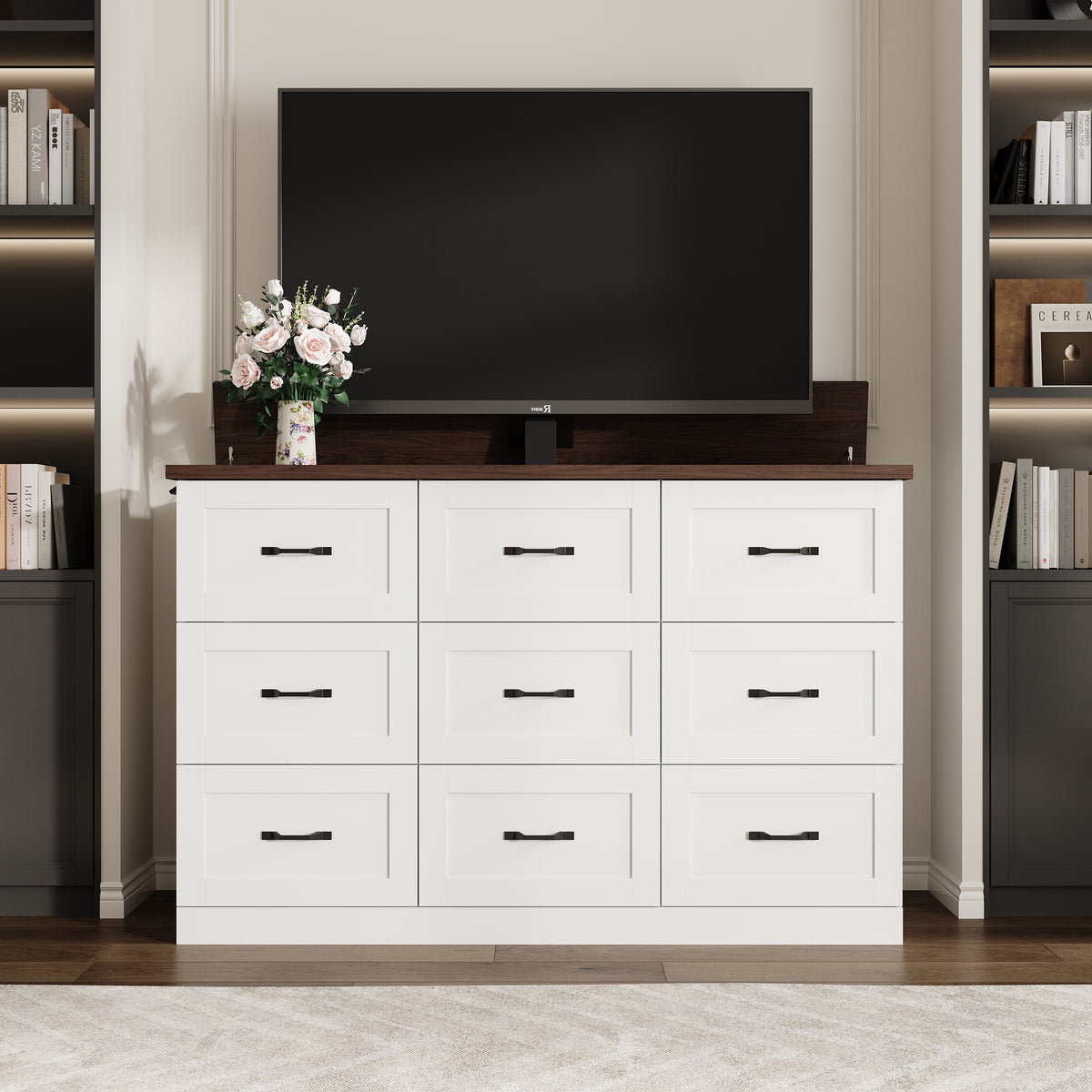
63-inch White TV Stand Dresser with Hidden TV Lift and 9 Drawers

The pick for a bedroom that needs a TV and real dresser storage. It hides a TV of up to 65 inches and raises it with side buttons or a remote, nine drawers hold clothes and consoles, and a built-in two-socket outlet powers the TV from inside.
- 63 in W x 23.6 in D x 40.5 in H; 246 lb; weight capacity 150 lb
- Fits TVs up to 65 inches; lift range 30 to 69 inches with four memory heights
- Safety sensor, TV anti-tip kit and dresser tipover restraint included
- Nine drawers on metal full-extension slides with safety stops; white with fluted and ribbed detailing
Best for: 55- to 65-inch TVs in a primary bedroom where you also need drawer space.
50.4-inch Lifting TV Stand with Motorized Vertical Lift

This console suits smaller rooms and the foot-of-bed spot. It is finished on every side, and at 15.7 inches deep it leaves more walking room than a dresser. Two doors hide consoles and media gear, and side ports route cables out of view.
- 50.4 in W x 15.7 in D x 39.3 in H; interior 35 in H x 50 in W x 10 in D; 137 lb
- Fits TVs up to 50 inches; lift range 28.7 to 68 inches with four memory presets
- Safety limiter, soft start and stop, safety sensors, integrated TV mount and TV anti-tip kit
- Available in black, white, natural or brown
Best for: TVs up to 50 inches at the foot of a bed or floating in a living room.
65.7-inch Black Wall-Mount Hidden TV Media Cabinet with 4 Panel Doors

Not every hidden TV needs a motor. This wall cabinet closes four raised-panel doors over a TV of about 60 inches and sits just 9.4 inches off the wall, with ventilation gaps and hidden cable channels.
- 65.7 in W x 9.4 in D x 43.3 in H; 102.46 lb
- Interior opening 60.6 in W x 31.7 in H, fits most 60-inch TVs, up to 62 inches diagonal including the bezel
- Four doors with silent magnetic latches; top, bottom and side ventilation
- Wall mounted; no anti-tip device included
Best for: living rooms where floor space is tight and a motor is not needed.
| Product | Size (W x D x H) | Max TV | Standout feature | Best for |
|---|---|---|---|---|
| 63-inch lift dresser | 63 x 23.6 x 40.5 in | 65 in | Nine drawers plus built-in outlet | Bedroom with storage needs |
| 50.4-inch lift console | 50.4 x 15.7 x 39.3 in | 50 in | Finished on all sides, four colors | Foot of the bed |
| 65.7-inch wall cabinet | 65.7 x 9.4 x 43.3 in | About 60 in | 9.4-inch depth, no motor | Tight living rooms |
TV lift safety and mistakes to avoid
A TV lift cabinet moves a heavy screen, so stability matters more than with a fixed stand. The U.S. Consumer Product Safety Commission counted 581 tip-over deaths involving furniture, TVs or appliances since 2000, 81% of them children, and found that 71% of child fatalities involved a television. CPSC advises anchoring TVs and furniture to the wall and keeping remotes and toys where children will not climb for them.
The CPSC's Anchor It! campaign estimates that about 11,300 children a year were treated in emergency rooms for furniture, TV and appliance tip-overs between 2017 and 2019. A wall anchor takes a small hole in the wall and a few minutes; our step-by-step anchoring guide shows the method.
- Skipping the anti-tip kit: both lift models above include one; install it before the first lift.
- Using the top as a shelf: keep vases, lamps and remotes off the opening, since the TV and mount need a clear path.
- Short cables: leave enough slack for the full travel, or the lift can pull plugs out of the TV.
- Ignoring ventilation: leave space around devices stored inside.
- Letting kids ride the lift: the safety sensor stops movement, but adults should still supervise while the TV moves.
FAQ
Which TV lift cabinet is the best?
The best TV lift cabinet is the one rated for your TV's size and weight, with an interior that fits the panel and a lift range that reaches your eye level. For 55- to 65-inch TVs in a bedroom, a lift dresser adds storage. For TVs up to 50 inches at the foot of a bed, a slim console finished on all sides works better.
Will a 55-inch TV fit in a 50-inch TV lift cabinet?
No. A lift rated for TVs up to 50 inches is sized for that screen, and a 55-inch TV is about 4.3 inches wider before the bezel. Choose a lift rated for 65 inches instead, and check your TV's overall width, height and weight against the cabinet's specs before you order.
Can a TV lift cabinet go at the foot of the bed?
Yes, as long as the cabinet is finished on all sides, because the back faces the room. The 50.4-inch lift console is finished all around and stands 39.3 inches tall with the TV lowered. Save a memory preset for the bed so the screen stops at the right height every time.
Are TV lift cabinets safe around children?
They can be when installed correctly. Look for an obstruction sensor and soft start and stop, install the TV anti-tip kit, and anchor or restrain the cabinet as the manual describes. CPSC data show that most child tip-over deaths involve a TV, so supervision and anchoring matter even with a lift.
Ready to compare sizes and finishes? Browse the full TV stands collection, and if the same room doubles as a guest room, read our comparison of a Murphy bed cabinet vs a sofa bed vs a daybed. FUFU&GAGA ships free to the 48 contiguous states, and most in-stock orders leave the warehouse within 48 hours.

Laisser un commentaire
Ce site est protégé par hCaptcha, et la Politique de confidentialité et les Conditions de service de hCaptcha s’appliquent.