


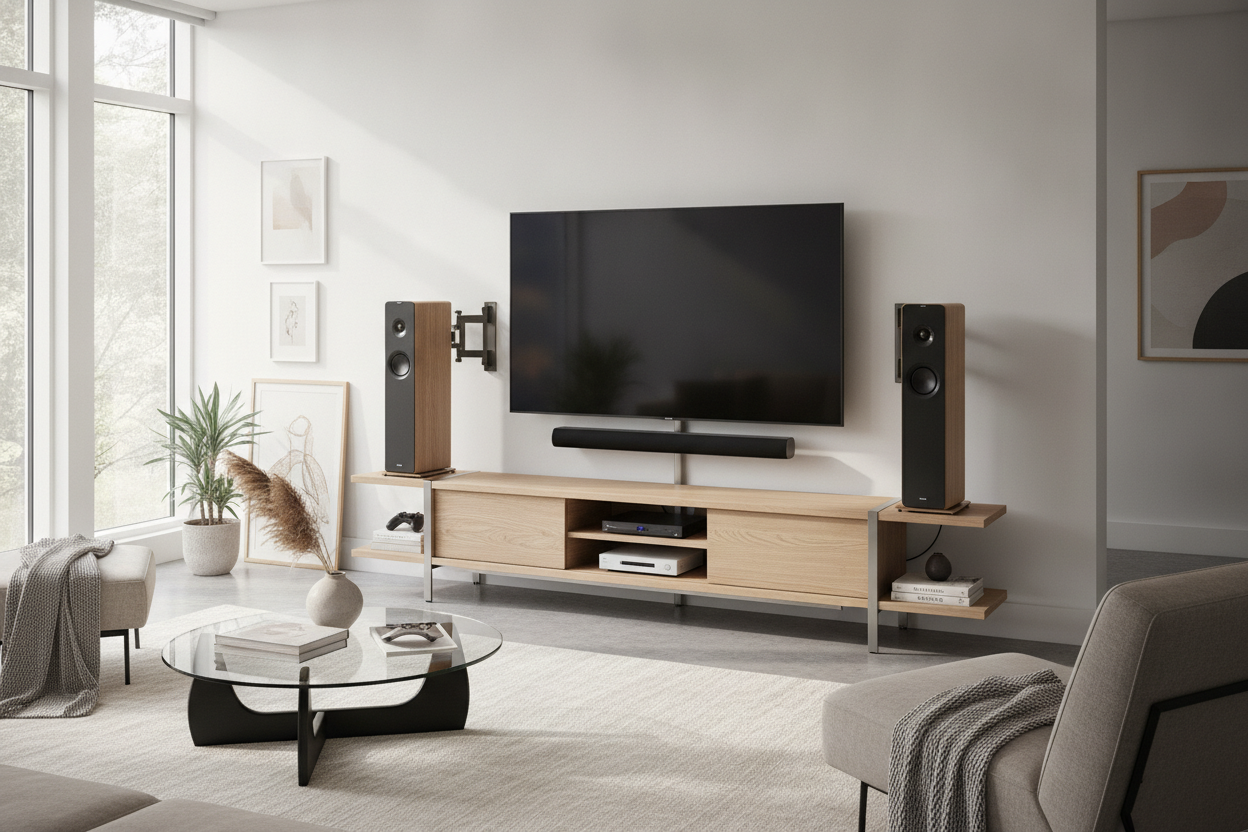
I spent three hours yesterday trying to find a spot for my new center channel speaker that didn't involve it literally covering up the subtitles on the screen. It is the classic living room standoff: you want the 4K cinematic experience, but your partner doesn't want the living room to look like a tech warehouse. Finding a tv stand with speaker shelf is basically the only way to keep the peace without sacrificing your ears or your floor plan.
Most media consoles are designed for aesthetics first and hardware second. They give you tiny little cubbies that might fit a DVD player from 2004, but they fail miserably when faced with a modern soundbar. Here is the reality: if your speaker is not at ear level and unobstructed, you are wasting your money on high-end audio.
- Open shelving is mandatory for center channel clarity and projection.
- Check the weight capacity; some center speakers weigh 20+ pounds and will bow cheap MDF.
- Adjustable shelves accommodate different soundbar heights as you upgrade gear.
- Wire management holes save you from the dreaded 'cable spaghetti' behind the glass.
The Giant Rectangular Elephant in the Room
Let's be honest: center channel speakers and soundbars are ugly. They are big, black, plastic-y boxes that ruin the 'mid-century modern' vibe you spent months perfecting. But they are entirely necessary for hearing dialogue. If you put them on top of the console, they block the IR sensor on your TV or cut off the bottom of the picture. If you hide them behind a solid door, your favorite actors sound like they are talking through a thick wool blanket.
I remember swapping out my basic TV stand for a beautiful vintage sideboard a few years ago. It looked incredible, but I had to leave the doors hanging wide open every time we watched a movie just so the sound could escape. It was a mess. A dedicated tv stand with speaker shelves solves this by giving that gear a home that is physically open to the room but visually integrated into the furniture frame.
Why the 'Open Top Tier' is the Ultimate Compromise
The 'open top tier' design is the sweet spot. This is usually a wide, bridge-like shelf sitting directly under the top surface. It allows the sound to travel directly to your ears without bouncing off the interior walls of a cabinet. It bridges the gap between the audiophile who needs performance and the decorator who wants a clean surface for a few candles or a plant next to the screen.
When shopping, I always look for a TV stand with an adjustable center shelf. Soundbars vary wildly in height—some are slim 2-inch strips, while high-end Atmos bars can be 5 inches tall. If your shelf is fixed, you are stuck. Having those extra peg holes lets you snug the speaker right up against the top of the opening, making it look custom-built for your specific gear.
What About the Subwoofer and Receiver?
While the center channel needs to breathe, your A/V receiver is a different story. Receivers are heat-generating monsters, but they do not produce sound themselves, so they can live behind a door. I usually recommend a black cabinet with glass doors for this. The glass allows your remote's infrared signal to pass through, but hides the glowing LEDs and the rat's nest of HDMI cables in the back.
If you have a full surround setup, you might even consider a tv stand with speaker cabinet sections specifically for your front left and right channels if they are small enough to fit. However, keep the subwoofer on the floor. Putting a vibrating sub inside a wooden cabinet is a fast track to annoying rattles that will drive you insane during action movies. No amount of padding will fix a sub vibrating against a thin plywood backer.
3 Measurements You Must Take Before Buying
Don't trust the photos. Manufacturers love to Photoshop slim, tiny speakers into their product shots to make the furniture look bigger. First, measure the depth of your speaker. Many center channels are 12 to 15 inches deep, and some consoles are only 14 inches deep. You do not want your expensive gear hanging off the edge like a cliffhanger.
Second, check the weight. A solid wood or heavy-duty composite shelf is fine, but cheap 1/2-inch particle board will sag under a heavy speaker within six months. Third, ensure there is a clear path for cables. If you are looking for a tv stand with speaker mount for side speakers, make sure the built-in cable management can actually handle the gauge of your wire. Thick 12-gauge speaker wire does not bend easily around tight corners in cheap furniture.
Can I put a soundbar inside a cabinet with mesh doors?
Yes, mesh or acoustic cloth doors are a great middle ground. They hide the speaker visually while letting the sound waves pass through. Just make sure the mesh is thin enough that it does not muffle the high-frequency details or block your remote signal.
How much clearance does a receiver need for heat?
Give it at least 2 or 3 inches on the top and sides. If you cram a high-powered receiver into a tight space without airflow, it will overheat and shut down right at the climax of the movie. I have killed two receivers by being too greedy with shelf space.
Should the speaker be flush with the front of the shelf?
Always. If you tuck the speaker back into the shelf, the sound will reflect off the lip of the wood, creating a muddy, echo-ey mess. Pull it forward until the front of the speaker is slightly past the edge of the shelf for the cleanest audio.

Laisser un commentaire
Ce site est protégé par hCaptcha, et la Politique de confidentialité et les Conditions de service de hCaptcha s’appliquent.