


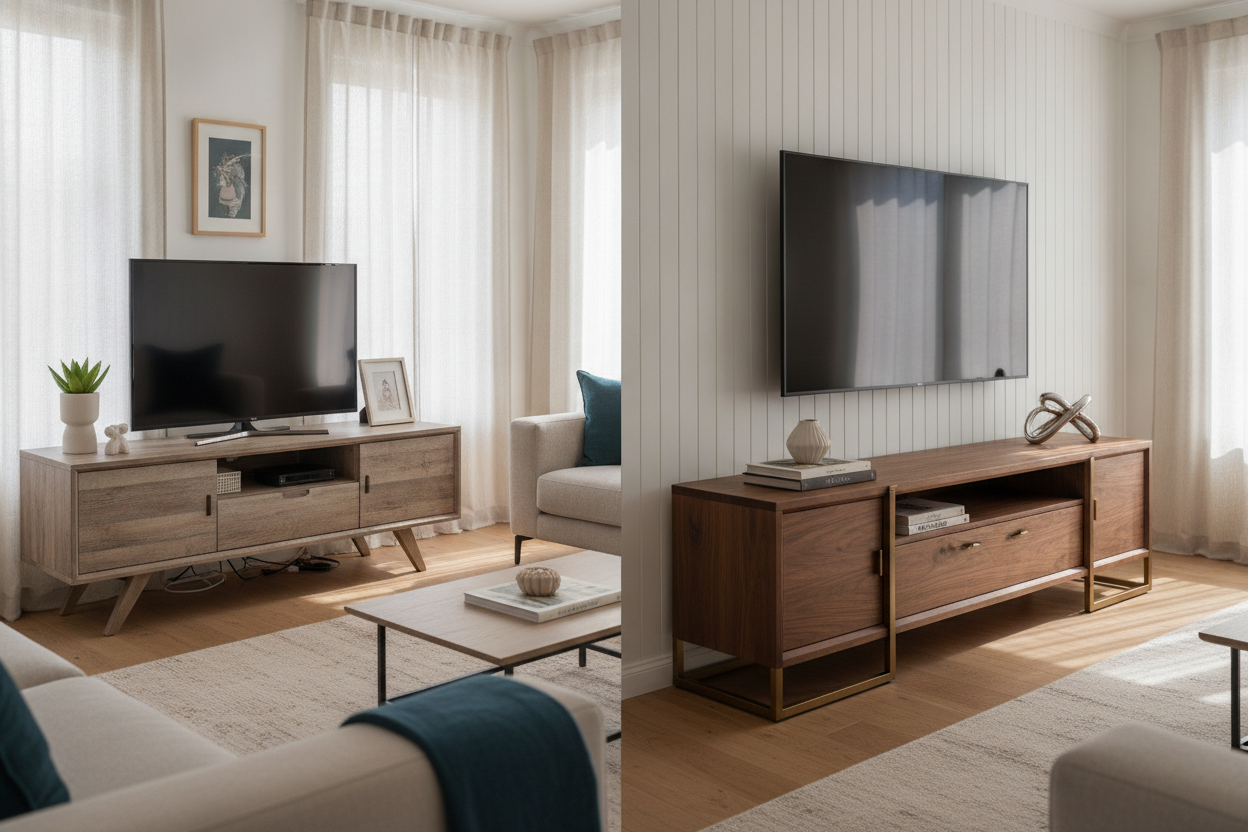
I spent three months obsessing over refresh rates and local dimming zones before dropping two grand on a 77-inch OLED. I brought it home, unboxed it like a fragile religious artifact, and then set it on a $60 fiberboard console I had owned since my first apartment. Within a week, I noticed the 'IKEA smile'—that slow, agonizing sag in the middle of the top shelf that screams 'this is about to collapse.'
It is a classic mistake. We spend the entire budget on the tech and treat the furniture as an afterthought. But after watching my expensive screen wobble every time the cat jumped nearby, I realized a premium tv stand isn't just about looking fancy. It is about structural integrity and not living in a state of constant furniture-induced anxiety.
- Solid wood and high-grade plywood won't bow under the weight of a 70-pound screen.
- Internal cable routing keeps your living room from looking like a server room.
- Proper ventilation prevents your gaming consoles from overheating in a closed cabinet.
- Real hardware and soft-close hinges mean the doors won't fall off in six months.
The $2,000 Screen on a $50 Stand (My Big Mistake)
I used to think a shelf was just a shelf. If it held the weight today, it would hold it tomorrow, right? Wrong. Cheap flat-pack furniture is usually made of medium-density fiberboard (MDF) or particle board, which is essentially sawdust held together with hope and glue. Over time, gravity wins. My TV started leaning forward at a three-degree angle, and the doors on the console wouldn't shut because the frame had warped so badly.
The worst part wasn't even the sag; it was the scale. A massive, high-end television on a flimsy, narrow stand looks top-heavy and accidental. It makes the whole room feel cluttered and cheap, regardless of how many 4K pixels you have firing at your face. I spent more time worrying about the stand snapping than I did enjoying the movies I bought the TV for.
What Actually Makes a Console 'Premium'?
When you move from a $150 budget piece to something high-end, you are paying for the stuff you can't see just as much as the stuff you can. Premium units use kiln-dried hardwoods or thick, multi-layered plywood. These materials don't expand and contract with the weather like the cheap stuff does. You also get real joinery—think dovetails or mortise-and-tenon joints—rather than those silver cam-locks that always seem to strip the wood the second you tighten them.
Weight capacity is the silent killer. A cheap stand might be rated for 50 pounds, but that rating is often 'static,' meaning it assumes the weight never moves and is perfectly distributed. A high-end unit is built to handle the concentrated weight of a heavy center-channel speaker and a massive screen without flinching.
Solid Wood vs. The Dreaded Sagging Middle
If you have ever seen a bookshelf that looks like a frown, you have seen the limits of MDF. Most budget consoles lack a center support leg, relying entirely on the tension of the side panels. A well-built storage credenza with sliding glass doors is designed with a reinforced base and vertical dividers that transfer the weight directly to the floor. This prevents the top from bowing, ensuring your sliding doors actually slide instead of getting jammed in a warped track.
I have seen 1-inch thick solid walnut tops stay perfectly flat for decades, while 1.5-inch honeycomb-fill 'wood' tops from big-box retailers start to dip within a single humid summer. If you are planning on keeping your TV for more than two years, the material choice is non-negotiable.
Cable Management That Was Actually Designed by a Human
Cheap stands usually have a single, 2-inch punch-out hole in the back made of flimsy cardboard. Good luck fitting a power strip, an HDMI cable, and a Toslink connector through that without tearing it. Premium stands treat cable management as a feature, not a footnote. They include wide channels, removable back panels, and even internal 'chimneys' to route wires between shelves.
I once spent four hours trying to 'hide' cables on a budget stand using zip ties and electrical tape. It still looked like a nest of black snakes. On my current high-end unit, everything is routed through a central spine. You see the TV, you see the console, and you see absolutely zero wires. That cleanliness is worth the price of admission alone.
Does the Upgrade Actually Change the Room?
There is a psychological shift that happens when you put your tech on a piece of furniture that actually has some visual weight. It stops being a 'TV area' and starts being a designed space. A heavy, well-proportioned console anchors the wall. It makes that giant black rectangle of a TV feel like an intentional part of your decor rather than a piece of equipment that just happened to land there.
Focusing on balancing living room style and function means you aren't just buying a shelf; you're buying a focal point. When the materials are high-quality—think brushed brass hardware or fluted wood details—the furniture stands on its own merits. You could take the TV off entirely, and the piece would still look like it belongs in the room.
When You Should (and Shouldn't) Spend the Money
Look, I'm not saying you need to drop $3,000 on a stand for a guest bedroom or a basement playroom. If the TV is small and the stakes are low, a budget option is fine. But if this is your primary living space, and you’ve already invested in a high-quality screen, don't undercut your own experience. If you live in a 'forever' home or even a long-term rental, skip the temporary fix.
If you are tired of the wobble and the wires, investing in high-quality TV stands is the one upgrade that will outlast the TV itself. Your electronics will be obsolete in five years; a solid wood console will still be beautiful in twenty. Buy it once, cry once, and actually enjoy your living room.
FAQ
Do I really need a stand if my TV is wall-mounted?
Yes, usually. Unless you've hidden all your components inside the wall, you still need a place for your soundbar, gaming consoles, and streaming boxes. A console underneath a mounted TV also helps ground the visual, so the screen doesn't look like it's floating aimlessly on a giant empty wall.
How much wider should the stand be than the TV?
Aim for at least 6 to 10 inches of extra width on each side. If the stand is the same width as the TV (or narrower), it looks 'pinched' and unstable. You want the furniture to frame the screen, not just hold it up.
Is assembly hard on premium stands?
Actually, it's often easier. High-end furniture often arrives fully assembled or 'partially knocked down,' meaning you just have to bolt on the legs. The pieces fit together with precision because they weren't mass-produced in a factory that prioritizes speed over straight lines.

Laisser un commentaire
Ce site est protégé par hCaptcha, et la Politique de confidentialité et les Conditions de service de hCaptcha s’appliquent.