


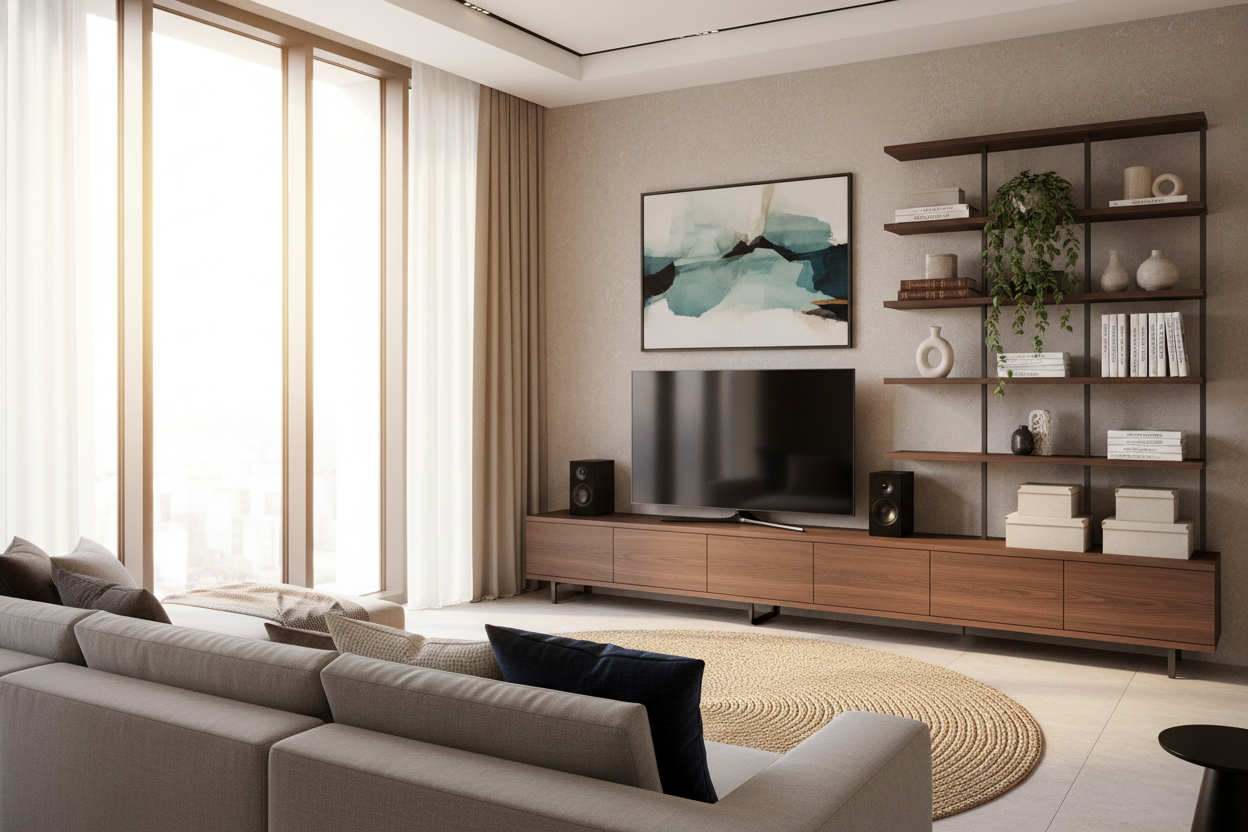
I spent three weeks staring at my 65-inch TV sitting on its original cardboard box because every nice entertainment center I found online was either a $90 piece of kindling or a $4,000 heirloom that required a literal mortgage. It is the ultimate furniture dead zone. You want something that does not wobble when the cat jumps on it, but you also do not want to spend your entire tax return on a single cabinet.
- Weight is your best friend; if the box is light enough for one person to carry, the furniture is too flimsy.
- Closed storage is non-negotiable for hiding the 'cable spaghetti' behind your PlayStation.
- Measure the TV's actual width, not the diagonal screen size, to avoid the dreaded overhang.
- Look for soft-close hinges and adjustable shelving to ensure the piece lasts through your next tech upgrade.
The 'Dorm Room vs. Custom Cabinet' Trap
The furniture market has a massive gap in the middle. On one side, you have the big-box retailers selling 'wood' that is essentially contact paper over compressed sawdust. It looks okay from ten feet away, but the second you try to move it, the cam locks strip and the whole thing leans to the left. It feels like disposable furniture designed for a temporary dorm room, not a real home.
On the other end of the spectrum, you have the custom-built world. These are beautiful, solid-oak beasts that cost $8,000 and require a professional installation team. For most of us, that is just not realistic. Finding a piece that bridges this gap—something with actual heft and smart design that does not require a financing plan—feels like searching for a unicorn.
So, What Actually Makes a Nice Entertainment Center?
What separates the junk from the gems is rarely the outward style; it is the guts. We are talking about what designers actually mean when they say nice: soft-close hinges that do not slam, adjustable shelves that do not bow under a heavy receiver, and cord management that actually works. If the back panel is just a piece of folded cardboard held on by tiny nails, keep walking.
Proportions are just as vital. A high-quality unit should be deep enough to actually fit a modern amplifier (usually 14-16 inches) and long enough to provide visual balance. If your TV is wider than your stand, the whole room feels top-heavy and unfinished. A quality piece anchors the wall rather than just floating against it.
Weight and Material Matter More Than Trendy Styling
Weight is a massive indicator of quality. If the shipping weight is only 40 pounds for a 70-inch unit, you are buying air. I look for pieces like a wood grain color entertainment center that utilizes dense materials and high-quality finishes. Authentic-looking textures and solid internal bracing ensure the unit will not sag under the weight of a large screen over time.
The 'Hide the Mess' Rule I Swear By
I have a personal rule: if I can see the router, the setup has failed. Open shelving is a trap for dust and visual clutter. You need closed storage—ideally pull-down doors or deep drawers—to swallow the controllers, the tangled HDMI cables, and that weird remote for the soundbar you only use once a month. It turns a chaotic tech hub into a piece of actual furniture.
Pull-down doors are particularly great because they offer a clean, monolithic look when closed but provide easy access when you need to sync a new device. Deep drawers are better for media storage or those random manuals you refuse to throw away. The goal is to make the technology disappear when the screen is off.
How to Shop Without Losing Your Mind
Before you browse an entertainment center, do the math. Measure your TV’s actual width. A 65-inch TV is usually about 57 inches wide; if you put it on a 60-inch stand, it looks cramped. Aim for at least 6-10 inches of breathing room on each side to make the setup look intentional and high-end.
Check the hardware specs in the fine print. If the handles are plastic or the 'wood' is described as 'engineered paper,' move on. You are looking for 'high-density' materials or solid wood legs. A good piece is an investment in your sanity—no one wants to spend their Saturday afternoon trying to level a wobbly stand on a rug.
My Personal Experience
I once fell for a $150 'scandi-chic' stand that looked like a million bucks on a filtered Instagram ad. Three months in, the center started to dip like a hammock because the 'solid legs' were actually hollow plastic shells. I ended up having to reinforce it with literal 2x4s from my garage. It taught me a valuable lesson: buy for the weight and the hardware, not the aesthetic filter.
FAQ
How much wider should the stand be than the TV?
At least 3-5 inches on each side. If the TV is flush with the edges, the room feels cramped and the TV looks like it is about to fall off. More width creates a more 'built-in' look.
Is MDF always bad?
No. High-density MDF is actually great for painted finishes because it does not warp like solid wood can. Just avoid the low-density particleboard that feels like a cereal box.
Should I mount the TV instead?
Mounting is great for viewing height, but you still need a nice unit underneath to anchor the room and hide the wires. A floating TV with nothing under it often looks like a doctor's office waiting room.

Laisser un commentaire
Ce site est protégé par hCaptcha, et la Politique de confidentialité et les Conditions de service de hCaptcha s’appliquent.