


I remember the day I finally ditched my wobbly kitchen chair for a real setup. I spent three hours cable-managing a triple-monitor rig, feeling like a productivity god. Then I hit the button on my new electric adjustable office desk and heard a sound like a dying blender.
It was a slow, agonizing realization. I had spent all my money on the monitors and the PC, and went for the cheapest frame I could find. Now, my entire workspace was stuck at a height that was too low to stand and too high to sit comfortably. I was stuck in ergonomic purgatory.
Quick Takeaways
- Static weight limits are not the same as lifting (dynamic) limits.
- Single-motor desks struggle with uneven weight distribution from monitor arms.
- Cheap motors have shorter duty cycles and overheat quickly under heavy loads.
- Stability decreases at height; heavier frames handle wobble better than budget models.
The Day My Desk Refused to Go Up
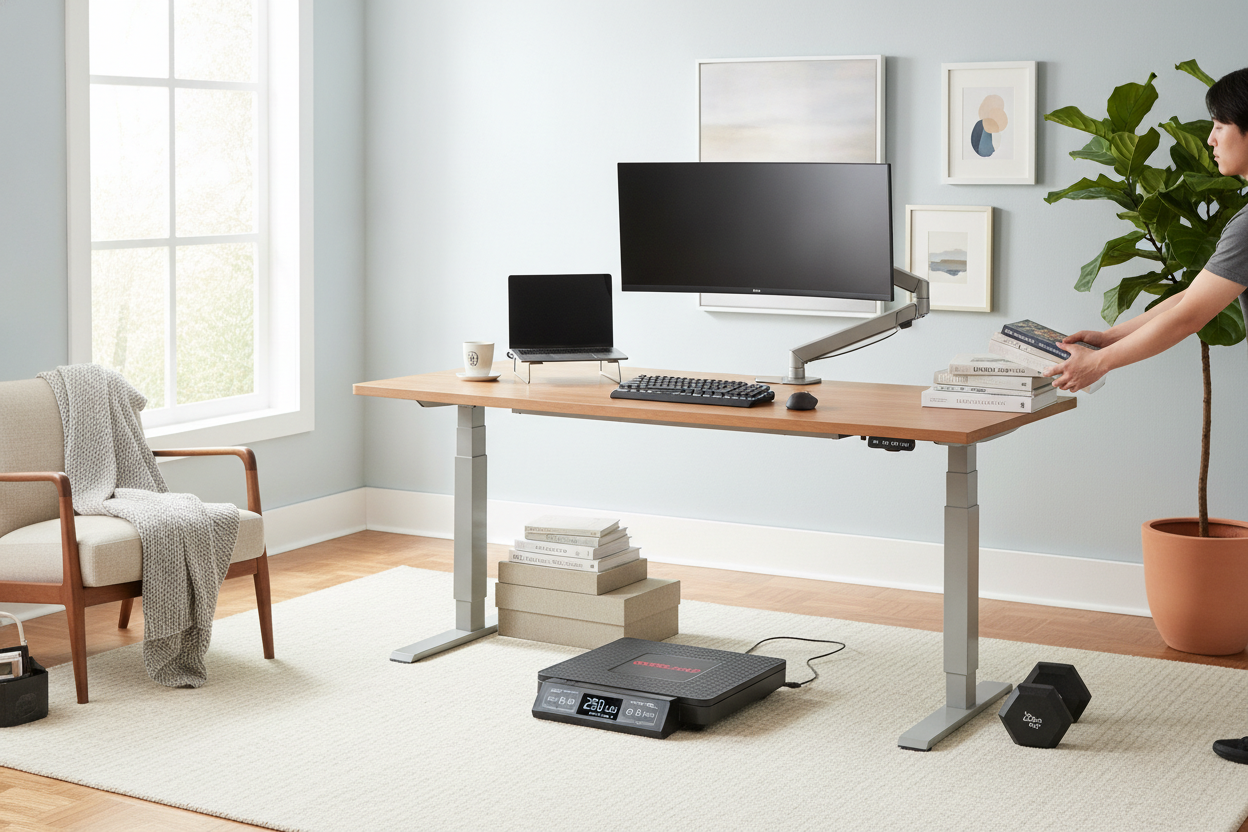
Back when I used a standard writing computer desk, weight was never a thought. If the surface didn't bow, I was golden. But an electric lift desk operates on a different set of rules. I had bolted a heavy-duty dual-monitor arm to the back edge of my new electrical standing desk, added a pair of studio monitors, and tucked my mid-tower PC into an under-desk cradle.
The first few days were fine. But by day four, the motor started making a high-pitched whine that sounded like a cat in a vacuum cleaner. One afternoon, I pressed the stand preset and the desk moved two inches before stopping with a pathetic click. The motor had literally burned out trying to fight the physics of my lopsided setup.
I ended up having to disassemble the entire rig just to get the frame back into its box for a return. It was a four-hour lesson in why you shouldn't skimp on the one part of your office that actually has moving parts. If you are building a pro setup, you cannot use entry-level lifting tech.
Why Lift Capacities on Automatic Desks Lie to You
When you are browsing automatic desks, you will see big numbers like 250 lbs capacity splashed across the page. Here is the secret: that is almost always the static load. It means the adjustable desk electric can hold that weight without the legs buckling while it is stationary. It does not mean the motor can actually lift that weight from a sitting to a standing position.
The dynamic load is what matters. On an electric adjustable height desk, the dynamic capacity is often 30 percent to 50 percent lower than the static rating. If you see a cheap electric adjustable height table rated for 150 lbs, and you put 100 lbs of gear on it, that motor is working at its absolute limit every single time you change heights. It is like driving your car at the redline constantly.
This is especially true for the electric adjustable desk Amazon keeps showing you for under two hundred bucks. These desks electric often use small, brushed motors that are not designed for heavy daily use. They are fine for a laptop and a notebook, but they are not designed for the heavy-duty gear most remote workers are rocking these days. Electric desks that adjust height need headroom in their power specs, or they simply will not last more than a year.
The Off-Center Problem Crushing Your Motor
Most people do not realize that where you put the weight on an adjustable table electric matters just as much as how much weight you add. Monitor arms are the biggest culprits. By clamping a heavy mount to the back edge, you are creating a massive amount of torque. This puts uneven pressure on the lifting columns of your electric adjustable height table.
If you have a single-motor desk, there is a hex rod running from the motor to the other leg. That rod is a major point of failure. When the weight is off-center, one leg experiences more friction than the other. The motor has to work double-time to keep the desk level. Over time, this leads to desk creep, where one side sits slightly higher than the other, or the gears inside the leg simply strip themselves bare.
I have seen people try to balance this out by putting their heavy PC tower on the opposite side, but that is just adding more total weight to a system that is already struggling. The better solution is a dual-motor setup where each leg has its own dedicated power source to handle the load independently and keep the surface perfectly level.
The High-Altitude Wobble Test
Stability is the silent killer of productivity. If you are using an electric standing desk height adjustable model, you need to know how it performs at its peak. Every desk is stable at 28 inches. The real test happens at 45 inches and above. When the legs are fully extended, the overlap between the telescopic segments is at its minimum.
Before you trust your expensive gear to a new frame, do a wobble test. Raise the desk to your standing height and give it a typing test by hitting the keys with your usual force. Then, give the side of the desk a gentle shove. If the monitors keep swaying for three or four seconds, the frame is not rigid enough for your weight load. This vibration is not just annoying; it is a sign that the joints and motor housing are under constant stress.
Heavier desks with T-style legs tend to be more stable than C-style legs where the column is toward the back. If you have a lot of weight at the back of the desk, a C-frame might actually be better for legroom, but it is inherently more prone to that front-to-back rocking motion. Always check for a crossbar if you are worried about lateral stability.
What You Actually Need for a Heavy Gear Setup
If you are serious about your workspace, stop looking at the bottom-barrel options. You need an office desk electric with a dual-motor system. This ensures that the lifting power is distributed evenly. A motorised computer desk should also feature a soft start and stop mechanism. Cheap desks jerk when they start moving, which can cause your monitors to tip or your coffee to spill. A motorized adjustable height desk with a high-quality controller will ramp up the speed smoothly.
I highly recommend looking for an electric lift system desk with memory presets. It saves you from having to manually adjust and guess your height, which reduces the total run-time of the motor. For those who need to keep their desktop clear of clutter, a modern electric height adjustable desk can provide the storage you need while maintaining a beefy lifting capacity.
Finally, check the thickness of the steel. A motorised office desk worth its salt will have legs made of 3mm thick steel or better. Thinner legs will flex, leading to that dreaded wobble. Avoid any electric rising table that does not clearly list its lifting capacity in the manual. If they are not proud of the number, it is probably because it is too low for a real workstation with multiple monitors.
FAQ
How do I know if my desk motor is failing?
Listen for changes in pitch. If the motor sounds deeper or more grindy than it did when it was new, it is struggling. Also, look for stuttering where the desk moves in small jerks rather than a smooth motion.
Can I upgrade the motor on my current desk?
Almost never. The motors are usually integrated into the leg columns or the control box is programmed specifically for that motor voltage. You are better off selling the frame and buying a higher-rated one.
Is a manual crank desk better for heavy weight?
Actually, no. Manual cranks have plastic gears that can strip even easier than a motor drive system if you are trying to lift 200 lbs by hand. A high-quality dual-motor electric system is the gold standard for heavy loads.


Laisser un commentaire
Ce site est protégé par hCaptcha, et la Politique de confidentialité et les Conditions de service de hCaptcha s’appliquent.