


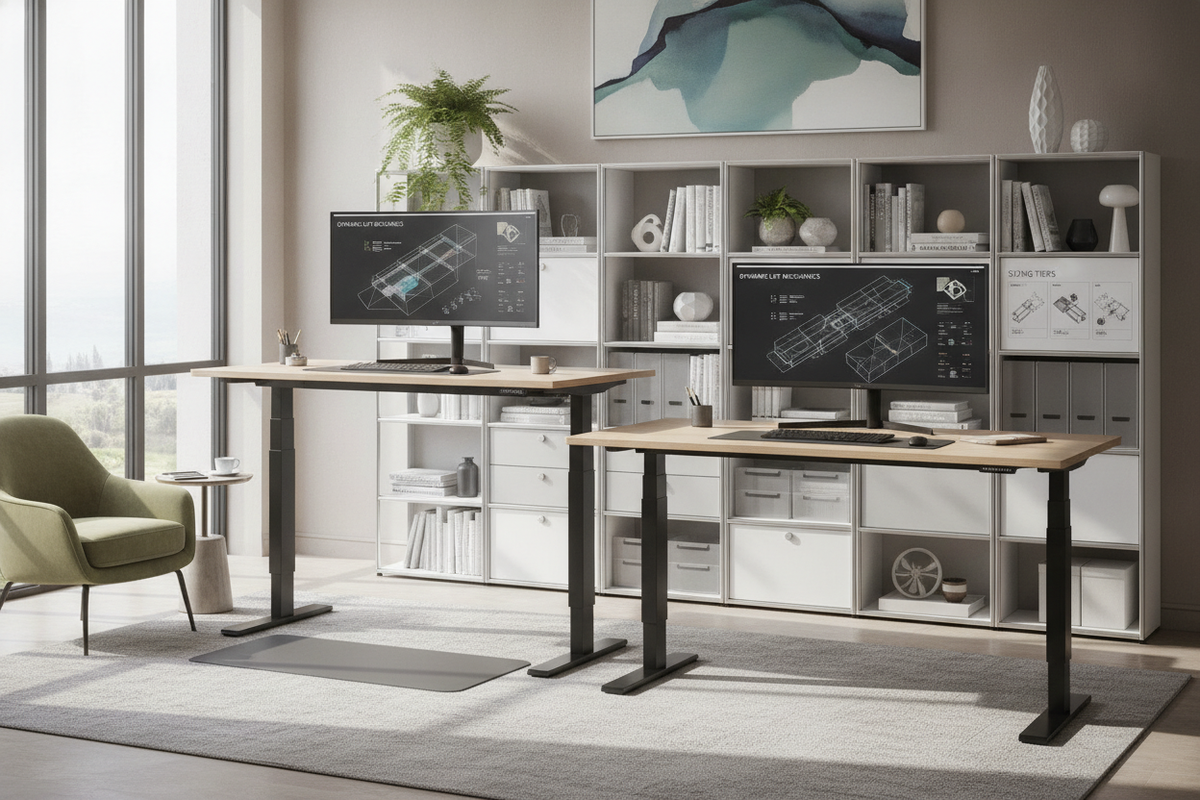
Understanding Adjustable Desks for Standing and Sitting
Modern workspaces increasingly revolve around dynamic layouts that adapt to daily activity rather than locking users into a single static posture. Selecting adjustable desks for standing and sitting allows individuals to transition between seated focus and standing tasks smoothly throughout the day. Moving beyond fixed-height furniture, an electric sit stand workstation offers structural adaptability that supports natural movement patterns while accommodating diverse user heights, computer hardware, and task workflows.
Dynamic Lift Mechanics: Comparing Motorised and Power Lift Systems
The core functionality of any height adjustable standing desk electric frame lies in its motorized drive system. Motorised desks generally feature either a centralized single-motor system connected by a hex drive rod or independent dual-motor assemblies housed inside each telescoping leg column. Dual-motor configurations distribute lifting force evenly across both sides of the desktop, resulting in steady velocity during vertical travel and stable handling of distributed hardware loads.
Contemporary power lift standing desk designs pair these mechanical columns with digital keypad controllers. An adjustable intelligent standing electronic desk often incorporates multi-position memory presets, allowing users to return to preferred seated and standing elevations with a single touch. When evaluating dual-column mechanics and digital controllers, exploring a pre-configured adjustable height standing desk with electric lift system helps contextualize how programmable presets simplify daily posture adjustments.
Dimensional Planning and Workstation Sizing Tiers
Matching your desk footprint to room architecture and task requirements ensures both physical comfort and visual balance. Workspace planners typically categorize sit standing desk height adjustable surfaces into three functional sizing tiers:
- Compact Nook Footprints: Streamlined surfaces designed for tight home office corners or multipurpose living spaces, comfortably accommodating a laptop, compact keyboard, and single external display.
- Standard Workstation Surfaces: Versatile mid-range dimensions suited for dual-monitor setups, document reference space, and dedicated desk accessories without crowding the perimeter.
- Expansive Executive Dimensions: Broad work surfaces designed for multi-display creative arrays, desktop audio interfaces, or mixed-media physical drafting.
For multi-display productivity setups or creative studio hardware, integrating a large-format height adjustable standing desk provides adequate surface depth without compromising structural balance during full extension.
Structural Rigidity and Frame Stability Across Height Ranges
Maintaining frame stability at elevated heights represents one of the most critical design considerations for any standing table electric installation. As telescoping leg stages extend upward, the center of gravity rises, increasing the potential for minor front-to-back or lateral wobble during typing.
Rigidity depends heavily on robust cold-rolled steel leg construction, substantial base foot lengths, and precision-engineered crossbar brackets that brace the underside of the work surface. Adjustable leveling glides installed beneath each foot bracket allow fine-tuning on uneven hard flooring or plush carpeting, ensuring an electric desk sit stand platform remains solid throughout vertical movement.
Dynamic Cable Management and Power Routing
Unlike stationary desks, desks that raise and lower electric require active cable management that accounts for continuous vertical movement. In my experience, the simplest way to prevent snagged wires is to treat cord routing as a dynamic system rather than a static bundle.
Effective cable routing strategies for sit stand electric adjustable desks include:
- Underside Cable Trays: Mounting a broad raceway or mesh channel beneath the desktop to secure power strips, power bricks, and excess cord lengths directly to the moving surface.
- Single-Feed Power Drop: Consolidating all desktop electronics into a single heavy-duty power strip, requiring only one main cord to drop from the desk to the wall outlet.
- Vertical Cable Spines: Utilizing articulated cable track links or flexible fabric sleeves that expand and contract smoothly during height transitions.
- Service Slack Loops: Ensuring the primary wall power cord and monitor feeds maintain sufficient slack at maximum standing height to eliminate tension.
Pairing power routing trays with functional office desk accessories and cable tools ensures that charging hubs and dynamic wires remain tidy and visually discreet across all height transitions.
Coordinating Sit-Stand Desks with Modular Storage Furniture
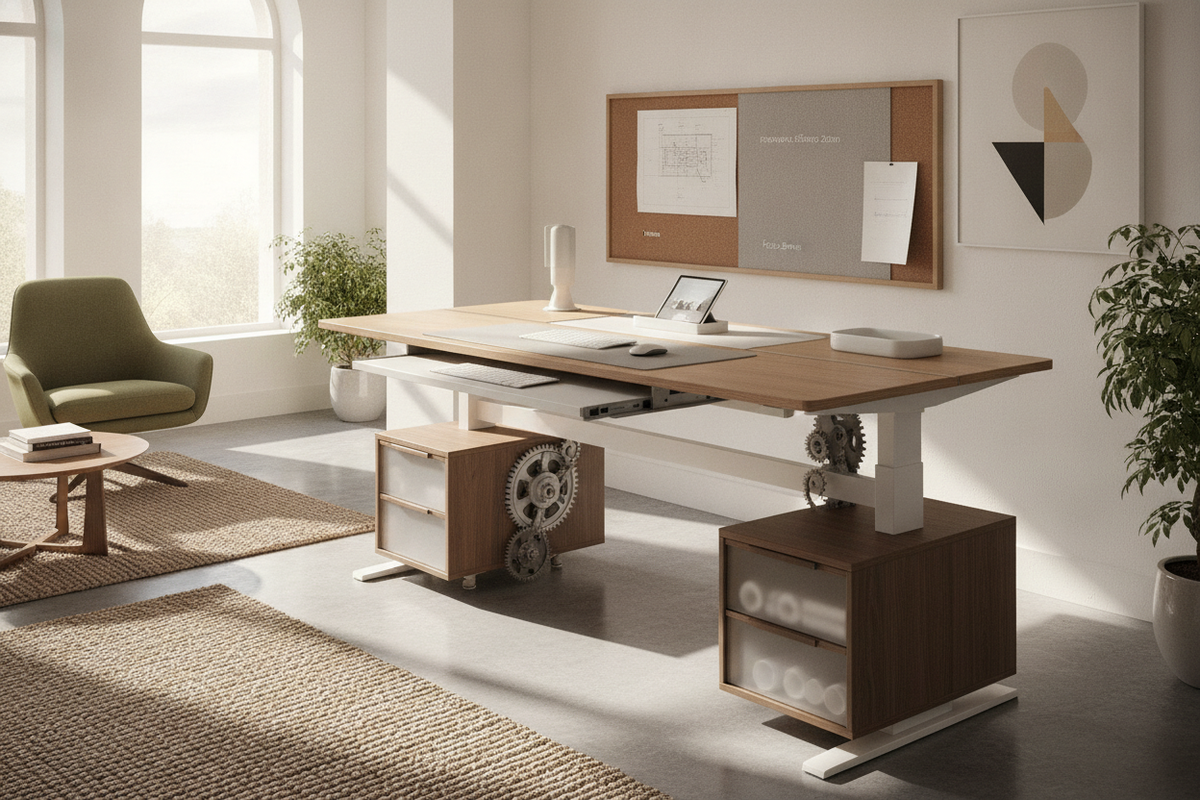
Because an electric moving desk moves up and down, surrounding storage furniture must be arranged thoughtfully to avoid physical collisions. Mobile pedestals, low filing cabinets, and credenzas should be positioned either entirely outside the desk frame footprint or sized low enough to remain clear of the desktop at its lowest seated position.
Positioning modular adjustable shelf storage units adjacent to the workstation keeps reference materials and peripherals within arm's reach while preserving unobstructed vertical travel beneath the desktop. Maintaining perimeter clearance between the desk edge and adjacent cabinet side panels prevents accidental contact during motor operation.
Above-Desk Ergonomics and Visual Balance
Wall-mounted organization and display hardware positioned behind a height-adjustable workstation require intentional spatial planning. When mounting floating ledges or pinboards directly behind an adjustable workstation, implementing above-desk storage solutions and wall displays requires leaving sufficient clearance for the monitor at peak height.
Ensure monitor arms allow independent vertical and tilt adjustments, enabling comfortable eye-level alignment whether standing upright or resting in an ergonomic task chair. Placing artwork and wall storage higher on the wall prevents visual clutter behind extended monitor screens.
Selection and Maintenance Decision Framework
When selecting an electric adjustable office table, evaluate your total equipment weight, desired surface depth, frame color harmony, and budget considerations such as overall electric table price and adjustable desk price ranges. Routine maintenance involves periodically checking bolt tightness on structural frame joints, wiping the desktop surface with mild non-abrasive cleaners, and verifying that dynamic wire loops remain free from friction points.

Laisser un commentaire
Ce site est protégé par hCaptcha, et la Politique de confidentialité et les Conditions de service de hCaptcha s’appliquent.