



A 6 foot desk represents a distinct threshold in workspace architecture. Stepping beyond standard compact desks, this seventy-two-inch span transitions an office from a constrained writing corner into a dedicated operational hub. Whether accommodating multi-monitor arrays, specialized creative hardware, or expansive analog paperwork, choosing a wide workstation requires careful consideration of structural mechanics, room flow, and storage placement.
When evaluating broad spatial formats, exploring a dedicated computer desk collection helps clarify the transition from standard study desks to wide professional surfaces. The additional width introduces both remarkable ergonomic potential and distinct spatial demands that shape the entire room layout.
The Expansive Workstation Format: Understanding the 6 Foot Desk Class
The standard residential workstation often ranges between forty and fifty inches in width. By contrast, 6ft desks provide substantial linear territory designed for simultaneous workflows. In modern professional setups, this width allows for distinct visual and functional sectors across a single continuous tabletop.
For professionals managing complex digital tasks, a desk 6ft in width accommodates dual or triple display setups without crowding peripheral equipment, desktop audio monitors, or document trays. Selecting a 6 desk platform of this scale transforms the physical interaction with your workspace, giving each tool an intentional place while eliminating the clutter that arises on smaller surfaces.
Spatial Footprint and Room Clearance: Sizing the 6 Foot Long Desk
Integrating a 6 foot long desk into a floor plan requires more than measuring seventy-two inches of clear wall space. An expansive 6ft long desk demands proportional clearance around its perimeter to maintain functional room circulation and ergonomic chair movement.
- Pushback and Seating Clearance: Ensure ample depth behind the desk edge to allow task chairs to roll back smoothly and swivel without striking baseboards or secondary furniture.
- Perimeter Flow: Maintain open walkways alongside the table edges so the room does not feel obstructed or narrow.
- Window and Natural Light Positioning: Position the desktop perpendicular or adjacent to light sources to balance daytime illumination while reducing direct screen glare across wide monitors.
For rooms where a single long run might crowd a tight wall, comparing straight configurations with a corner-oriented office computer desk product highlights alternative spatial efficiencies. However, when floor plans permit a continuous linear run, 6 foot long desks offer unmatched visual continuity and executive presence.
Structural Geometry and Long-Span Load Distribution
Spanning six continuous feet introduces structural physics that shorter desks rarely encounter. Over an extended span, downward force from heavy desktop monitors, book stacks, and natural forearm resting pressure concentrates toward the center of the surface.
A well-engineered 6 foot computer table mitigates central deflection through deliberate frame architecture:
- Under-Desktop Support Rails: Longitudinal steel beams or rigid wooden aprons running beneath the primary surface resist downward bending across the central span.
- Core Top Thickness: A reinforced 6ft desktop panel provides internal rigidity, ensuring the center remains true and level over years of daily use.
- Grounded Base Framework: Broad leg profiles, reinforced corner brackets, and stabilizing crossbars distribute equipment weight evenly down to the flooring.
Inspecting these structural features ensures your workstation provides a stable, wobble-free foundation during rigorous typing, drafting, or hardware adjustment.
Storage Architecture: Open Legs vs. 6 Foot Desk with Drawers
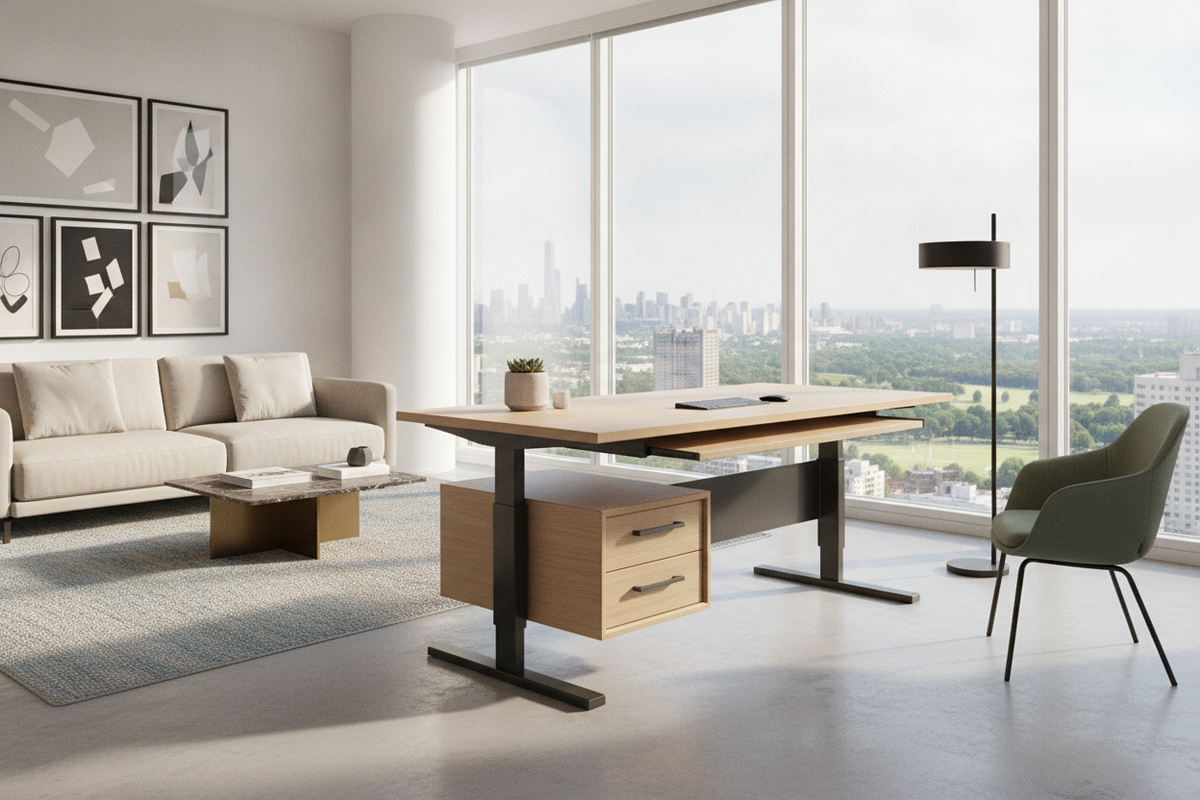
One of the most consequential decisions when configuring an expansive workspace is deciding how to manage under-desk volume. The breadth of a 6 foot desk with drawers offers versatile storage arrangements that influence both aesthetic lightness and organization.
Workspaces demanding dedicated gadget management often integrate tiered storage, such as a specialized computer desk drawers product featuring elevated shelving. Selecting the proper storage layout depends on how you balance physical leg movement against filing requirements:
- Single Pedestal Layouts: A 6 ft desk with drawers arranged along one side provides deep filing and supply storage while leaving the remaining width entirely open for active legroom and mobile chair travel.
- Dual Pedestal Architecture: Positioning drawer towers on both flanks creates a balanced, classic executive aesthetic with maximized compartmental storage, defining a centered seating pocket.
- Open Frame with Mobile Storage: An open 6ft desk with drawers on independent casters allows you to reconfigure the under-desk layout whenever workflow needs change.
Maintaining deep pedestal storage requires intentional compartment zoning, as detailed in our comprehensive desk drawers office guide. Well-planned internal organization prevents large drawer cavities from becoming disorganized catch-alls.
Surface Zoning for Multi-Screen Work and Dual-Purpose Setups
A major advantage of a 6 foot computer desk is the ability to establish distinct functional zones across a unified surface. Rather than overlapping your computing and non-computing tasks, a 6 ft computer desk allows you to split the seventy-two-inch span into dedicated task zones:
- Primary Computing Zone: The central section holds your primary display, keyboard, and mouse, aligned ergonomically with your seating posture.
- Secondary Digital Zone: A dedicated sector to the left or right houses secondary vertical displays, laptop docking stands, graphic tablets, or reference screens.
- Analog Drafting and Document Zone: The opposite perimeter provides an uncluttered physical space for note-taking, reviewing paperwork, sketching, or staging project folders without displacing keyboard peripherals.
While expansive desks remain exposed as focal furniture pieces, comparing open layouts with an enclosed computer desk office guide helps determine whether visual concealment is preferred. For dedicated home offices, the broad layout of a 6ft computer desk establishes a productive, inspiring workflow environment.
Material Selection, Assembly Logistics, and Long-Term Care
Selecting the right materials for a 6 foot office desk ensures both immediate assembly success and long-term durability. High-density engineered wood panels finished with durable laminates provide excellent resistance to daily scuffs, moisture rings, and pen impressions, while powder-coated metal subframes deliver dependable structural rigidity.
Because wide desktop components arrive in large parcels, staging your assembly area is essential. Clear sufficient floor space and assemble the frame close to its final room location. Enlisting a second person to assist when flipping or positioning a completed seventy-two-inch frame prevents joint stress during setup.
Routine care involves regular wiping with a soft microfiber cloth and gentle cleaners suitable for composite or finished wood surfaces. Using desk pads beneath heavily used mouse zones and felt pads under metallic hardware preserves the pristine finish of your desktop, ensuring your expansive workstation serves as a dependable cornerstone of productivity for years to come.

Laisser un commentaire
Ce site est protégé par hCaptcha, et la Politique de confidentialité et les Conditions de service de hCaptcha s’appliquent.