


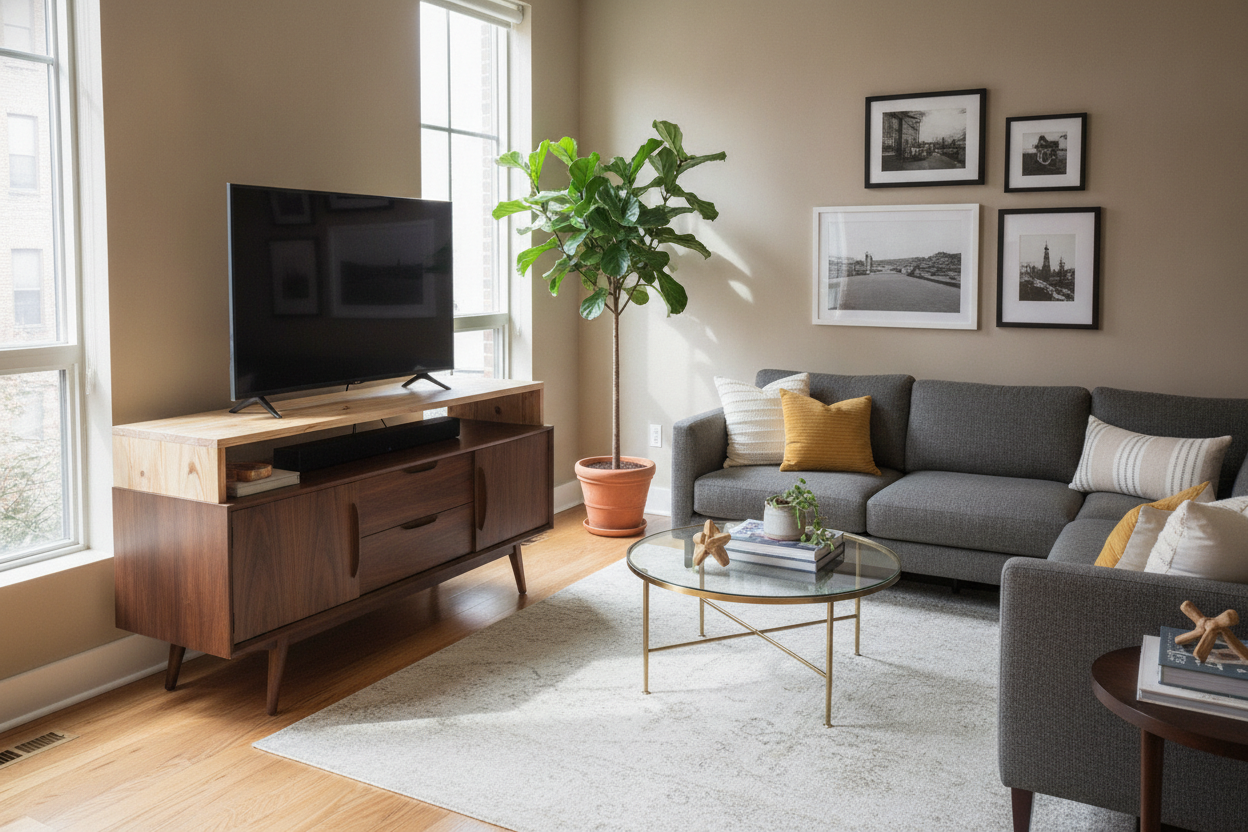
I spent three months scouring Facebook Marketplace for the perfect mid-century teak credenza. When I finally found it—tapered legs, original brass pulls, and that honey-colored glow—I swore I’d never part with it. Then I bought a 65-inch flat screen. Suddenly, my living room looked less like a curated sanctuary and more like a tech-store clearance aisle. The screen was so low that I had to slouch on my sofa just to see the bottom third of the frame, and the massive base of the television completely swallowed the beautiful wood grain of my console. I almost considered selling the credenza, but then I discovered the humble tv riser.
- Height is Everything: A riser brings your screen to eye level, preventing neck strain and making the room feel more intentional.
- Save Your Furniture: You don't have to ditch a vintage piece just because modern tech wasn't designed for its height.
- Hidden Storage: The gap created by a riser is the perfect spot for a soundbar or streaming devices.
- Renter Friendly: No drilling, no plaster dust, and no security deposit drama.
The Awkward 'New Tech, Old Furniture' Dilemma
The problem with vintage furniture is that it was designed for a different era of domestic life. Back in the 1960s, a 'big' TV was a wooden box the size of a microwave. My credenza is only 26 inches tall, which is perfect for a record player, but disastrous for a modern 4K display. When I set the new TV down, the center of the screen sat well below my natural line of sight. I felt like I was looking down into a pit every time I tried to watch a movie. It felt cluttered, mismatched, and frankly, cheap.
I spent hours looking at new media consoles, but everything felt like a downgrade. Most modern units are made of particle board that off-gasses for weeks, and the solid wood options were easily $1,200. I realized I didn't actually need to buy a whole new console just to fix a minor height issue. Instead of replacing the furniture, I started looking for television riser stands. You can get a TV stand riser for 55 inch TV or larger screens that bridge that gap between vintage charm and modern ergonomics without breaking the bank.
Why I Completely Ruled Out Wall Mounting
Everyone told me to just mount the TV on the wall. In theory, that sounds great. In reality, I live in an apartment with crumbly plaster walls that have been painted over about fifteen times since the Nixon administration. I’ve seen enough 'wall mount fails' on Reddit to know that my heavy 65-inch screen would likely take a chunk of the wall down with it. Plus, there is the cord situation. Unless you’re prepared to cut into the drywall to hide cables, you’re left with a black plastic tail dangling down to your console. It’s a mess.
Choosing a tv platform riser or simple blocks to raise tv legs was the only logical path. It’s a damage-free solution that keeps the TV mobile. If I want to rearrange the room next month, I just pick up the TV and the riser. No holes to patch, no paint to match. Using tv riser blocks is essentially the 'lazy' solution that actually looks better in the end because it keeps the technology grounded on the furniture rather than floating awkwardly in mid-air.
Finding a Riser That Doesn't Look Like Office Supplies
The biggest hurdle was finding a riser that didn't look like it belonged in a cubicle. A lot of the early options I found were made of cheap, perforated silver metal or that flimsy clear plastic that scratches if you even look at it wrong. If you’re trying to maintain a specific aesthetic, you have to be picky about materials. I wanted something that felt like a natural extension of the furniture, not a temporary plastic booster seat.
I eventually found that a sleek black tv riser in tempered glass or powder-coated steel disappears into the shadows of the TV's bezel. If your furniture has a warmer tone, a wood tv riser shelf is the way to go. I’ve seen some brilliant DIY versions using furniture risers for tv stand legs, but for most people, a solid one-piece riser is more stable. I opted for a 42-inch wide version to accommodate the wide-set feet of my screen. It’s sturdy, doesn't wobble when the dog runs past, and actually makes the TV look like it was custom-fitted for the room.
The Unexpected Bonus: Sneaky Tech Storage
Once the riser was in place, I realized I had accidentally solved my biggest pet peeve: cord clutter. By using a riser shelf for tv, you create a four-inch cubby directly underneath the screen. This is prime real estate. Before, my soundbar was sitting awkwardly in front of the TV stand, partially blocking the remote sensor. Now, it slides perfectly into the gap under the riser.
I also managed to tuck my Apple TV and a small HDMI switcher into that same space. It’s like a secret compartment for all the ugly black boxes that usually clutter up the top of a dresser. If you're using a tv table riser on a bedroom dresser, this gap is also great for holding a jewelry tray or your remote collection. It’s one of those rare instances where adding more 'stuff' to a setup actually makes it look cleaner and more organized. Even a small tv riser can provide enough clearance to hide a tangled mess of power strips behind it.
When a Riser Isn't Enough (And It's Time to Upgrade)
As much as I love a good hack, I have to be honest: a tv height extender has its limits. I once tried to put a 75-inch monster on a small riser meant for a computer monitor, and the physics just didn't work. If your TV’s feet are hanging off the edges of the riser, or if the riser is bowing in the middle like a wet noodle, you are asking for a shattered screen. Safety has to come before style.
If your current console is so narrow that the TV legs are dangerously close to the edge, or if the piece is an antique that’s already sagging under its own weight, it’s time to look at dedicated TV stands. There is no shame in admitting that a piece of furniture has met its match. If you need something that handles the weight of a massive screen while still offering that mid-century look, a modern TV stand with cabinets can give you the height you need with the structural integrity you actually want. Don't risk a $1,000 electronics investment on a $40 fix if the foundation isn't solid.
FAQ
Will a TV riser make my setup wobbly?
Not if you choose one with a weight rating that exceeds your TV. Look for tempered glass or solid steel. Avoid the 'stackable' plastic blocks if you have a large, top-heavy screen; those are better for smaller monitors or lightweight displays.
How high should my TV actually be?
The general rule is that your eyes should be level with the middle of the screen when you're sitting in your usual viewing spot. For most sofa setups, this means the base of the TV should be between 24 and 30 inches off the floor. If your credenza is low, a 4-5 inch riser usually hits the sweet spot.
Can I use a riser for a TV with a center pedestal base?
Yes, and it’s actually easier. Since the weight is concentrated in the center, you can use a shorter, more compact riser. Just make sure the depth of the riser is at least two inches deeper than the pedestal base to prevent it from tipping forward or backward.

Laisser un commentaire
Ce site est protégé par hCaptcha, et la Politique de confidentialité et les Conditions de service de hCaptcha s’appliquent.