


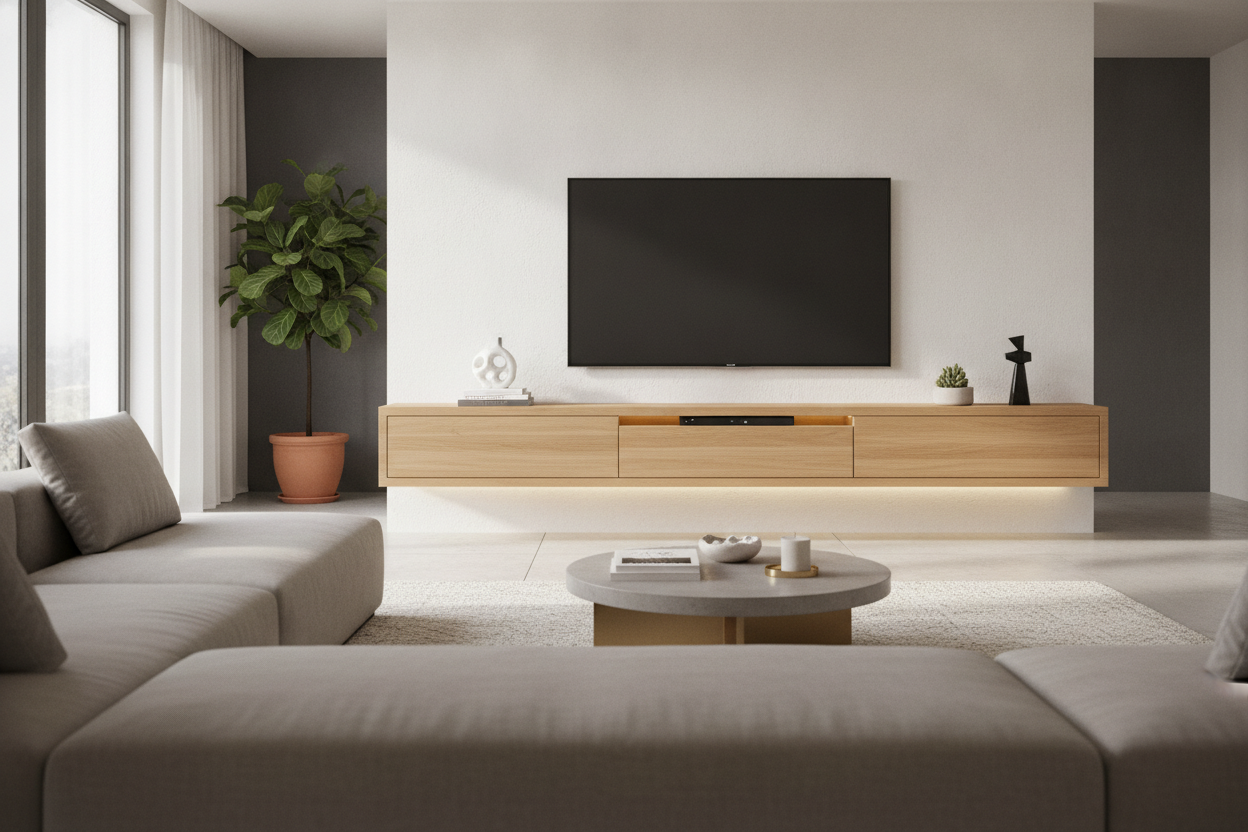
I spent three weeks staring at 47 browser tabs of media consoles, trying to figure out why my living room felt so cramped. My old unit was a 70-pound block of espresso-stained particle board that sat like a lead weight against the wall. It wasn't just ugly; it was a vacuum for light and space. Switching to a contemporary floating tv stand was the architectural equivalent of opening a window in a stuffy room. It changed the entire geometry of my apartment by doing one simple thing: showing me the floor again.
- Floor Visibility: Revealing the baseboards makes a small room feel instantly deeper.
- Height Control: You can mount it at your exact eye level, not the manufacturer's.
- Cable Stealth: Floating units require a cable management plan, or the illusion is ruined.
- Material Balance: Wood tones prevent a wall-mounted unit from looking like a piece of office equipment.
Why Your Floor Console Is Making the Room Feel Tiny
The problem with traditional floor-bound TV stands isn't just their footprint; it's their visual weight. When a piece of furniture sits directly on the floor, your brain registers that entire area as 'occupied.' It creates a hard boundary that stops the eye. In a standard 12x14 living room, a deep floor console can eat up nearly 10% of your perceived floor space. It’s a heavy, grounded presence that makes the walls feel like they’re closing in.
I’ve found that most people buy consoles that are far too deep for their needs. We’re not storing 300-pound CRT televisions anymore. Modern OLEDs are thinner than a stack of pancakes, yet we still use furniture designed for the technology of 1998. When you eliminate those legs and that bulky base, you break the 'visual anchor.' The room feels lighter because the floor continues all the way to the wall, giving your eyes more 'runway' to travel across. It’s a simple trick of spatial planning that works every single time.
The 'Airflow' Effect of a Contemporary Floating TV Stand
Architects often talk about 'airflow,' but not the kind that comes from a vent. It’s about the movement of light and sightlines. A floating tv stand modern design creates a gap between the furniture and the floor that allows shadows to dissipate. This 'negative space' is what makes a room feel airy. It also makes cleaning a breeze—no more moving a 100-pound oak beast just to get the dust bunnies that have been colonizing the space behind it for two years. My Roomba can actually do its job now.
Beyond the cleaning perks, the airflow effect allows you to layer your lighting. I’ve seen some incredible setups where people run a simple LED strip along the bottom of the floating unit. This 'under-glow' makes the unit look like it’s actually hovering and adds a layer of soft, indirect light that makes movie night feel significantly more cinematic. It’s about creating a sense of depth in a flat, 2D space. When you can see the rug extending under the TV, the room doesn't just look wider—it feels more intentional.
Softening the Look with a Floating TV Stand Wood Finish
The biggest risk with wall-mounted furniture is that it can look a bit 'clinical' or like it belongs in a tech startup's lobby. To avoid this, I always lean toward a floating tv stand wood finish. Natural grain brings a necessary organic warmth to the room, balancing out the cold, black glass of the television screen. If you're investing in solid wood furniture, you're getting a piece that won't bow under the weight of your soundbar or look like cheap laminate after six months.
I personally prefer walnut or white oak for these units. Walnut offers a mid-century vibe that feels sophisticated, while white oak keeps things bright and Scandinavian. The key is to look for a unit with a continuous grain across the front panels. It makes the piece look like a custom architectural installation rather than something you just bolted to the drywall. It’s that touch of nature that keeps a modern room from feeling like a laboratory.
How to Actually Style Modern Floating TV Shelves
Once the unit is on the wall, the temptation is to cover it in stuff. Don't. Styling modern floating tv shelves requires a 'less is more' philosophy. Because the unit is elevated, any clutter on top feels twice as messy. I follow the rule of thirds: one-third of the surface can have decor, while the rest should remain clear to maintain that sense of lightness. A single matte ceramic vase or a small stack of linen-bound books is usually enough to make it feel 'lived in' without looking like a junk drawer.
If you find that a single floating shelf looks too small for your wall, you might want to look into larger multi-piece entertainment centers. These can frame the TV with overhead cabinets or side piers, providing much more storage for things like board games or extra tech while still maintaining that 'off-the-floor' look. The goal is to create a cohesive visual block that feels integrated into your home's architecture, rather than just a lone shelf hanging in the middle of a vast white wall.
Does a Floating TV Stand Modern Design Work With Older Homes?
There is a common misconception that sleek, wall-mounted furniture only belongs in glass-walled condos. In my experience, a floating tv stand modern unit is actually the perfect foil for a 1920s bungalow or a Victorian-era home. The clean, horizontal lines of the stand provide a sharp contrast to traditional elements like heavy crown molding or intricate wainscoting. It’s a way of signaling that the home is being lived in by someone with a contemporary eye.
Specifically, mid-century modern floating units are the ultimate bridge between eras. They use the same warm wood tones found in historic flooring but apply them to a silhouette that feels fresh. If you have 10-inch high baseboards, a floating stand is actually the only way to show them off. Why hide beautiful, original woodwork behind a bulky floor console? Lift the furniture up and let the house’s original character be the star of the show.
My Personal Lesson: The Cable Waterfall
I’ll be honest: my first attempt at a floating stand was a disaster. I bought a beautiful walnut unit, spent two hours finding the studs, leveled it perfectly, and then realized I had six black cables dangling down like a technological waterfall. It looked terrible. I ended up having to buy a cord concealer kit and eventually cut into the drywall to install a recessed 'bridge' outlet. If you aren't prepared to hide the wires, don't buy a floating stand. The 'magic' of the piece depends entirely on the absence of visible tech clutter. Also, check your wall for bows; if your wall isn't perfectly flat, a long floating unit will highlight every single curve.
FAQ
Is it safe to mount a TV stand on drywall?
Only if you hit the studs. I never recommend using just drywall anchors for something this heavy. If your studs don't line up with the mounting holes, use a mounting board or heavy-duty toggle bolts, but studs are the gold standard for safety.
How high should I mount my floating stand?
The sweet spot is usually 10 to 14 inches off the floor. You want the center of your TV to be at eye level when you're sitting on your sofa. If you mount it too high, you'll end up with 'bedroom neck' from looking upward.
Can a floating stand hold a heavy gaming console?
Absolutely, provided it's built from quality materials. Most well-made units are rated for 50-100 lbs. Just make sure you aren't blocking the ventilation for your PS5 or Xbox, as these units can sometimes trap heat if they don't have enough clearance.


Laisser un commentaire
Ce site est protégé par hCaptcha, et la Politique de confidentialité et les Conditions de service de hCaptcha s’appliquent.