

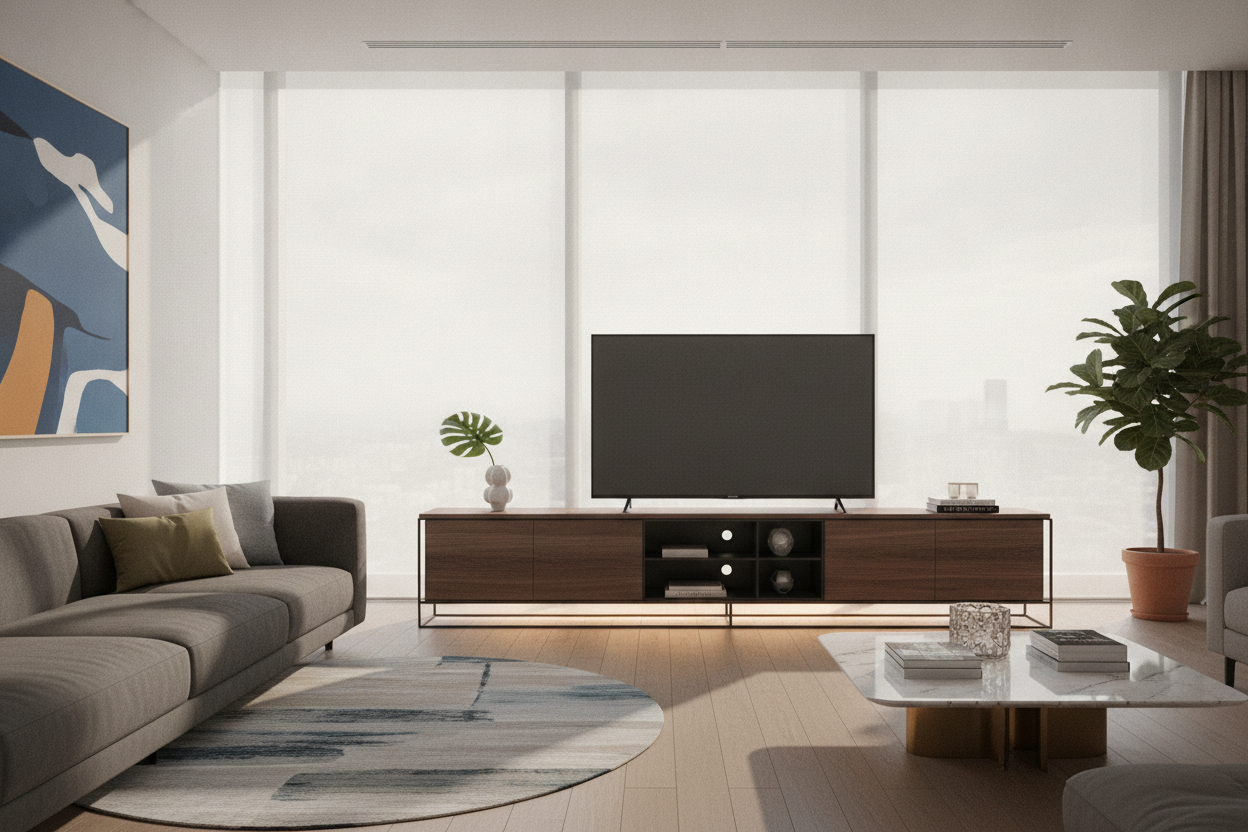
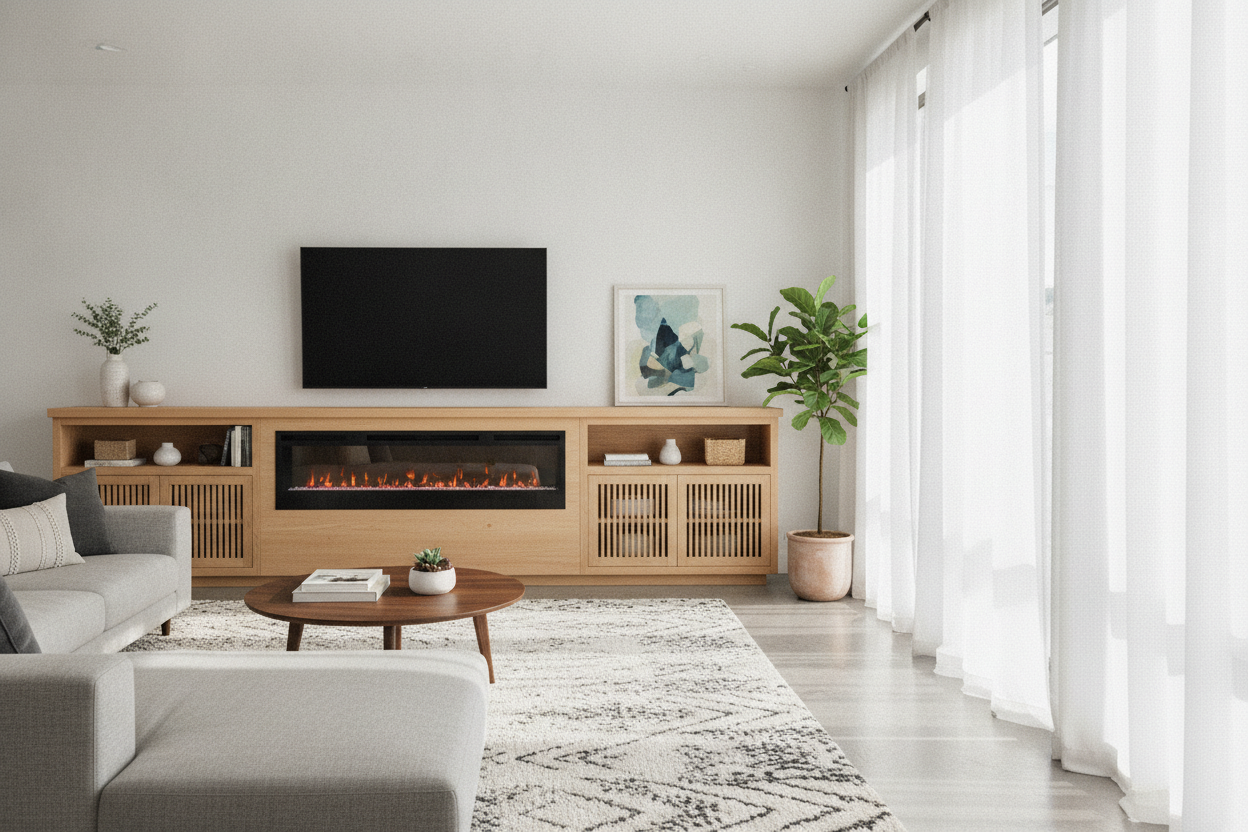
A CRT TV stand needs to do four things: carry a listed weight capacity well above the TV's weight plus everything else on top, give the TV's feet a top deep enough that the front of the set doesn't hang over the edge, sit low and stable, and let you push the TV back and strap it in place. Tube TVs are heavy and front-heavy: in a CPSC staff report, the 32-inch CRT TVs tested weighed between 106 and 163 lb, against 18.75 lb for a 32-inch flat screen (CPSC, TVs: Tipping the Scale to Safety).
Below: real CRT weights and depths from the makers' manuals, the arithmetic to check a stand against your set, what to avoid, how to move a tube TV safely, and four low, high-capacity stands from the FUFU&GAGA entertainment center collection, with the limits of each one spelled out.
Key takeaways
- Weight: TV plus consoles and decor, compared with the stand's listed capacity, with real headroom.
- Depth: the 20- to 36-inch sets in the table below are 18 7/8 to 24 7/8 inches deep overall. All of the TV's feet must sit on the top, with the front of the TV level with or behind the front edge.
- Low and stable: CPSC advises a low, stable piece of furniture for a large, heavy CRT; its report flags dressers and bookcases as unsuitable.
- Push back and strap: TV pushed back, strapped to the stand, stand anchored to the wall.
- Moving: Sony's manuals say to use two or more people; never open the case.
How heavy is a CRT TV?
The CPSC report found that the 19-inch CRTs it tested weighed 40 to 60 lb, the 27-inch sets 76 to 94 lb and the 32-inch sets 106 to 163 lb, and notes that in the 1990s the average main TV set was 27 inches, with these TVs weighing anywhere from 75 to 150 lb, depending mainly on the weight of the picture tube.
The makers' operating manuals give exact figures for individual models. Here are seven Sony and JVC sets:
| CRT TV (maker's manual) | Screen | Width | Height | Depth | Weight |
|---|---|---|---|---|---|
| Sony KV-20FS120 | 20 in | 24 7/8 in | 18 3/8 in | 19 1/4 in | 55 lb 9 oz |
| Sony KV-24FS120 (same manual) | 24 in | 28 1/4 in | 20 3/4 in | 18 7/8 in | 72 lb 5 oz |
| JVC AV-27D501 / AV-27D201 | 27 in | 29 5/8 in | 23 1/4 in | 19 1/2 in | 78.1 lb |
| JVC AV-32D501 / AV-32D201 | 32 in | 33 7/8 in | 27 in | 21 5/8 in | 114.4 lb |
| Sony KV-32FS120 | 32 in | 35 3/8 in | 27 3/8 in | 22 5/8 in | 165 lb 6 oz |
| JVC AV-36D501 / AV-36D201 | 36 in | 37 7/8 in | 30 1/2 in | 24 1/2 in | 149.6 lb |
| Sony KV-36FS120 (same manual) | 36 in | 38 3/4 in | 30 1/2 in | 24 7/8 in | 216 lb 15 oz |
Same-size sets differ a lot: the two 32-inch sets above are 165.4 - 114.4 = 51 lb apart. Look up your own model number, printed on the back of the set.
Why CRT TVs tip forward
CPSC staff explain that CRT TVs are heavier toward the front because of the weight of the cathode-ray tube, which makes them prone to falling forward if tilted past their stability point. The same report lists the setups that go wrong most often:
- Furniture not built for a TV. Incident reports describe CRTs on furniture with multiple drawers that isn't designed to support large CRT TVs. A TV on top of a dresser shifts the center of gravity forward, and a child climbing open drawers adds more weight at the front.
- Tops that are too small. A large CRT that doesn't sit well on a small surface can leave one of its feet unsupported, so the slightest movement can topple it.
- Height. CPSC's consumer advice is to place TVs on low surfaces, and if you have a large, heavy CRT, on a low, stable piece of furniture.
In CPSC's drop tests the average maximum impact force for 32-inch CRT TVs dropped 36 inches was 12,703 pounds.
How to check a CRT TV stand: weight, depth, overhang, height
1. Weight: TV plus everything on top vs listed capacity
Add the TV's weight from its manual, the consoles, receiver or VCR you plan to keep on the same piece, and any speakers or decor. Then compare the total with the stand's listed weight capacity. Example with the 32-inch JVC above and, say, 20 lb of consoles and a receiver:
- 114.4 + 20 = 134.4 lb on the stand.
- On a stand listed at 150 lb: 134.4 / 150 = 90% of capacity, only 15.6 lb to spare. Too tight.
- On a stand listed at 300 lb: 134.4 / 300 = 45% of capacity, 165.6 lb to spare.
Two things a capacity figure doesn't tell you: whether it covers the top alone or the whole unit, and how the load is spread. A CRT puts its whole weight on a few feet in one spot. When a listing doesn't say, ask the seller before you load it.
2. Depth: TV depth vs top depth
A manual's depth is the whole case, including the back of the cabinet. What has to fit on the top is the TV's base: measure from its front feet to its rear feet with a tape. Then compare both numbers with the stand's depth:
- Sony 20-inch, 19 1/4 inches deep, on a 15.7-inch-deep top: 19.25 - 15.7 = 3.55 inches of case past the back edge, if the front is flush.
- JVC 32-inch, 21 5/8 inches deep: 21.625 - 15.7 = 5.9 inches past the back.
- Sony 36-inch, 24 7/8 inches deep: 24.875 - 15.7 = 9.2 inches past the back. If the base is deeper than the top, choose a deeper stand.
The makers' own stands give a sense of scale. Philips built matching floor stands for its CRT sets: the ST288720, designed to match Philips 28PW models, is 487 mm (19.2 in) deep and 514 mm (20.2 in) high (Philips ST288720 leaflet), and the ST329520, designed to match 32PW models, is 467 mm (18.4 in) deep and 534 mm (21.0 in) high (Philips ST329520 leaflet). Both are deeper than the 15.7-inch tops on most of the stands in our picks below.
3. Overhang: front never, back only with a gap
Put the TV so its front is level with the front edge of the stand or set back from it, never sticking out over the edge, and every foot is fully on the top. CPSC's advice is to place TVs on a sturdy, low base and push the TV back as far as possible, particularly if anchoring is not possible (CPSC, 2023). If the case is deeper than the top, the extra hangs off the back, so pull the stand away from the wall by at least that amount, plus air space, and keep the rear vents clear.
4. Height and width
CPSC's advice is to place TVs on low surfaces. The two Philips stands above are about 20 to 21 inches tall; the lowest picks below are 11.8 to 15.4 inches. For width, the stand's top should be wider than the TV, with the consoles beside it rather than on top: the Sony manual says not to place any objects, especially heavy objects, on top of the set.
Glass tops, open shelves and stands with wheels
- Glass tops: avoid them for a CRT unless the listing gives a weight rating for that glass top. Philips' own CRT stands put the TV on a painted MDF top plate and used clear glass only for the shelves that hold peripheral devices.
- Shelves inside a cabinet or open bay: a unit's capacity may not apply to a single shelf. Put the TV on the top or a fixed deck the listing rates, not on an adjustable shelf resting on pins.
- Carts and casters: a rolling cart is handy for light-gun games, but JVC's manual warns not to roll a cart with small casters across thresholds or deep pile carpets, and that quick stops, excessive force and uneven surfaces may cause the TV and cart to overturn. Lock the casters and move it slowly, or not at all with the TV on it.
- Sag: lay a straightedge across the top with the TV on. Light under the middle means it is bending; take the TV off.
Ventilation: don't box in a tube TV
JVC's manual says a TV's ventilation openings let out the heat generated during operation. Sony's manual says the slots and openings in the cabinet, back and bottom are for ventilation and must never be blocked or covered, and to never place the set in a confined space such as a bookcase or built-in cabinet unless proper ventilation is provided. JVC's says the same about built-in enclosures and adds never to place the set near or over a radiator or heat register. In a TV opening or entertainment center, leave open air above and behind the set, and keep consoles on their own shelf.
Anchoring and straps
CPSC's report recommends securing the TV to the furniture with straps, brackets or braces to keep it from sliding, and securing top-heavy furniture to the wall. Its 2023 release adds: anchor TVs and furniture securely to the wall, and avoid storing toys and remotes where kids may be tempted to climb to reach them. Use a TV safety strap kit that fits your set and whose weight rating covers it. Each pick below says whether the listing includes a tipover restraint; if it doesn't, buy an anti-tip kit. Our guide on how to anchor a bookcase to the wall covers studs and straps, and a TV stand is anchored the same way.
Moving a CRT TV safely
- Two people at least. Sony's manual: "Always use two or more people to lift or move the set. The set is heavy and the bottom surface is flat." It warns that serious injury can result from moving it alone or from unsteady handling.
- Never open the case. JVC's manual says not to remove the rear cover, that there are no user-serviceable parts inside, and that opening or removing covers may expose you to dangerous voltage. Leave repairs and recapping to a qualified technician.
- Disposal: JVC warns that improper disposal could result in a picture tube implosion and to ask a qualified service technician to dispose of the set. CPSC suggests recycling CRT TVs you no longer use.
Is a DIY CRT TV stand a good idea?
It can be, if it is built for the load and passes the same four checks. Wedging a post under a sagging flat-pack console doesn't give you a rated capacity, and the listing's figure no longer describes the modified piece. Sony's and JVC's manuals say to use only a cart or stand recommended by the TV's maker, so an original matching stand is the first choice. Whatever you use, make it low, wider and deeper than the TV's base, level, and anchored.
A used 90s cabinet is another route: they were built around tube TVs. Our 90s entertainment center guide covers what to check before buying one, from swollen particleboard to loose back panels.
CRT TV stand checklist
- Find your TV's model number and its weight and depth in the maker's manual.
- Total the TV, consoles and decor; compare with the stand's listed capacity and keep a wide margin.
- Measure the TV's base, front feet to rear feet; it must fit fully on the top.
- Front of the TV level with or behind the front edge; no front overhang.
- Rear overhang only with the stand pulled out from the wall and the vents clear.
- Choose a low stand; no dressers, bookcases or tall chests.
- No glass top or adjustable shelf unless the listing rates it for the load.
- Strap the TV, anchor the stand, and keep remotes and toys off the top.
- Two people to lift; never open the case.
Our picks: low, high-capacity stands for a CRT TV
No FUFU&GAGA stand is sold as a CRT stand, and none is rated for a specific CRT. These are the pieces in our range with the highest listed capacities, low tops or the most depth. Sizes, capacities and hardware come from each listing.
106.3" Modern Minimalist Wide TV Stand with Adjustable Width
The highest listed capacity among our low stands: 300 lb, on a top 15.7 inches deep and 15.4 inches high (on 2.4-inch legs), 106.3 inches wide with an expandable design that adjusts the width. Three drawers on metal slides and two shelves hold consoles and controllers beside the TV. Black or white.
Best for: a 27- to 32-inch set with a row of consoles, where you want plenty of weight headroom on a low top.
Skip it if: your TV's base is deeper than 15.7 inches, or you have a 36-inch set. The photos show the top in sections at slightly different heights, so the TV's feet must all sit on one flat section. No tipover restraint is included; add an anti-tip kit and a TV strap.

71" Minimalist High Gloss TV Stand with LED Ambiance
The lowest top in this list: 11.8 inches high, 70.9 inches wide and 15.7 inches deep, with a 150 lb weight capacity. Four large drawers on metal slides with safety stops hold game consoles and controllers, and a plug-in LED strip lights the base in three colors. One person can assemble it.
Best for: a 20- to 27-inch set in a bedroom or game room, close to the floor.
Skip it if: your TV plus consoles comes near 150 lb. The 32-inch JVC above (114.4 lb) with 20 lb of gear would use 90% of it, and the 32-inch Sony (165.4 lb) is over it on its own. No tipover restraint is included.
90.6" Modern Farmhouse TV Stand with Glass Doors and 10 Storage Compartments
The deepest stand in our range: 19.7 inches deep, 90.6 inches wide and 31.4 inches high, with a brown wood-grain melamine top over a white MDF cabinet. That depth holds the whole case of some smaller sets: 19.7 - 19.25 = 0.45 inches to spare for the 20-inch Sony above. Ten storage spaces include three cabinets, four drawers on metal slides and a central glass-door cabinet, with two adjustable shelves and cable openings. A tipover restraint is included.
Best for: a 20- to 27-inch set you want sitting fully on the top, with closed storage for games and media below.
Skip it if: you need a confirmed weight capacity. The capacity in its specs looks low for a stand listed for TVs up to 88 inches and has been flagged for confirmation, so ask customer service for the top's capacity before you put a CRT on it. At 31.4 inches it is also taller than the other picks.

102.4" Modern White TV Hutch Large Entertainment Center with Storage Cabinets
A four-piece CRT TV entertainment center look: a 57-inch-wide console, two tall piers and an overhead bridge, 104.3 inches wide, 82.3 inches high and 17.4 inches deep overall in its specs (the title says 102.4 inches). The listing gives an 800 lb total capacity, includes tipover restraint hardware, and lists 5 drawers on metal slides, 5 cabinets with magnetic catches and 6 interior shelves, with cable management. Four people are recommended for assembly.
Best for: a collector who wants a full wall of shelves for games, boxes and memorabilia around a mid-size tube TV.
Skip it if: you need the console's own capacity or the height of the opening under the bridge. The 800 lb figure is for the whole unit and the specs give neither, so ask before you buy. A deep set will overhang the 17.4-inch depth, and the piers and bridge close in the opening, so leave air above and behind the TV.

Compare the picks
| Pick | Listed capacity | Top depth | Height | Tipover restraint | Best for |
|---|---|---|---|---|---|
| 106.3" wide TV stand | 300 lb | 15.7 in | 15.4 in | Not included | 27-32 in set plus consoles |
| 71" high-gloss stand | 150 lb | 15.7 in | 11.8 in | Not included | 20-27 in set, low |
| 90.6" farmhouse stand | Ask before ordering | 19.7 in | 31.4 in | Included | Whole case on the top |
| 102.4" TV hutch | 800 lb total unit | 17.4 in overall | Console not listed | Included | Collector wall with shelves |
For wider wall units and sizing, see our entertainment center and wall unit buying guide.
FAQ
What kind of stand do you need for a CRT TV?
A low, sturdy stand with a listed weight capacity well above the TV plus everything on it, a top deep enough for all of the TV's feet with no front overhang, and room to strap the TV and anchor the stand. CPSC advises a low, stable piece of furniture for a large, heavy CRT.
How much does a 32-inch CRT TV weigh?
Often more than 100 lb. CPSC's tested 32-inch CRTs weighed 106 to 163 lb, and Sony's manual lists the KV-32FS120 at 165 lb 6 oz. Check your own model's manual.
Can I put a CRT TV on a dresser?
No. CPSC incident reports describe CRTs placed on furniture with drawers that isn't designed to support large CRT TVs, and a TV on a dresser shifts the center of gravity forward. Use a TV stand and anchor both.
Looking for a low, strong base for a tube TV and your consoles? Browse the FUFU&GAGA entertainment center collection, and run the weight, depth and overhang checks above before you choose.

Laisser un commentaire
Ce site est protégé par hCaptcha, et la Politique de confidentialité et les Conditions de service de hCaptcha s’appliquent.