


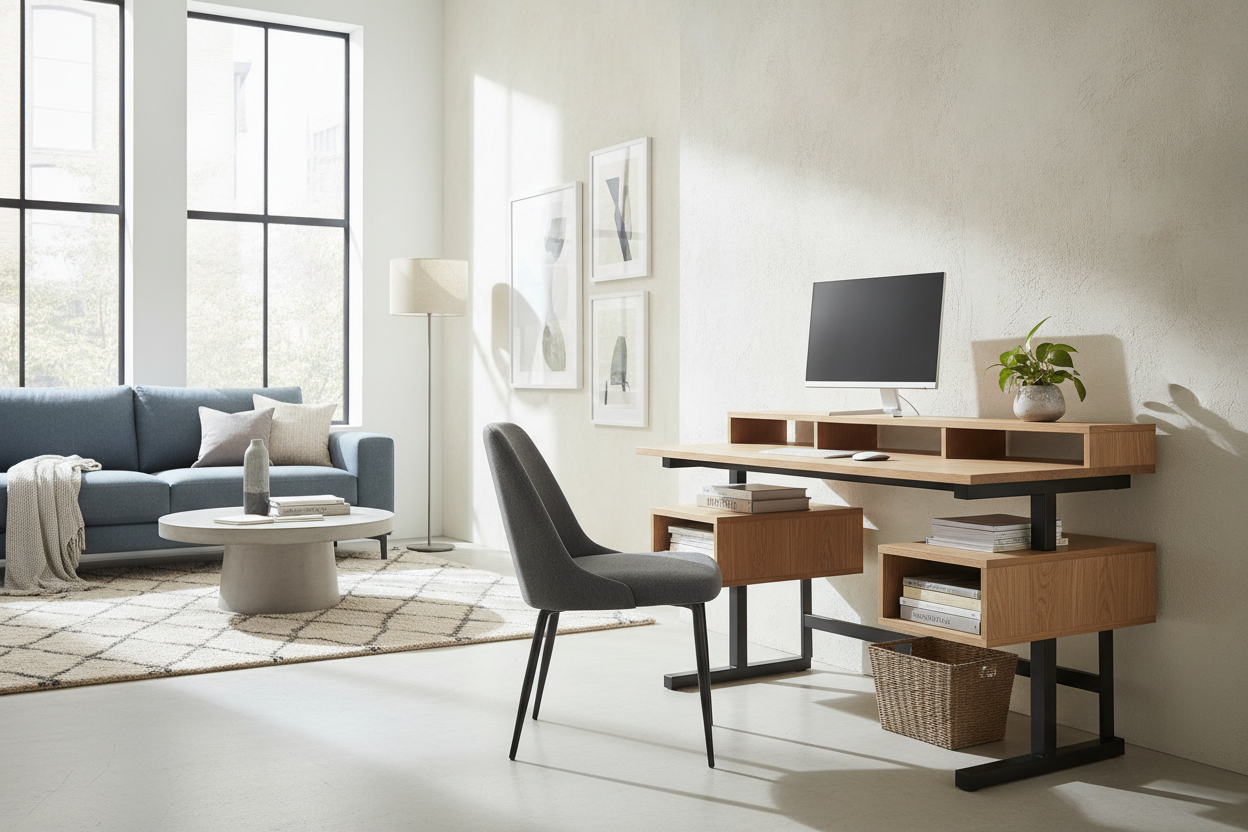
What Is a 2-Leg Desk and How Does It Function?
A 2-leg desk relies on a dual-column support structure rather than the four perimeter corner posts found on traditional tables. Each vertical column connects to a horizontal base foot resting along the floor and an upper mounting bracket that secures the desktop. A central crossbar or structural frame often spans between the two uprights to maintain rigid alignment.
By consolidating floor contact into two balanced points, a desk with two legs eliminates corner obstructions. This configuration allows office chairs to swivel freely without catching armrests or casters on outer table legs. For motorized models, dual uprights often house synchronized lifting columns, making the architecture a standard foundation across modern sit-stand workstations. When evaluating powered variations, consulting a practical buying a standing desk checklist can help clarify motor and frame preferences.
Key Differences Between 2-Leg and Traditional 4-Leg Frames
- Knee and Leg Clearance: Dual-column architecture frees up the entire front boundary of the desk, accommodating wider seating angles and side-to-side leg movement.
- Visual Footprint: With fewer vertical lines breaking up sightlines, a two-legged desk gives rooms an open, airy feeling.
- Modular Adaptation: The open under-desk zone accommodates add-on accessories such as hanging CPU holders, clamp-on modesty panels, and footrests without corner interference.
Comparing Frame Geometries: T-Leg, C-Leg, and Trestle Profiles
The placement of the vertical column along the horizontal foot defines the desk geometry, directly influencing weight distribution and knee room.
T-Frame: Centered Symmetry for Balanced Weight
On a T-frame desk, the vertical column connects directly to the center of the horizontal base foot. This symmetrical balance distributes weight evenly across the front and rear portions of the foot. T-frame desks are well-suited for setups where heavy equipment, such as monitor arms and desktop towers, is distributed evenly across the center line of the worksurface.
C-Frame: Cantilevered Design for Maximum Under-Desk Room
A C-frame shifts the vertical column toward the rear edge of the base foot. This cantilevered approach positions the uprights further back, maximizing open knee clearance and leaving ample room for under-desk footrests, keyboard trays, or deep wire-management troughs. C-frames are popular in compact home offices where users want uninterrupted space to stretch their legs.
Trestle 2-Leg Styles: Aesthetic Elegance for Fixed Workspaces
For static, non-adjustable workstations, trestle-style two legged desk frames offer architectural character. Trestle designs often feature angled or solid slab uprights bridged by a decorative lower stretcher. These designs provide visual warmth and solid floor contact, pairing naturally with natural wood tops and classic interior schemes.
Room Fit and Spatial Planning for a Desk with Two Legs
Choosing the right layout ensures that a two-legged desk complements room traffic while maintaining comfortable seated clearance.
Compact Rooms and Open Walkways
In narrow bedrooms, guest rooms, or multi-purpose spaces, the minimal perimeter framing of a 2-leg desk prevents the workstation from feeling bulky. Because there are no front corner legs, chairs can tuck cleanly beneath the desktop when not in use, preserving precious walkway width.
Wall-Facing vs. Floating Island Placements
Placing a 2-leg desk against a wall is straightforward and allows cables to drop directly down toward wall outlets. When floating the desk in the center of a room, consider using a decorative modesty panel or an enclosed wire spine along one column to keep power runs tidy and maintain a polished look from every angle.
Stability and Structural Considerations for Two-Legged Desks
Because a two legged desk channels all load through dual points, structural engineering plays an essential role in preventing lateral wobble and front-to-back sway.
Managing Lateral and Front-to-Back Sway
Lateral stability depends on the connection between the crossbar and the vertical columns, as well as the thickness of the steel or timber components. A wide base foot prevents front-to-back tipping when applying downward pressure on the front edge of the worksurface. Ensuring all frame bolts remain securely tightened provides dependable, wobble-free support during daily typing and writing.
Leveling Glides and Floor Surface Adaptations
Floors in residential homes are rarely perfectly flat. Most 2-leg desks include adjustable leveling glides beneath each foot. Adjusting these glides eliminates minor rocking on hardwood or tile and accommodates transitions between hard flooring and low-pile area rugs. On adjustable motorized models, keeping the frame level also prevents uneven column wear; if an electronic desk ever desynchronizes due to floor shifts, knowing how to reset standing desk lift mechanisms helps restore smooth, level height transitions.
Storage and Cable Management Strategies for Open 2-Leg Frames
The open base of a two-legged desk creates vast knee space, but it also means built-in drawers are omitted. Integrating modular storage keeps the tabletop clean while preserving the open aesthetic.
Modular Rolling Pedestals and Side Credenzas
A mobile filing cabinet or rolling drawer unit can slide directly beneath one side of a 2-leg desk or sit adjacent to it. For users who prefer expansive built-in cabinetry over modular rolling units, selecting a dedicated l shaped desk with 3 drawers and wood legs offers a comprehensive, all-in-one storage foundation.
Under-Desk Cable Trays and Vertical Wire Spines
With an open under-frame, managing wires is essential to avoid visual clutter:
- Horizontal Cable Trays: Mount a metal or mesh tray to the underside of the tabletop to cradle power strips and adapter bricks.
- Vertical Cable Spines: Route power and peripheral cables down the inner side of a leg column using magnetic clips, adhesive channels, or flexible cable vertebrae.
- Under-Desk Hooks: Use adhesive or clamp-on hooks for headphones and backpack storage to keep accessories off the floor.
Decision Matrix: Choosing the Right 2-Leg Desk for Your Workspace
Selecting the ideal desk involves matching the frame style to your daily equipment needs and room aesthetic:
- Choose a T-Frame if you need balanced weight distribution for centered monitor arms and a neutral visual appearance.
- Choose a C-Frame if you prioritize maximum legroom, plan to install an under-desk keyboard tray, or use deep footrests.
- Choose a Trestle Frame if you want a fixed-height, design-focused centerpiece with architectural wood accents.
- Evaluate Desktop Depth: Ensure the tabletop depth aligns with the length of the base feet to maintain proper stability and prevent tipping.
By balancing frame geometry, room layout, and modular organization, a 2-leg desk delivers an open, adaptable foundation tailored to modern working routines.

Laisser un commentaire
Ce site est protégé par hCaptcha, et la Politique de confidentialité et les Conditions de service de hCaptcha s’appliquent.