


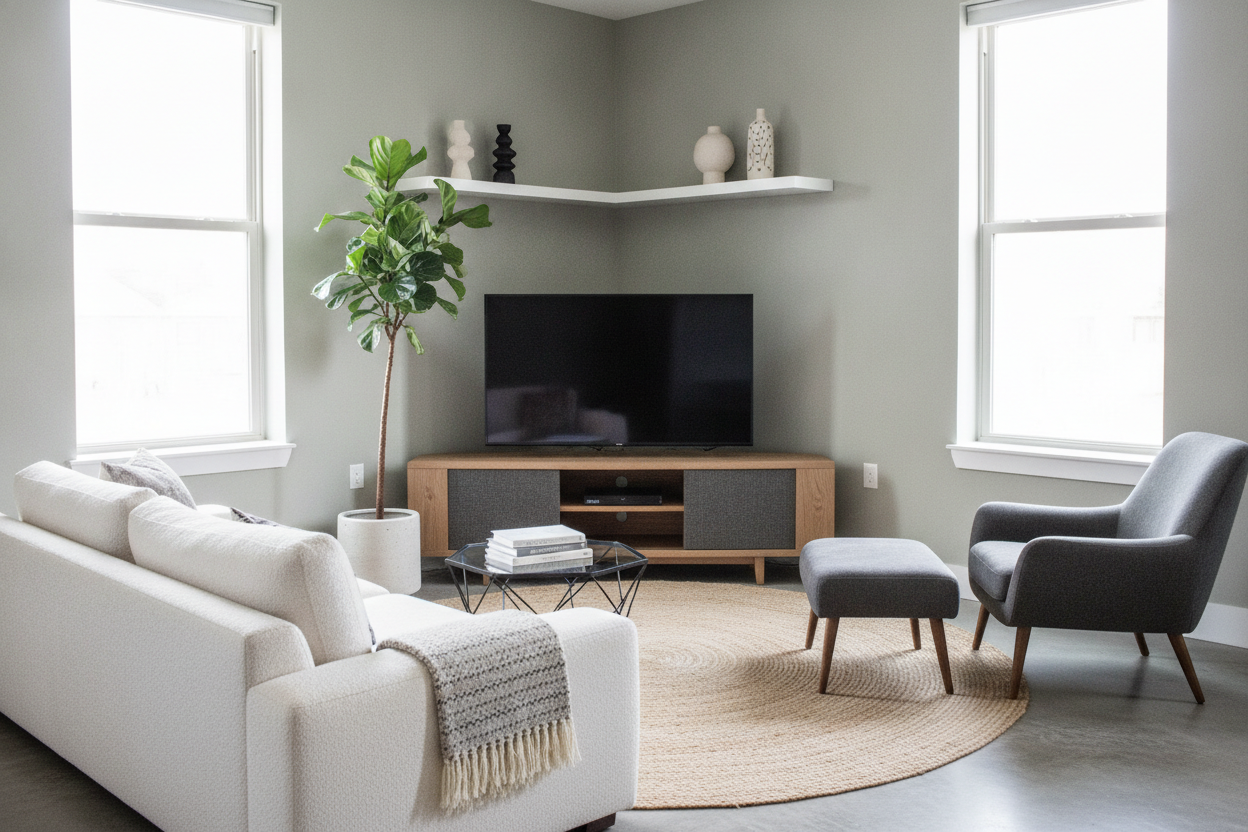
I spent three weeks staring at a blank wall between two massive windows, trying to figure out how to center a 55-inch OLED without it looking like a giant black hole blocking the view. I was obsessed with symmetry. I thought putting a TV in the corner was something only people in 1994 did with those 200-pound CRT sets. But after tripping over my coffee table for the tenth time because of a forced layout, I started looking into corner tv ideas that actually made sense for a modern home.
Quick Takeaways
- Corner placement frees up the 'hero wall' for art or a large sofa.
- Modern corner units are slim and architectural, not chunky like 90s furniture.
- Viewing angles are often better from a corner in narrow or open-concept rooms.
- Cable management is significantly easier in the 'dead zone' behind a corner stand.
The 'Centered TV' Myth (And Why It Was Ruining My Space)
We’ve been conditioned to believe that the TV must be the altar at the center of the room. But if you live in a place with character—think fireplaces, radiators, or floor-to-ceiling windows—that center-stage placement usually blocks the natural flow. In my last apartment, the only 'flat' wall was directly opposite a wall of glass. The glare was unbearable, and the sofa had to sit in the middle of the kitchen walkway just to face the screen. I finally admitted I needed a corner shelf for a TV to stop the furniture from feeling like it was in a permanent state of transit.
By moving the screen to a 45-degree angle, I suddenly had a 12-foot wall open for a massive gallery wall. The room felt four feet wider instantly. We often sacrifice the best parts of our architecture just to accommodate a piece of plastic. Breaking that habit is the first step to a functional layout. When you stop fighting the room's geometry, you realize that ideas for corner tv placement are often the most logical solution for awkward floor plans.
Why We Need to Stop Fearing the Corner
When most people think of a tv corner design ideas, they picture a massive, honey-oak armoire that takes up half the room. We need to move past that trauma. A modern corner tv unit design for living room spaces is about being discreet. We’re talking about powder-coated steel, slim wood veneers, and floating elements that let the floor continue underneath the furniture. This creates the illusion of more square footage.
Corner tv setups today are intentional. They aren't where TVs go to die; they are where they go to be accessible but not dominant. It turns the screen into a part of the room’s texture rather than its entire personality. Plus, from a purely functional standpoint, most of us don't sit perfectly straight when we watch TV anyway—we lounge at angles. A corner setup actually aligns better with how we actually use our sofas.
3 Corner TV Setup Ideas That Don't Look Like an Afterthought
Putting a TV in the corner doesn't mean you're giving up on style. It's about framing. Here are three ways I've seen this work perfectly without making the room look like a waiting room.
The Asymmetrical 'Floating L' Setup
Instead of one heavy piece of furniture, use two floating shelves on adjacent walls. One shelf sits lower to hold the TV and a soundbar, while the other sits higher on the perpendicular wall for books or plants. These living room corner tv wall unit designs draw the eye horizontally across the corner rather than just pointing it into a dark nook. It creates a sense of movement and makes the TV feel like part of a larger composition. Use 2-inch thick solid wood shelves to ensure they can handle the weight without sagging—cheap MDF will bow in six months.
The Art of the Angled Console
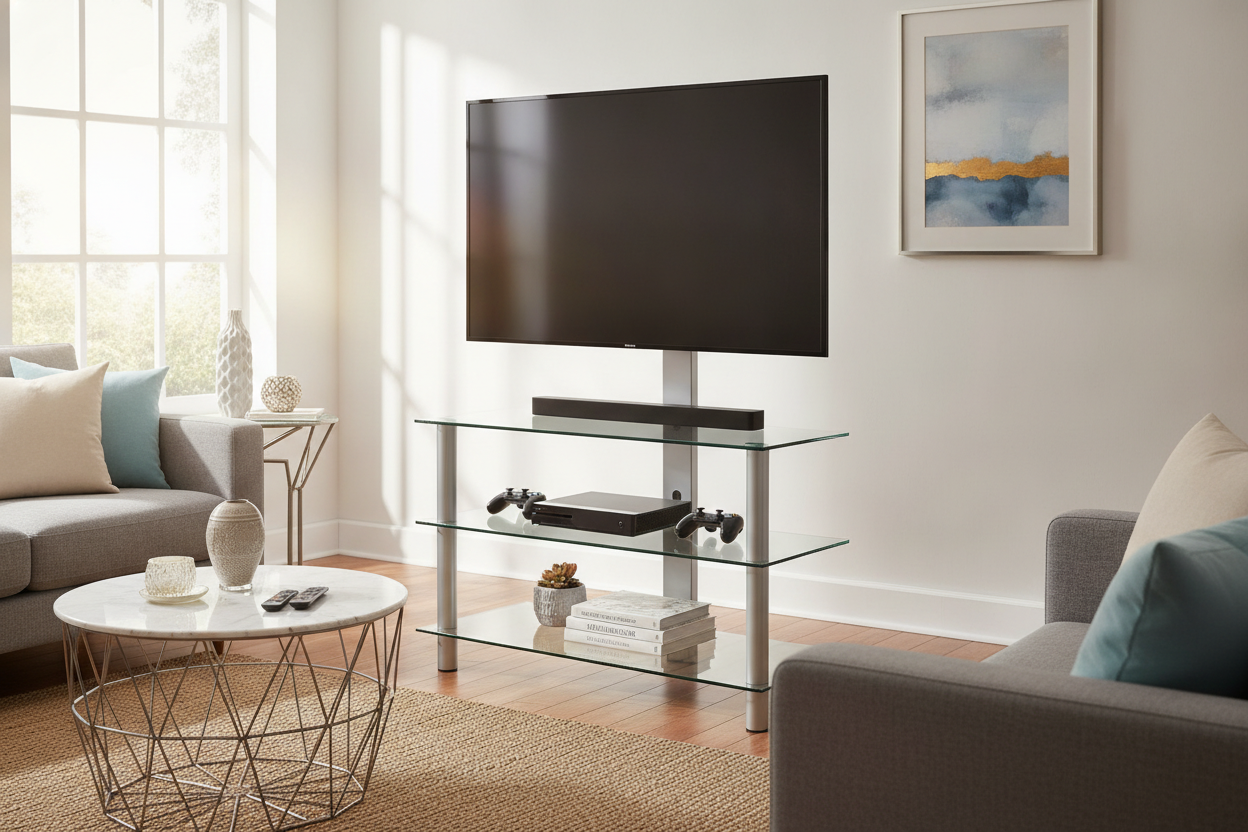
The biggest mistake is shoving a standard 60-inch rectangular console flat against a corner. It leaves a weird triangular gap behind it that collects dust and lost remotes. If your walls aren't perfectly perpendicular, you might need an adjustable TV stand for living room layouts that can pivot to the exact degree you need. Look for a unit with a tapered back. This allows the front of the stand to sit flush with your sightline while the back tucks neatly into the 90-degree intersection. It saves about 15% more floor space than a standard unit.
The Moody Camouflage Method
If you hate the look of a big black screen, paint that corner two shades darker than the rest of the room—think charcoal or a deep navy. I'm a big fan of a black TV stand entertainment center because it turns the 'black box' of the screen into a cohesive design element. When the TV is off, it virtually disappears into the shadows. This is a pro move for small living room corner tv ideas because it prevents the TV from becoming a giant focal point in a tiny space.
How to Measure a Corner Without Losing Your Mind
Measuring for a corner is different than a flat wall. You aren't just measuring width; you're measuring depth and 'projection.' You need to know how far out the corners of your TV will stick. A 55-inch TV is roughly 48 inches wide. When angled at 45 degrees, it will stick out about 34 inches from the very back of the corner. If you have a narrow walkway, that's a problem.
Before you browse modern TV stands, take a piece of blue painter's tape and mark the footprint on your floor. Don't forget the baseboards—they usually add an extra half-inch of clearance you didn't account for. Also, check your viewing height. Because corner TVs often sit slightly further away from the sofa, you might want to lower the stand by 2-3 inches to avoid 'neck tilt.' A 20-inch high console is usually the sweet spot for most standard sofas.
The Verdict: My Living Room Actually Feels Bigger Now
After I moved my setup, the transformation was immediate. I stopped looking at the back of my sofa when I walked in the front door. The corner tv design allowed me to rotate my entire seating arrangement toward the windows and the fireplace, which are the actual features of the room. The TV is there when I want to binge a show, but it’s no longer the first thing guests see. If you’re struggling with a room that feels 'blocked,' stop trying to find the center. The corner might just be the best seat in the house.
FAQ
Is a corner TV bad for your neck?
Not if you place it correctly. The key is to ensure the center of the screen is at eye level when you are seated. Avoid mounting it high in the corner like a sports bar monitor.
How do I hide cables in a corner?
Corner setups are actually the best for cable management. The triangular space behind the stand is the perfect place to mount a power strip and tuck away all those messy HDMI cords where no one can see them.
What size TV works best in a corner?
Usually, a 43-inch to 55-inch screen is the 'Goldilocks' zone for corners. Anything larger than 65 inches starts to cut off too much of the room's usable floor space because of how far it must sit from the wall.

Laisser un commentaire
Ce site est protégé par hCaptcha, et la Politique de confidentialité et les Conditions de service de hCaptcha s’appliquent.