


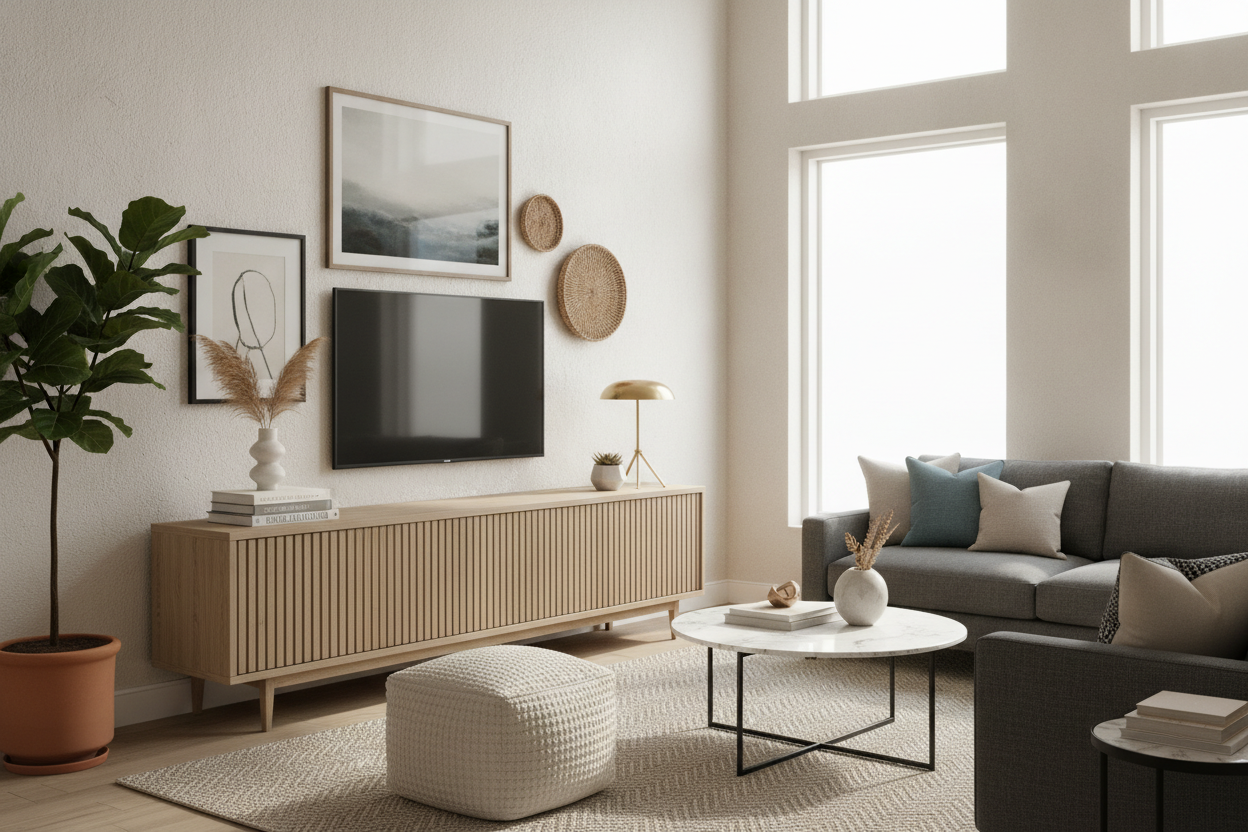
I remember moving into my first 'adult' apartment and realizing my entire living room layout was basically a shrine. I had a sofa, a rug, and a massive media console center that did nothing but hold a TV I barely watched. It felt like I was living in a waiting room for Netflix rather than a home.
We spend thousands on velvet sofas and hand-knotted rugs, only to point them all at a giant black rectangle sitting on a piece of furniture we treat as a utility shelf. It is a waste of a perfectly good piece of wood. Your console should be doing more for you than just keeping your PlayStation off the floor.
Quick Takeaways
- Stop centering your layout entirely on the screen; it kills conversation flow.
- Use your console for 'invisible' storage like linens or barware.
- Balance the TV's harsh lines with asymmetrical art and soft lighting.
- Prioritize ventilation to keep your tech from frying inside closed cabinets.
Why Do We Give the TV So Much Respect?
Most American living rooms are arranged like mini-theaters. We obsess over sightlines and viewing angles as if we are prepping for a Scorsese premiere every Tuesday night. This habit of centering your living room around the home media cabinet often leaves the rest of the room feeling cold and directional.
I once lived in a studio where the console was the only long surface I owned. By treating it strictly as a 'TV stand,' I lost five feet of usable styling space. Break the habit. If your sofa is 84 inches long, your console should be at least 60 to 70 inches to keep the proportions from looking top-heavy, but that doesn't mean the screen has to be the star.
It's Just a Credenza (So Treat It Like One)
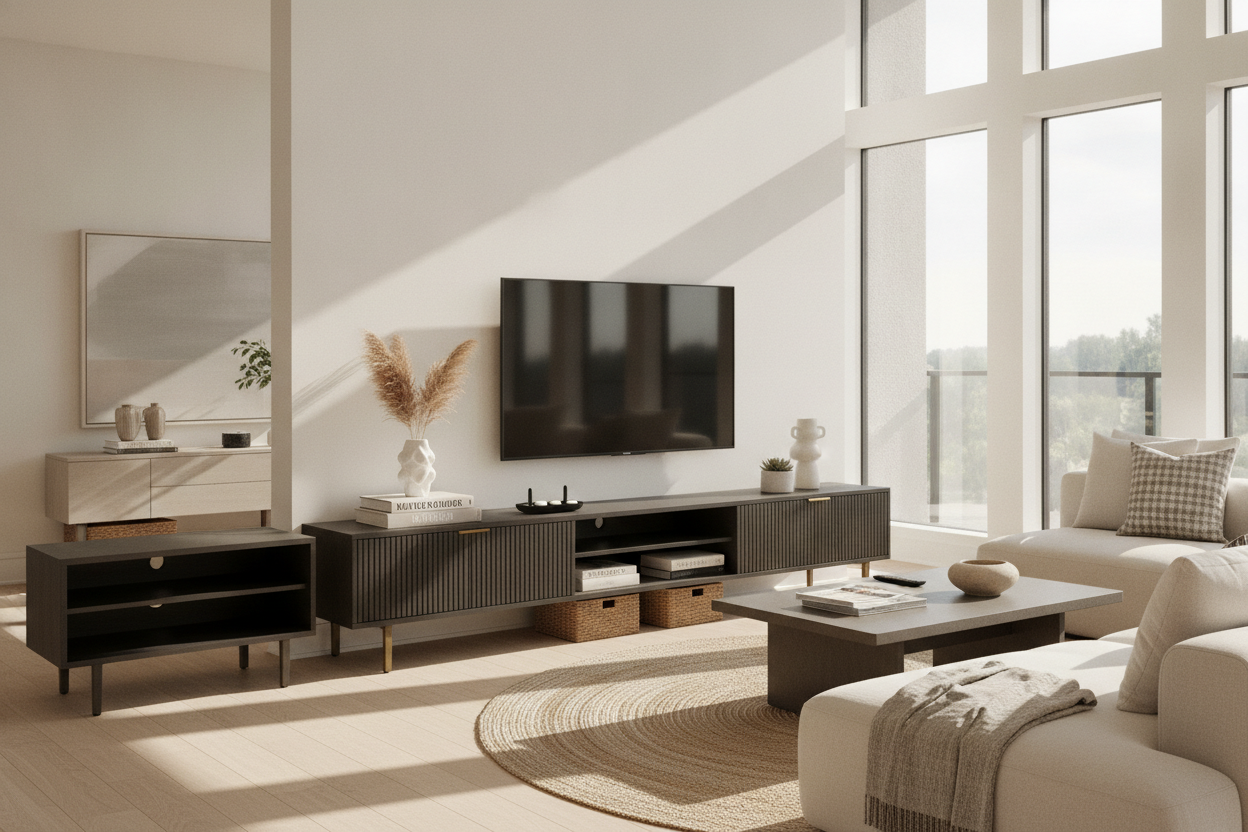
If you stripped the electronics away, that living room media cabinet is really just a low sideboard or a credenza. There is no law stating it can only hold DVDs and remote controls. In my current setup, the left cabinet holds my heavy board games, and the right side stores extra table linens I only use for holidays.
Realizing that your TV console is wasting space is the first step toward a functional home. I have seen people use these units as overflow pantries or even bar carts. If you have solid doors, use that depth for things you actually need to access daily but don't want to see, like bulky binders or that heavy Dutch oven that doesn't fit in your tiny kitchen.
How to Reclaim the Surface Area
A TV is a giant, dark void when it is off. To soften that, you need to layer the surface of the console. I always suggest a small table lamp on one end—something with a warm bulb to provide ambient light that doesn't reflect directly off the glass. It makes the room feel cozy instead of clinical.
Stack three or four thick coffee table books on the other side. It breaks up the long, flat plane of the wood. I also like to lean a piece of art slightly behind the TV or off to the side. By creating an asymmetrical look, the TV becomes just one part of a gallery rather than the undisputed centerpiece. It tricks your eye into seeing a decorated surface instead of just a tech dock.
Hiding the Tech (Because It Still Needs to Work)
The biggest hurdle to the 'credenza look' is the cable nightmare. I have spent hours untangling what I call the 'spaghetti mess' behind my 60-inch oak unit. Use adhesive cable clips to run wires down the legs of the furniture so they aren't visible from the side. It is a ten-minute job that makes a $400 cabinet look like a $2,000 custom piece.
If you are putting consoles or receivers inside closed doors, check the back panel. Many cheap units have a single, tiny hole for cords that provides zero airflow. I actually took a hole saw to the back of my last cabinet to ensure my receiver didn't overheat. If your remotes won't work through the wood, look into an IR repeater—it is a tiny sensor that sits on the edge of the unit and passes the signal through to the hidden gear inside.
Personal Experience: The Wobbly Veneer Mistake
I once bought a 72-inch console made of cheap MDF with a paper-thin 'walnut' finish. It looked great for three months until I spilled a glass of water on it. The 'wood' bubbled instantly, and because the TV was so heavy, the top started to sag in the middle by half an inch. Now, I only buy units with a solid wood frame or at least a high-quality wood veneer on top of plywood. If you are putting a 50-pound TV on something, it needs a center support leg. Trust me on this—don't let your expensive tech end up on the floor because you saved fifty bucks on a flimsy frame.
FAQ
How high should my media console be?
Ideally, your eyes should be level with the middle of the TV screen when you are sitting down. For most sofas, that means a console height of about 22 to 28 inches. Anything higher and you will be crane-necking like you are in the front row of a movie theater.
Can I put a TV on a regular sideboard?
Yes, but check the depth. Sideboards are often 18-20 inches deep, while dedicated media units can be as slim as 14 inches. Also, make sure the back is finished or has cord management holes, otherwise, you will be drilling into your nice furniture.
Should the console be wider than the TV?
Always. Aim for at least 6 to 10 inches of extra space on both sides of the screen. If the TV is wider than the console, the whole room will feel off-balance and top-heavy, like a lollipop about to tip over.

Laisser un commentaire
Ce site est protégé par hCaptcha, et la Politique de confidentialité et les Conditions de service de hCaptcha s’appliquent.