


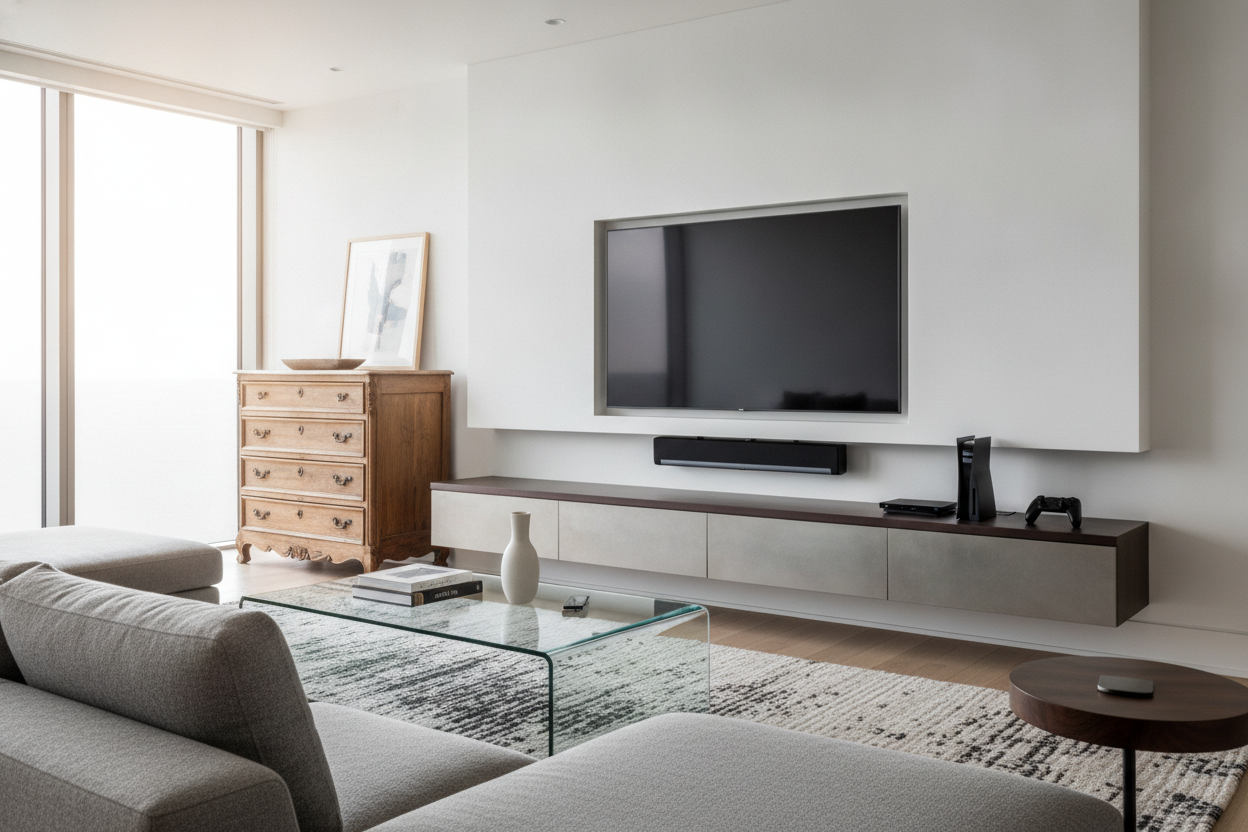
I remember unboxing my first OLED. It was 4mm thick, cost more than my first car, and I immediately plopped it onto a chunky, honey-oak media cabinet I’d hauled around since my first apartment. It looked ridiculous—like a spaceship landing on a log cabin. If you’ve upgraded to a modern tv, your furniture needs to keep up.
We spend hours researching refresh rates and nit brightness, then we put the finished product on a piece of furniture that was designed for a 150-pound CRT. The visual disconnect is jarring. You want your living room to feel intentional, not like a tech graveyard. It is about matching the engineering of the screen with the architecture of the stand.
- The console should be at least 6 to 10 inches wider than the TV on each side.
- Cable management isn't a luxury; it is the whole point of the piece.
- Lower is better—your eyes should hit the center of the screen without tilting your head.
- Mix materials like wood and metal to avoid a 'big box store' aesthetic.
The 'Paper-Thin Screen, Cinderblock Console' Problem
There is a specific kind of sadness in seeing a $2,000 bezel-less screen sitting on a piece of furniture with 2-inch thick MDF walls and brass hardware from 2005. A tv modern setup requires a sense of lightness. When your screen is thinner than a smartphone, putting it on a 'cinderblock' of a console makes the TV look fragile and the furniture look like a relic.
I’ve seen people try to hide the bulk with stacks of books or decorative vases, but it never works. The issue is visual weight. A sleek screen needs a base that feels architectural, not industrial. If your current stand has those weird 'media towers' on the side for DVDs you don't even own anymore, it's time to let go. You're suffocating the tech with furniture that was built for a different era of electronics.
3 Rules for Making Your TV Modern (and Integrated)
First, let's talk about texture. If everything in your media nook is glass and high-gloss plastic, your living room feels like a laboratory. I'm a big fan of using a mid-century modern TV stand with slatted doors. The wood slats provide a vertical rhythm that breaks up the massive horizontal slab of the screen, and they let IR signals through so you can hide your ugly cable box inside.
Second, proportion is king. A 65-inch TV on a 60-inch stand looks top-heavy and anxious. You want breathing room. Give the screen space to exist without hanging over the edges. It’s about balance—learning what designers actually think about retro styles can help you realize that a 1960s silhouette often handles 2024 tech better than anything else because it was designed for slim, elegant lines.
Third, kill the wires. If I see a single black cord dangling like a vine, the whole aesthetic is ruined. Use zip ties, use channels, or buy a console with dedicated routing holes. If the back of your furniture looks like a bird's nest, you haven't finished the job. Modern design is as much about what you hide as what you show.
The Great Debate: Dark vs. Light Consoles
When the TV is off, it’s a giant black rectangle. That is a design fact you can't ignore. A stylish black TV stand entertainment center helps that 'black hole' disappear into the furniture. It’s a trick of the eye that makes the room feel less tech-heavy during the day because the screen and the stand bleed together into one cohesive unit.
On the flip side, white consoles are tempting for that 'Scandi' vibe, but be careful. There’s a reason why modern white TV stands look cheap—it’s usually the finish. If it’s a low-rent melamine that yellows in the sun, it will make your high-end screen look like a budget knockoff. If you go light, go for a matte lacquer or a white-washed oak that shows a bit of soul.
It's Time to Retire the Hand-Me-Down Stand
Your living room usually points at one thing: the TV. It is the focal point whether we like it or not. Stop treating the furniture underneath it as an afterthought or a hand-me-down from your cousin's basement. It’s the anchor of the room. When you finally browse modern TV stands that actually match the scale of your life, you'll realize you weren't just buying a shelf—you were finishing the room.
Personal Experience: My Glossy Mistake
I once bought a high-gloss white floating console because I thought it looked 'futuristic.' Within a week, I hated it. Every speck of dust was visible, and the reflection of the TV screen on the top of the unit was distracting during movies. I ended up selling it and switching to a matte walnut. The wood grain actually made the TV look better by providing a natural contrast to the digital screen. It felt like a home, not a showroom.
FAQ
How high should my TV stand be?
Your eyes should be level with the middle of the screen when seated. For most sofas, that means a console height of 18 to 22 inches. If you're looking up at the screen, your stand is too tall or your TV is mounted too high.
Can I put a 75-inch TV on a 60-inch stand?
Technically yes, if the legs fit, but it will look terrible. It creates a 'lollipop' effect that makes the room feel unstable. Always aim for a stand that is at least 10-20% wider than the TV itself.
Do I need an open or closed console?
Closed is almost always better. Unless you want to dust your PlayStation every three days and stare at a tangle of HDMI cables, hide it all behind some doors or slats.

Laisser un commentaire
Ce site est protégé par hCaptcha, et la Politique de confidentialité et les Conditions de service de hCaptcha s’appliquent.