


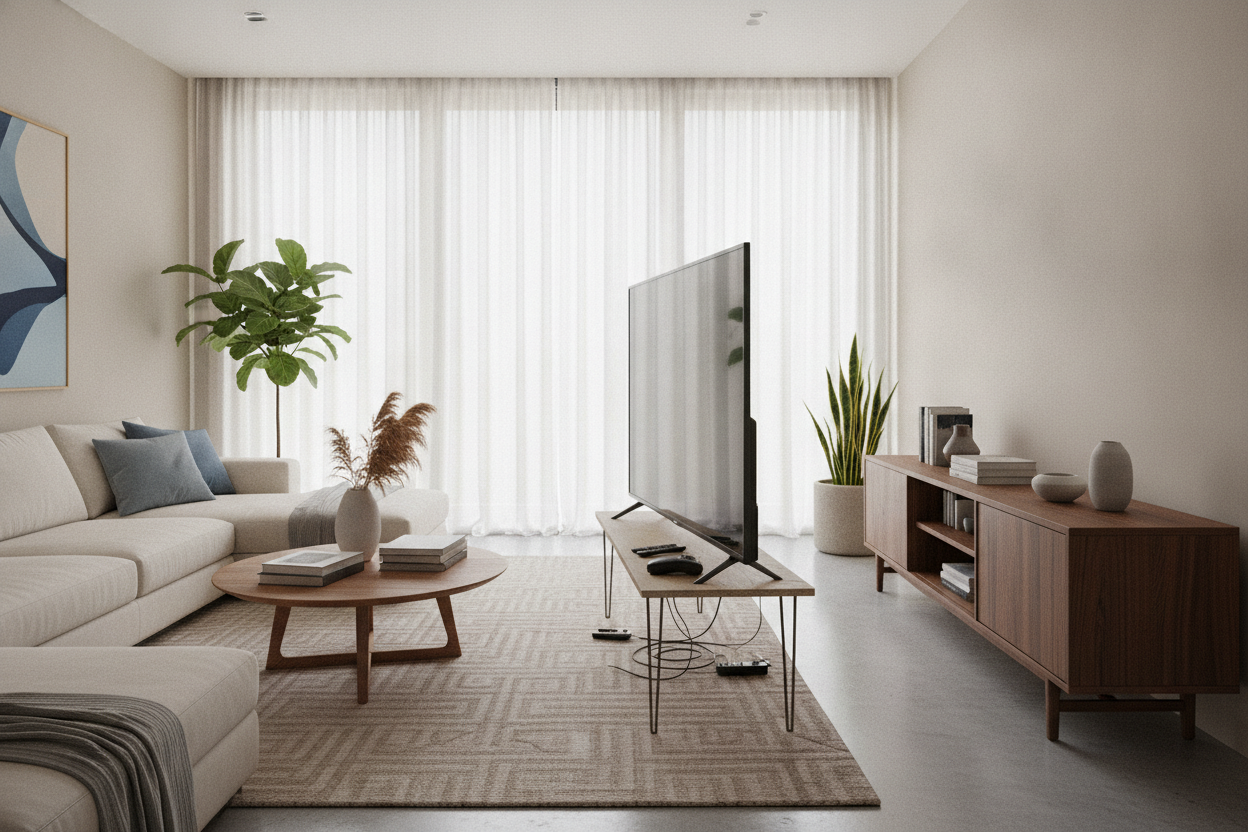
I remember the day I finally upgraded to a 65-inch 4K screen. I was so excited to see every blade of grass in the Sunday game that I completely ignored the sad, wobbling particle board unit underneath it. Within twenty minutes, I realized my mistake. The screen hung off the edges like a bad haircut, and the middle of the shelf was already groaning. We have all been there, scrolling through tv tables and stands at 1 AM, hoping a $50 fix will support a $1,000 piece of tech.
- A TV stand should always be at least 6-10 inches wider than the screen.
- Cheap particle board has a weight limit that modern 'big' TVs often exceed.
- Balance is visual—a tiny stand makes a large room feel cluttered and unstable.
- Invest in solid wood or reinforced metal if you want the unit to last more than a year.
The 'Big TV, Small Stand' Disaster
There is a specific kind of anxiety that comes from watching a top-heavy smart TV teeter on a narrow console. It’s the 'big tv small stand' syndrome. When your screen is wider than the base it sits on, you aren't just risking a physical tip-over; you’re ruining the room's proportions. A massive screen on a tiny tv table stand nearby creates a visual 'lollipop' effect that makes your living room feel accidental rather than designed.
Beyond the looks, modern TVs have feet that are often placed at the far edges of the frame. I’ve seen people try to 'make it work' by placing a table for smart tv use that is literally the exact same width as the TV feet. One bump from a vacuum or a curious cat, and that expensive panel is face-down on the hardwood. You need a big tv console that provides a safety buffer, plain and simple.
Why I Stopped Searching for a 'Cheap TV Stand Nearby'
I used to be the king of the bargain bin. I’d scour every tv table sale and tv cabinet on sale, thinking I was outsmarting the furniture industry. I wasn't. Most of what you find when looking for a cheap tv stand for sale is made of low-density fiberboard (MDF) with a paper-thin veneer. These units are designed to hold a 32-inch monitor from 2010, not a 75-inch beast.
After six months, the 'false economy' kicks in. The weight of your media setup causes the top shelf to sag, which eventually cracks the cam-lock joints holding the whole thing together. I finally realized that shopping for quality tv stands was cheaper in the long run than replacing a $100 tv unit on sale every year. Real wood or high-grade plywood doesn't bow; it holds.
The Golden Rule for TV Tables and Stands
If you take nothing else away from my trial and error, remember this: the 6-inch rule. Your console should have at least 6 to 8 inches of breathing room on either side of the screen. This anchors the TV to the wall visually and gives you space for a soundbar or a few pieces of decor without it looking like a cluttered mess. If you're stuck with a narrow piece of furniture and can't upgrade yet, I actually found a heavy duty stand for TV on table that uses a center-mount pedestal to save space while keeping things stable.
When you're browsing places that sell tv stands, don't just look at the height and width. Look at the depth. A lot of modern tv stand tables are getting shallower to save on shipping costs, but if your TV feet are 12 inches deep and the table is only 13, you have zero margin for error. Aim for at least 15-18 inches of depth to keep things grounded.
Alternatives to Flimsy Big-Box Store Consoles
If you hate the look of standard media furniture, stop looking at stores that sell tv stands exclusively. One of my favorite moves is repurposing a dining buffet cabinet. Buffets are usually built to hold heavy sets of china and are made of much sturdier wood than your average tv cabinet table. They also offer way better storage for cables and game consoles.
For those who want a cleaner, more high-tech look, you can go the opposite direction. I’ve recently become obsessed with the idea of a cabinet with a hidden TV mechanism. It solves the 'giant black rectangle' problem by tucking the screen away when you aren't using it. It’s a structural powerhouse that handles the weight without any of the visual clutter of a traditional entertainment center for sale.
When Is an Entertainment Center Actually Worth the Upgrade?
Sometimes a single table just isn't enough. If you have a massive, cavernous living room wall, a lone tv table for sale is going to look like a postage stamp. This is when you look for a full-scale high-gloss entertainment center. These units fill the vertical space and provide a frame for your screen, making it feel like a deliberate part of the architecture rather than an afterthought.
Whether you're hunting for a tv consoles sale or building a custom setup, just remember: your TV is the centerpiece of your downtime. Treat it like one. Stop asking 'how much for a tv stand' and start asking 'how long will this stand last?' Your floor—and your electronics—will thank you.
FAQ
How much wider should my TV stand be than the TV?
Ideally, your stand should be at least 12 inches wider total (6 inches on each side) than the actual width of the TV. This prevents the screen from looking like it's 'spilling' over the edges.
Can I use a cheap TV stand for a 75-inch TV?
I wouldn't recommend it. Most cheap tv table sale items have a weight capacity of 50-75 lbs. A large 75-inch TV plus a soundbar can easily push that limit, causing the center to sag over time.
Is it better to wall mount or use a TV table?
Wall mounting is great for saving space, but a TV stand provides necessary storage for cables, consoles, and routers. If you rent, a sturdy console is always the safer, hole-free bet.

Laisser un commentaire
Ce site est protégé par hCaptcha, et la Politique de confidentialité et les Conditions de service de hCaptcha s’appliquent.