


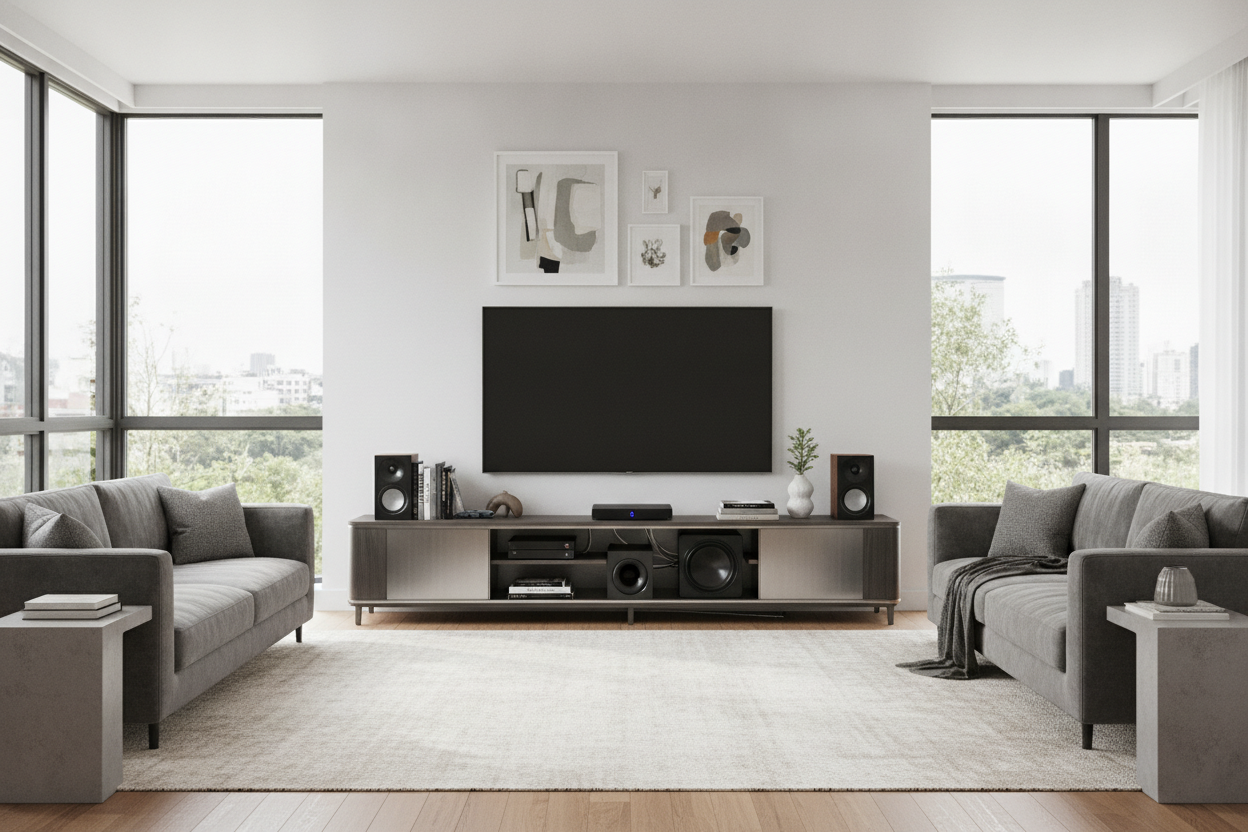
I smelled it before I saw it. That distinct, ozone-heavy scent of expensive electronics slowly turning into a very expensive space heater. I had just spent a month's rent on a high-end Marantz receiver, and like a total amateur, I shoved it into a cheap, enclosed cabinet I bought on clearance. Ten minutes into a movie, the audio started clipping. I touched the top of the cabinet and it was hot enough to fry an egg. That was the day I realized that a surround sound tv stand isn't just a luxury—it is a survival requirement for your gear.
Quick Takeaways
- Standard cabinets are usually 16-18 inches deep; audio gear needs at least 20 inches to accommodate cables.
- Passive ventilation (slots or mesh) is mandatory to prevent your receiver from thermal throttling.
- Slatted doors are the gold standard for hiding gear while allowing IR remote signals and airflow.
- Always check for a dedicated, open-front shelf for your center channel speaker.
The Day I Almost Fried My AV Receiver
I used to think a console was just a box to hold a screen. I bought a mid-century unit from a big-box retailer because it looked 'clean.' I didn't think about the fact that my AV receiver weighs 30 pounds and generates about as much heat as a small radiator. I tucked it behind a solid wood door, closed it tight, and sat back to enjoy some 4K action. Within an hour, the receiver's internal fans were screaming like a jet engine, and the unit shut down to prevent itself from melting.
It turns out, stuffing high-performance tech into a standard cabinet is like trying to run a marathon while wearing a parka. You might survive for a few minutes, but eventually, you are going to crash. Most furniture isn't designed for the reality of home theater. It’s designed for books and coasters. If you actually care about your speakers and your receiver, you need a tv stand with surround sound capabilities—meaning it was built with heat dissipation and component dimensions in mind.
Why Your Current Console Fails the Math Test
Here is the cold, hard truth: Most standard TV stands are too shallow. I have measured dozens of units, and the average depth is around 16 to 18 inches. That sounds like plenty until you realize your receiver is 15 inches deep, and the HDMI cables sticking out the back need another 3 to 4 inches of clearance just to avoid being bent at a 90-degree angle. If you force it, you end up with broken ports and a cabinet door that won't quite close.
A real surround sound tv stand needs to be at least 20 to 22 inches deep. This 'buffer zone' allows for what I call the 'cable spaghetti' factor. You also have to account for the weight. A proper 7.1 channel receiver isn't light. I’ve seen cheap MDF shelves bow under the weight of a heavy-duty amp within six months. You want kiln-dried hardwood or reinforced steel frames. If the manufacturer doesn't list a weight capacity for the internal shelves, walk away. Your gear is too heavy and too expensive to trust to luck.
The Holy Trinity: Airflow, Wire Management, and Center Channels
When you are shopping for a unit that actually handles tech, you have to look for three specific things. First: passive ventilation. This isn't just a hole in the back for wires. You want slots in the bottom of the cabinet and vents at the top. Heat rises; if it has nowhere to go, it just circles your receiver until something breaks. I look for units with 'chimney' style venting that lets cool air pull through the bottom and hot air escape out the back or top.
Second, look for a removable back panel. Trying to plug in fourteen different speaker wires through a tiny 2-inch grommet hole is a form of torture I wouldn't wish on my worst enemy. If the back panel doesn't come off, you’ll be doing 'blind surgery' with a flashlight in your mouth for three hours. A removable panel turns a nightmare setup into a 15-minute job.
Finally, the center channel shelf. This is the most ignored part of home theater. Your center speaker provides 80% of the dialogue. If it’s stuffed behind a glass door, it’s going to sound muffled and boxy. You need an open-front shelf or a shelf with an acoustically transparent cover so the sound can actually reach your ears without bouncing off the inside of a wooden box.
Slatted Doors vs. Glass: How to Hide the Mess
We all want the 'clean' look, but glass doors are a nightmare for heat and remote controls. Unless you have an RF-based remote, glass will block your signal, and it definitely blocks air. This is why I am a huge proponent of a TV stand with slatted doors. The vertical or horizontal slats allow air to flow freely and let IR signals pass through without any lag. Plus, they do a brilliant job of hiding the glowing blue and red LEDs of your gear that can be distracting during a dark movie night.
If you absolutely must see your gear—maybe you’ve got a beautiful vintage McIntosh receiver with those iconic glowing blue meters—then a credenza with sliding glass doors is the better move. It keeps the dust off your sensitive components while putting the tech on display. Just make sure you leave the doors cracked during long viewing sessions, or ensure the back of the unit is completely open to let the heat escape. Dust is the enemy of electronics, but heat is the killer.
Styling a Heavy-Duty Console So It Doesn't Look Like Best Buy
The biggest fear my partner had when I bought a 'tech-focused' stand was that our living room would start looking like a retail store. Heavy-duty consoles can look a bit industrial. To fix this, you have to balance the hard edges of the tech with organic textures. I put a large, leafy snake plant on one end of my console to soften the silhouette. It’s a hardy plant that doesn't mind a little extra warmth from the cabinet.
Avoid the 'symmetrical stack.' Don't just put the TV in the middle and two speakers on the side like a math equation. Offset your decor. Put a stack of oversized art books on one side and a textured ceramic vase on the other. I also use warm LED light strips behind the unit. It provides ambient bias lighting that makes the TV easier on the eyes and helps the massive piece of furniture feel like it's floating rather than looming over the room.
FAQ
Do I really need a special stand for a soundbar?
Not necessarily, but you do need to ensure the stand is wide enough so the soundbar doesn't overhang the edges. If your stand has a shelf for the soundbar, make sure it isn't recessed too far, or you'll get weird sound reflections.
How much clearance should I leave above my receiver?
At least 2 to 3 inches. Most manufacturers recommend more, but 2 inches is the bare minimum for air to circulate. If you don't have that, you need an active cooling fan.
Can I just drill holes in my current TV stand?
You can, but be careful. Most cheap furniture is made of particle board, and drilling too many holes can compromise the structural integrity. If you do it, use a 2-inch hole saw and add a plastic grommet to keep it looking clean.


Laisser un commentaire
Ce site est protégé par hCaptcha, et la Politique de confidentialité et les Conditions de service de hCaptcha s’appliquent.