


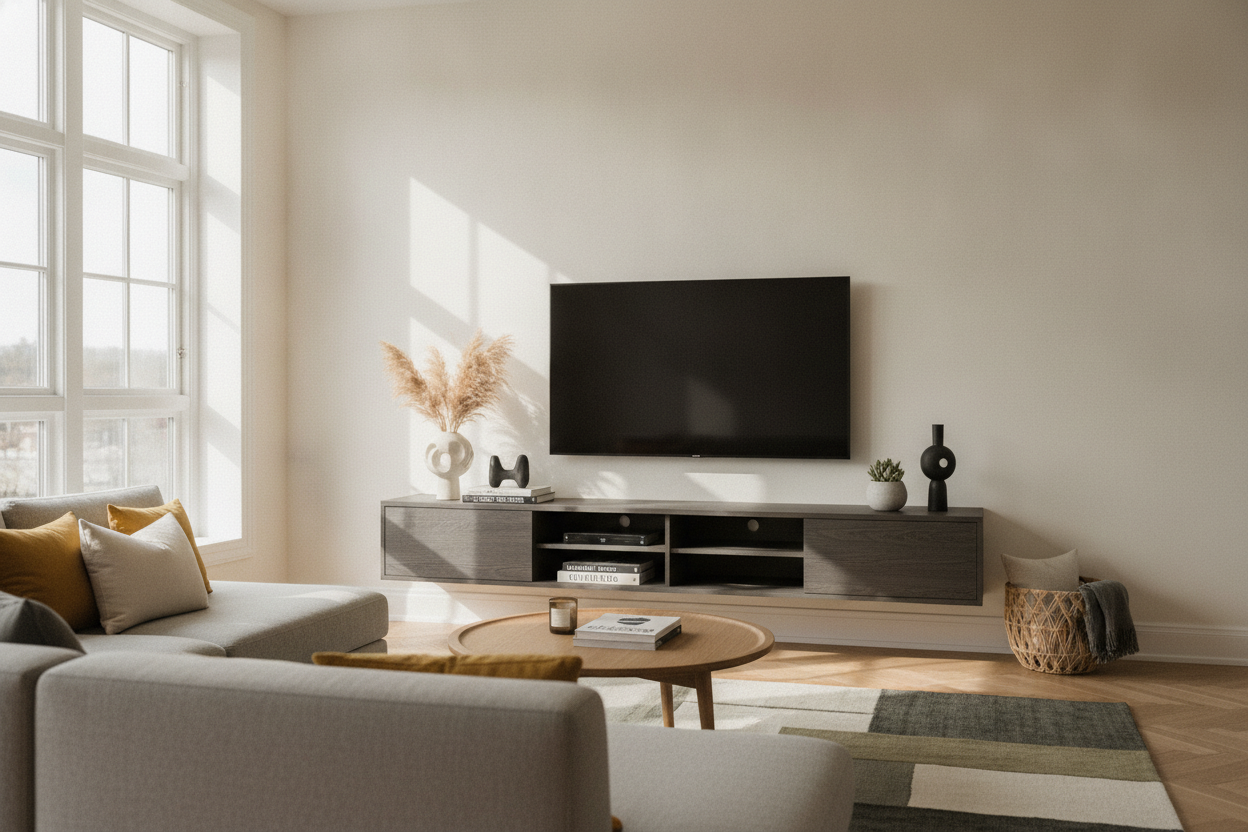
I spent four hours last Tuesday night staring at 47 different browser tabs of media consoles until my eyes burned. Every single one started to look like the same generic grey rectangle. If you are hunting for the floating tv stand amazon algorithm wants to shove in your face, you have probably noticed a pattern: they all look great in the renders, but the reviews tell a story of sagging shelves and shattered dreams.
We have all been there. You want that clean, minimalist look where the TV floats effortlessly above a sleek ledge, but the reality of mounting 40 pounds of fiberboard into drywall is terrifying. Before you click 'buy now' on that $79 special, let's talk about how to actually find a piece that won't end up in a heap on your floor.
- Ignore any listing where the TV in the photo is clearly photoshopped onto the wall.
- Assume the included drywall anchors are useless and buy your own metal toggles.
- Measure your receiver or gaming console depth twice; most floating units are surprisingly shallow.
- Look for 'high-density MDF' or 'solid wood'—avoid 'particle board' like the plague.
The First Page of Search Results is Lying to You
The Amazon search algorithm doesn't care if your TV stays on the wall; it cares about conversion rates. This means the top spots are usually occupied by the cheapest possible units made of compressed sawdust and paper veneer. These manufacturers spend more on SEO than on structural engineering. I have found that searching for an amazon floating tv shelf instead of a 'stand' or 'console' often yields much better results. The 'shelf' terminology tends to pull up smaller, boutique makers who focus on solid wood construction rather than mass-produced flat-packs.
When you see a unit for $60 that claims to be 70 inches long, be skeptical. Quality materials cost money. A real wood veneer or a heavy-duty mounting bracket adds weight to the shipping cost, which is why the 'best sellers' are often as light as a feather. If the shipping weight is less than 20 pounds for a large unit, you are buying a cardboard box with a wood-grain sticker on it.
Three Massive Red Flags in Product Listing Photos
The first red flag is the 'invisible cord' trick. If the listing photo shows a floating console with a TV above it and zero visible wires—but no cord management holes in the unit itself—the manufacturer is hiding something. You will either have to drill your own holes or live with a tangled mess of black snakes hanging down your wall.
Second, look at the scale of the items on the shelf. Manufacturers love to shrink the size of books and vases in their renders to make the console look massive. I once bought a unit that looked like it could hold a library, only to find it was barely wider than my soundbar. Check the actual dimensions in the description, not the 'vibes' of the photo.
Finally, check the mounting hardware photos. If they only show two small keyhole slots on the back, keep scrolling. For a piece of furniture that needs to hold electronics, you want a continuous French cleat or at least four distinct mounting points that allow you to hit multiple studs.
Weight Limits vs. Reality (Please Don't Trust the Box)
The weight limit on the box is a laboratory fantasy. It assumes you are mounting into perfect steel studs with professional-grade hardware. In the real world of old drywall and slightly-crooked wooden studs, that '50 lb capacity' is a suggestion at best. I learned this lesson the hard way after adding a walnut floating TV shelf in my last apartment and watching it slowly tilt forward over three months.
Do yourself a favor: throw away the plastic ribbed anchors that come in the box. They are meant for picture frames, not furniture. Go to the hardware store and buy 1/4-inch Snaptoggles. They can hold significantly more weight and won't pull through the drywall the first time your cat decides to jump on the console. It is a $10 insurance policy for your $1,500 television.
What I Actually Look For When Shopping for Consoles
I always look for a finish that has some texture. If the 'wood' looks perfectly smooth and shiny in every photo, it is likely a cheap laminate that will chip the second you slide a remote across it. I am a huge proponent of swapping a bulky console for a floating wooden unit because it creates the illusion of more floor space, but only if the wood looks intentional and high-end.
Storage flexibility is the other big one. Most cheap Amazon units have fixed vertical dividers that are just a half-inch too narrow for a standard router or a vertical PlayStation 5. I prioritize adjustable shelf storage options so I can actually fit my gear without having to leave the doors hanging open. Also, check for 'ventilation.' Electronics get hot, and a sealed box with no airflow will fry your gaming console in a week.
When to Skip the Endless Scroll and Buy Direct
There comes a point where the Amazon marketplace roulette just isn't worth it. If you are looking for a very specific aesthetic—like a seamless, 110-inch high gloss TV stand with LED lighting—you are often better off buying directly from a furniture brand. When you buy direct, you are usually getting better quality control and a customer service team that actually knows how the piece is assembled, rather than a bot responding to your complaints.
I’ve found that specialized furniture sites take more pride in their mounting systems. They know that a single failure can ruin their reputation, whereas an anonymous Amazon seller can just close their digital shop and open a new one under a different name the next day. If the piece is the focal point of your living room, it is worth the extra $100 to get something that won't sag.
Can I install a floating TV stand by myself?
Technically yes, but I wouldn't recommend it. You need someone to hold the unit level while you mark the stud locations. If you are even a quarter-inch off, the whole thing will look crooked against the horizontal line of your TV.
How do I hide the wires if I'm renting?
Use paintable cable raceways. They stick to the wall and hide the cords trailing down from the TV to the console. It is much better than cutting holes in the drywall that you will have to patch later.
Will a floating stand work on a plaster wall?
Yes, but you cannot use standard drywall anchors. You need masonry screws or heavy-duty toggle bolts, and you absolutely must use a hammer drill to avoid cracking the plaster. If you aren't comfortable with that, stick to a floor-standing unit.


Laisser un commentaire
Ce site est protégé par hCaptcha, et la Politique de confidentialité et les Conditions de service de hCaptcha s’appliquent.