


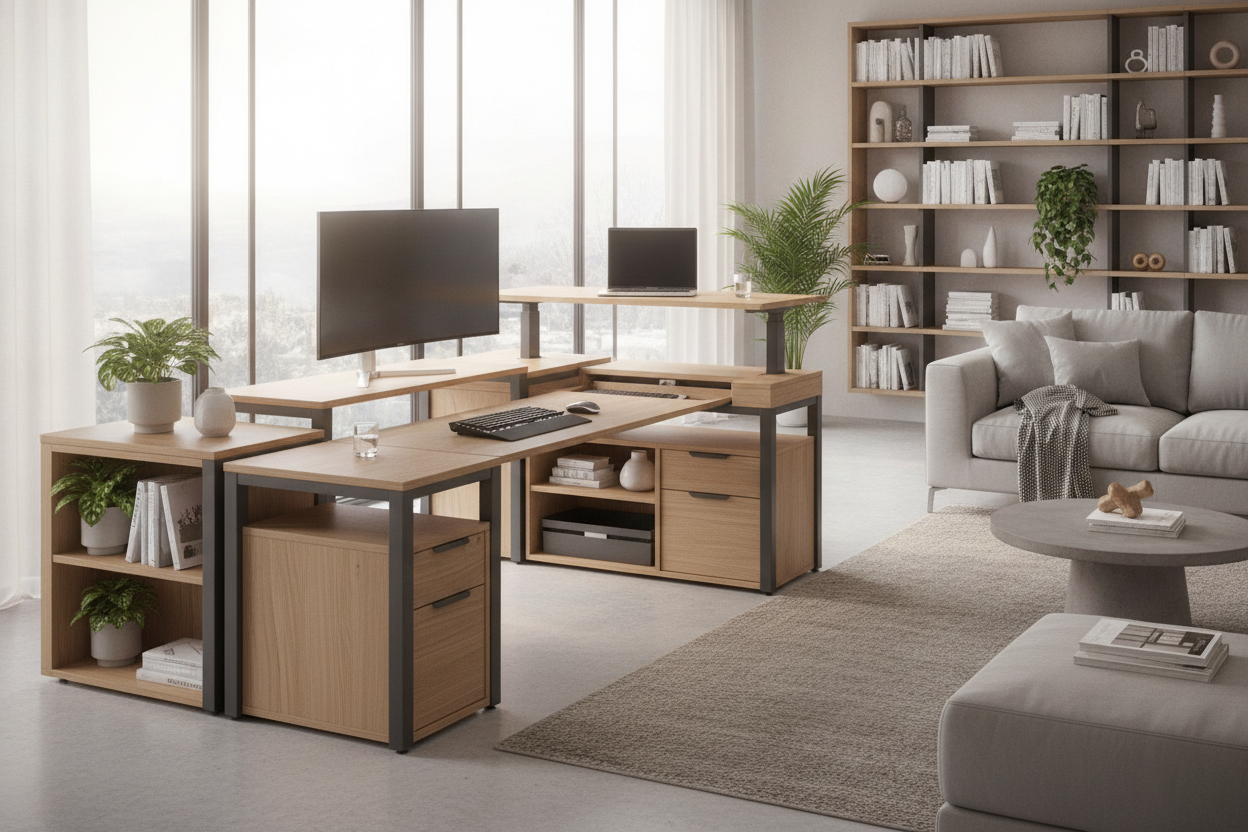
I remember staring at my $100 particle board desk three years ago, surrounded by two monitors, a ring light, and a microphone arm that kept slipping off the thin edge. It was a disaster. I thought I just needed a bigger table, but what I actually needed was the best modular desk system that could pivot as fast as my career did.
Quick Takeaways
- Static desks are dead ends; modularity allows for growth without replacement.
- Universal mounting points are essential for future-proofing your gear.
- You can upgrade to standing legs later without ditching your favorite desktop.
- Modular systems offer better weight capacity than standard flat-pack furniture.
The Frustrating Cycle of the 'One-Size-Fits-All' Desk
Most of us start with a standard writing computer desk because it is cheap and looks fine in a bedroom corner. Then the career grows. Suddenly you need a second monitor, a dedicated tablet area, and a place for a printer that doesn't involve the floor.
You end up with a crowded surface where you are constantly shuffling things just to find a square inch to write a note. The 'one-size' desk is a myth. As soon as you add a peripheral, it's too small. As soon as you move to a bigger office, it looks dinky. It is a wasteful cycle of buying, outgrowing, and donating.
What Actually Makes the Best Modular Desk System?
A real modular system isn't just about sticking two tables together. It is about specialized rails, interchangeable legs, and attachment points that don't strip the first time you move them. While I have spent years customizing a basic IKEA setup, a pro-grade modular system offers a level of stability those hacks just cannot touch.
The best modular desk should feel like Lego for adults. You want a heavy-duty steel frame that can expand in width. If the frame is fixed at 48 inches, you are stuck. Look for telescoping crossbars that let you swap a 48-inch top for a 72-inch top later while keeping the same expensive legs.
Look for Universal Mounting Points (Not Proprietary Junk)
Proprietary holes are the enemy of a long-term setup. If a desk only works with the brand’s own expensive monitor arm, walk away. You want a desk edge that is flat and at least 1 inch thick—this ensures your third-party C-clamps for lights and mics actually bite into the wood instead of slipping off a fancy beveled edge.
How I Scaled My Setup from a Corner to a Full Room
My office started as a tiny nook in the living room. When I went full-time freelance, I didn't throw the desk out. I bought a 30-inch return and a single modular leg to support the corner. Now I have an L-shape that fits my scanner and a second laptop station for my assistant.
It cost me about $180 to expand my existing footprint instead of $600 for a brand-new 'executive' desk that probably wouldn't have fit through my office door anyway. That is the beauty of modularity: it fits the room you have today, not just the one you had yesterday.
Mixing and Matching: Standing Frames and Storage Add-Ons
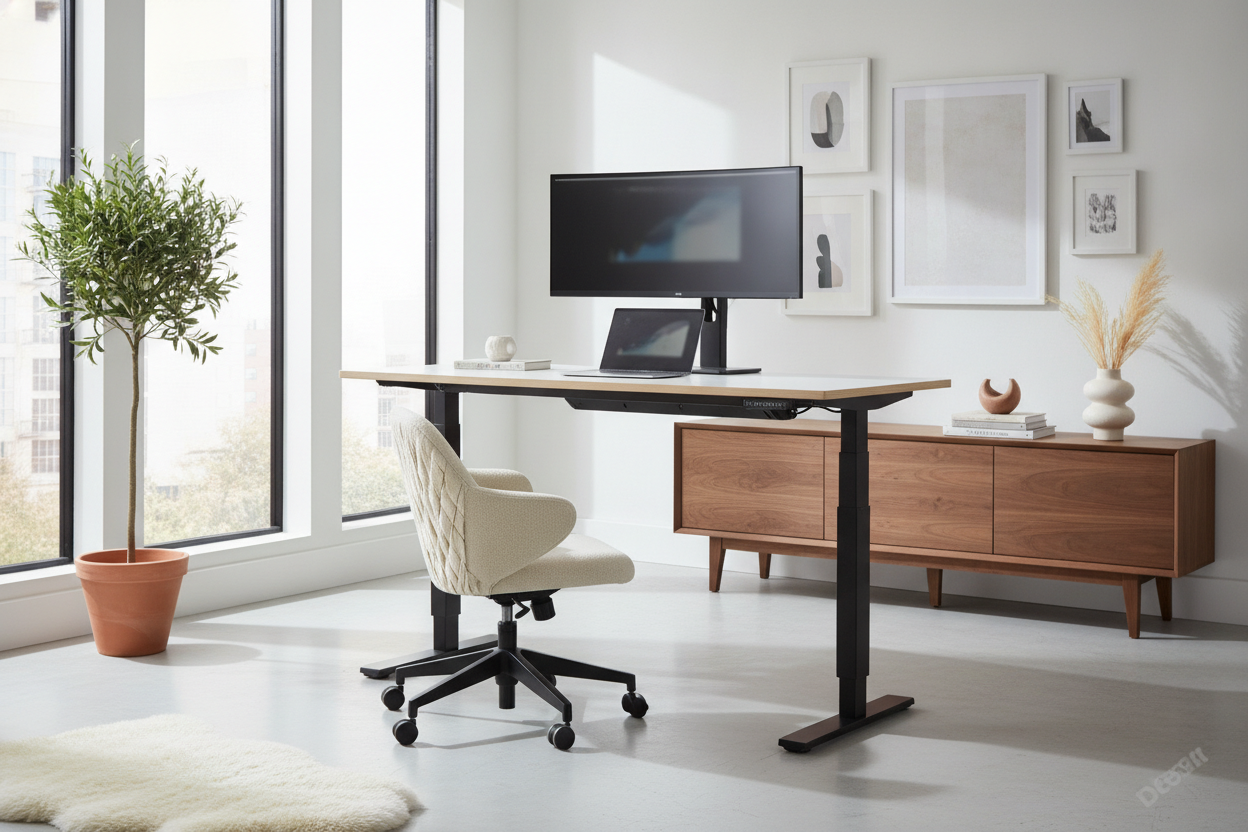
The ultimate modular move is the leg swap. You might start with static legs to save cash, but your lower back will eventually demand an upgrade. A good system lets you keep your high-quality desktop and simply bolt on an adjustable height standing desk frame when your budget allows.
If you have a heavy setup with multiple monitors and a tower PC, skip the cheap single-motor frames. An ergonomic sit stand desk base with dual motors provides the lift capacity you need to keep everything stable. You shouldn't have to worry about your coffee sloshing every time you hit the 'up' button.
When You Shouldn't Go Modular
If you want a 200-pound solid walnut heirloom that your grandkids will fight over in a will, don't buy modular. This stuff is utilitarian. It is designed for people who move, people whose jobs evolve, and people who like to tinker with their environment.
If you are a 'buy it once and never touch it' person who uses a single laptop and nothing else, a modular system is overkill. Stick to a solid wood table. But for the rest of us with evolving side-hustles, modularity is the only way to stay sane.
FAQ
How much weight can a modular desk hold?
Most high-quality modular frames are rated for 150 to 300 pounds. Always check the motor capacity if you are using an electric frame, as the weight of the desktop itself counts toward that limit.
Is it hard to assemble a modular system?
It takes longer than a basic table because there are more components, but the instructions are usually clearer. Expect to spend about 45 minutes with a hex key and a screwdriver.
Can I use my own wood top with a modular frame?
Yes, as long as the frame is width-adjustable. I have seen people mount vintage doors or live-edge slabs onto modular standing frames with great results.

Laisser un commentaire
Ce site est protégé par hCaptcha, et la Politique de confidentialité et les Conditions de service de hCaptcha s’appliquent.