


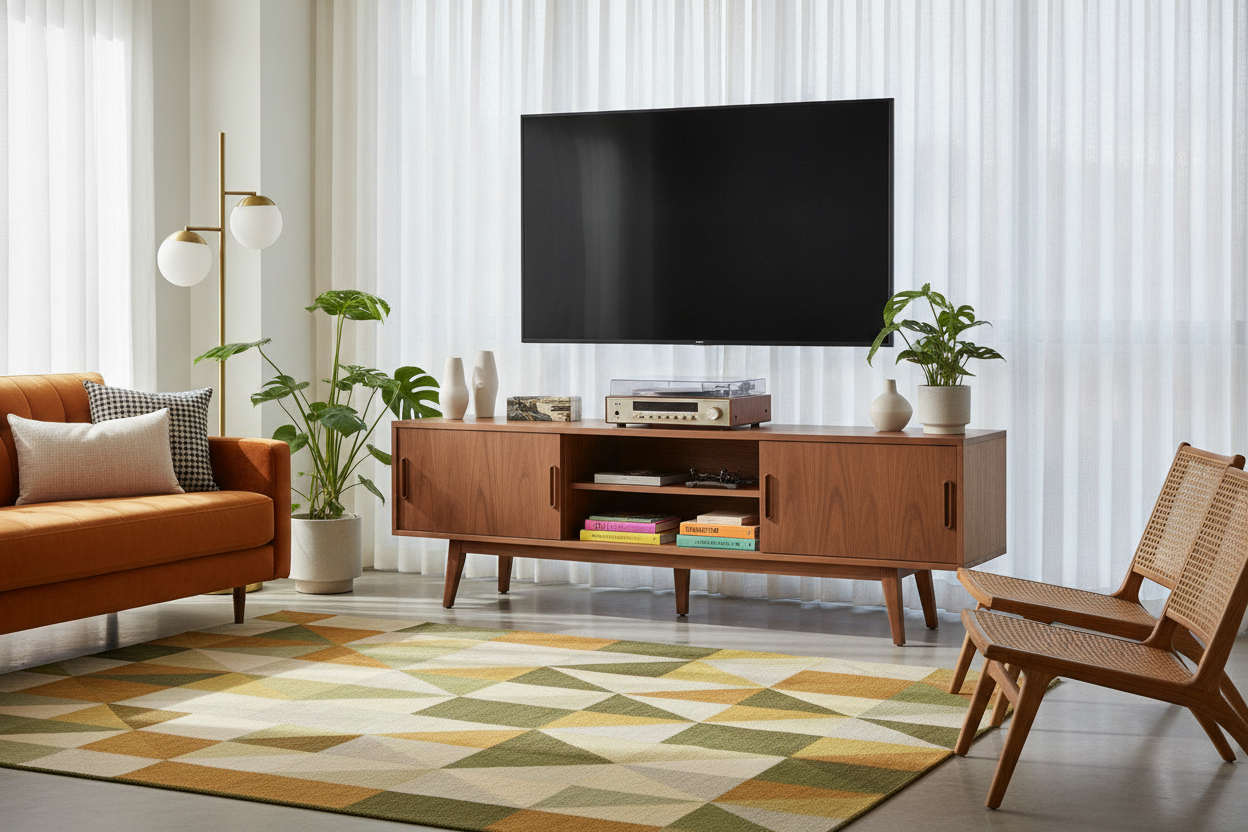
I spent three years staring at a living room that felt like a Best Buy waiting room. I had a dark charcoal sofa, a grey rug, and a massive black glass media stand that showed every single speck of dust and cat hair within a five-mile radius. It was a heavy, light-sucking void. I finally realized that my living room didn't have a 'style' problem; it had a 'tech-matching' problem. I was trying to match my furniture to my TV, which is like matching your outfit to your microwave.
The moment I swapped that glass monstrosity for a mid century 70 inch tv stand, the room finally exhaled. The warm wood tones immediately fought off the sterile, cold vibe of the 65-inch screen. If you are currently sitting in front of a black-on-black-on-black setup, this is your sign to stop the madness.
Quick Takeaways
- Warmth is mandatory: Wood tones like walnut and acorn neutralize the 'cold' look of large electronics.
- Legs matter: Tapered legs create visual floor space, making your room feel larger than it is.
- The 70-inch Rule: A 70-inch stand is the sweet spot for 55 to 65-inch TVs to avoid the 'top-heavy' look.
- Ventilation is king: Slatted doors allow for airflow and remote signals without exposing ugly wires.
The 'Black Hole' Effect in Modern Living Rooms
Most of us fall into the same trap. We buy a big, beautiful 4K television with a slim black bezel, and our first instinct is to buy a black or dark espresso console to match it. We think it makes the tech 'blend in.' In reality, it does the exact opposite—it creates a massive, lifeless black hole that dominates the entire wall. It’s a design vacuum that sucks the personality right out of your home.
When you browse the endless sea of generic TV stands online, you’ll see plenty of these blocky, dark units. They look fine in a showroom with 20-foot ceilings, but in a real living room, they feel like lead weights. They offer no contrast, no texture, and zero warmth. You aren't living in a server room; you're living in a home. Breaking up that dark silhouette with natural wood grain is the fastest way to make the space feel intentional rather than just 'functional.'
Why a Mid Century 70 Inch TV Stand is the Ultimate Antidote
Mid-century modern design was practically built for the way we live now, even if the designers in 1955 didn't know we'd be streaming 8K video. The core of the aesthetic is organic warmth. Whether it's a deep walnut or a lighter honey oak, those wood grains provide a necessary organic texture that balances the smooth, flat plastic and glass of your electronics. It acts as a bridge between your 'soft' furniture—like your linen sofa or wool rug—and your 'hard' tech.
A 70-inch width is particularly effective because it provides a generous physical footprint without feeling overbearing. It allows the TV to sit comfortably with a few inches of 'breathing room' on either side. This horizontal stretch draws the eye across the room rather than just fixing it on the screen. It turns the media area into a curated furniture arrangement rather than just a place where the TV lives.
The Magic of Tapered Legs
One of the biggest mistakes people make with large media consoles is buying a unit that sits flush against the floor. This creates a 'block' that stops the eye and makes the room feel cramped. Mid-century pieces are famous for those iconic angled, tapered legs. By lifting the bulk of the unit 6 to 8 inches off the ground, you expose the floor underneath, which trick the brain into seeing more square footage.
Even a substantial console with cabinets and drawers can look incredibly light if it’s perched on the right set of legs. I’ve seen 70-inch units that weigh 120 pounds but look like they’re floating. That visual lightness is the difference between a room that feels cluttered and one that feels airy, even if you’re packing a lot of storage inside.
Slatted Doors Are a Tech Lover's Best Friend
Let's talk about the nightmare of 'The Stack'—the gaming consoles, the cable boxes, and the soundbars that usually clutter up the top of a stand. This is where the mid-century slatted door (or tambour door) becomes a literal lifesaver. These slats allow infrared signals from your remote to pass through, meaning you can hide your ugly gear behind closed doors and it will still actually work.
I personally recommend the Mid Century Modern Tv Stand With Slatted Doors Open Shelves And Cable Management because it solves the heat issue. Gaming consoles like the PS5 or Xbox Series X are basically small space heaters; if you put them in a solid cabinet, they will melt. Slats allow for constant airflow. I even wrote about how I Hid My Ugly Soundbar Inside a Mid Century Modern TV Stand 70 Inch using this exact method. It keeps the audio clear while keeping the 'tech clutter' out of sight.
Finding a Mid Century Modern TV Stand 70 Inches Wide
When you are hunting for a mid century modern tv stand 70 inches wide, you have to be careful with the proportions. A common mistake is buying a stand that is the exact same width as the TV. If you have a 65-inch TV (which is usually about 57 inches wide in reality), a 70-inch stand gives you about 6 inches of space on each side. This is the 'Golden Ratio' for media setups. It provides enough space for a small lamp or a couple of books without looking crowded.
If you go too small, the TV looks like it’s about to tip the stand over. If you go too big, like a 85-inch stand for a small TV, the television looks like a postage stamp. I always tell people to check out this guide on a Mid Century Modern Tv Stand 75 Inch Stop Making Sizing Mistakes before they pull the trigger. Getting the scale right is 90% of the battle in interior design.
My Personal Experience: The Particle Board Lesson
I’ll be honest: my first 'mid-century' stand was a $150 special from a big-box retailer. It looked great for exactly three months. Then, the weight of my older, heavier TV started to make the center of the unit sag. Because it was made of cheap MDF with a paper thin veneer, the 'wood' started peeling at the corners where I bumped it with the vacuum. It was a total waste of money.
When I finally upgraded to a solid wood frame with kiln-dried hardwood legs, the difference was night and day. It didn't wobble when I walked past it. The doors didn't hang crooked. If you can afford it, always look for solid wood legs and a high-quality veneer over plywood rather than particle board. It’s the difference between a piece of furniture you keep for a decade and one you leave on the curb during your next move.
FAQ
Is a 70-inch stand too big for a small apartment?
Actually, no. Because most MCM stands have tapered legs and a low profile, they take up less 'visual space' than a smaller, chunkier unit. Just measure your wall to ensure you have at least 6 inches of clearance on either side of the stand.
Will my remote work through wood slats?
Most modern Bluetooth remotes (like Apple TV or Fire Stick) don't need line-of-sight anyway. For older IR remotes, as long as the slats have a gap of at least a quarter-inch, the signal usually bounces through just fine.
How do I hide the cables coming from the TV?
Look for units with pre-drilled cable management holes. I also use a bit of 'cable snake' wrap that matches my wall color to bundle the wires into one neat line that drops behind the center of the console.

Laisser un commentaire
Ce site est protégé par hCaptcha, et la Politique de confidentialité et les Conditions de service de hCaptcha s’appliquent.