
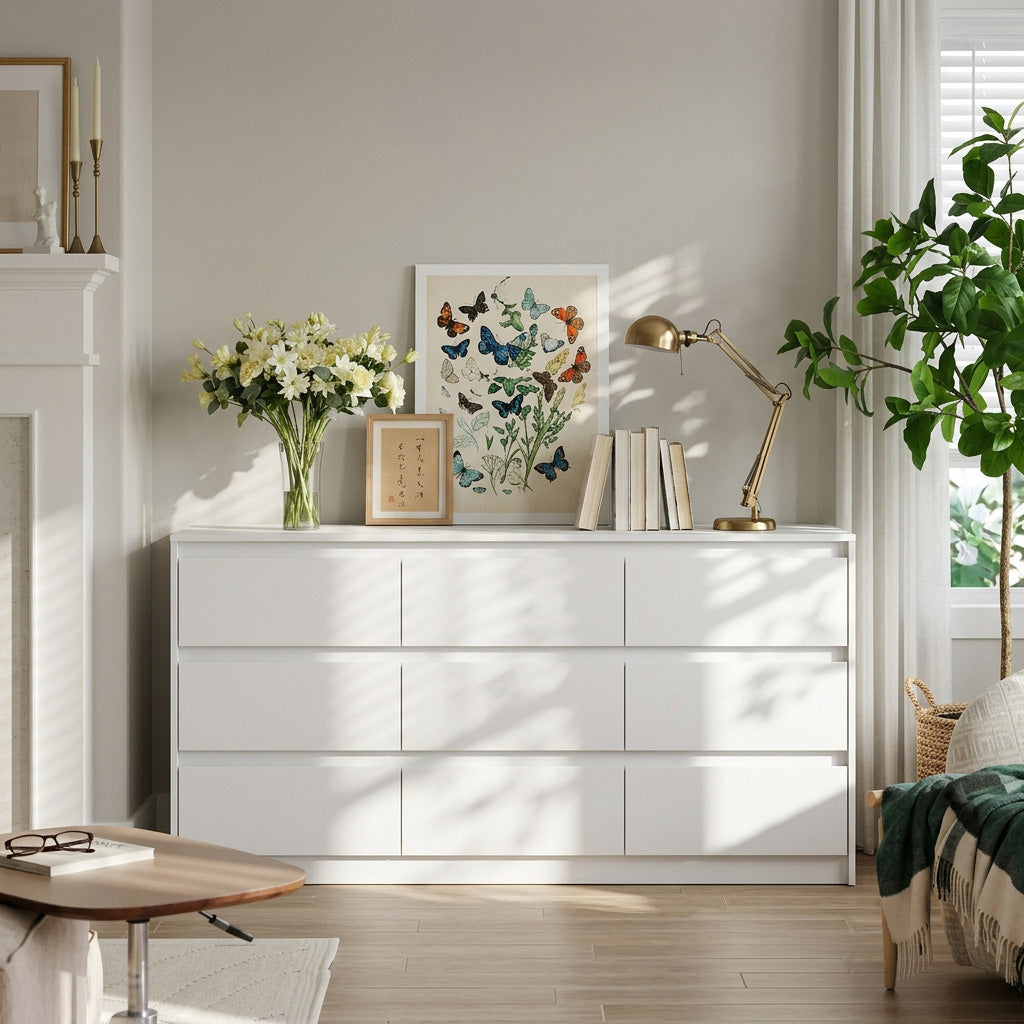
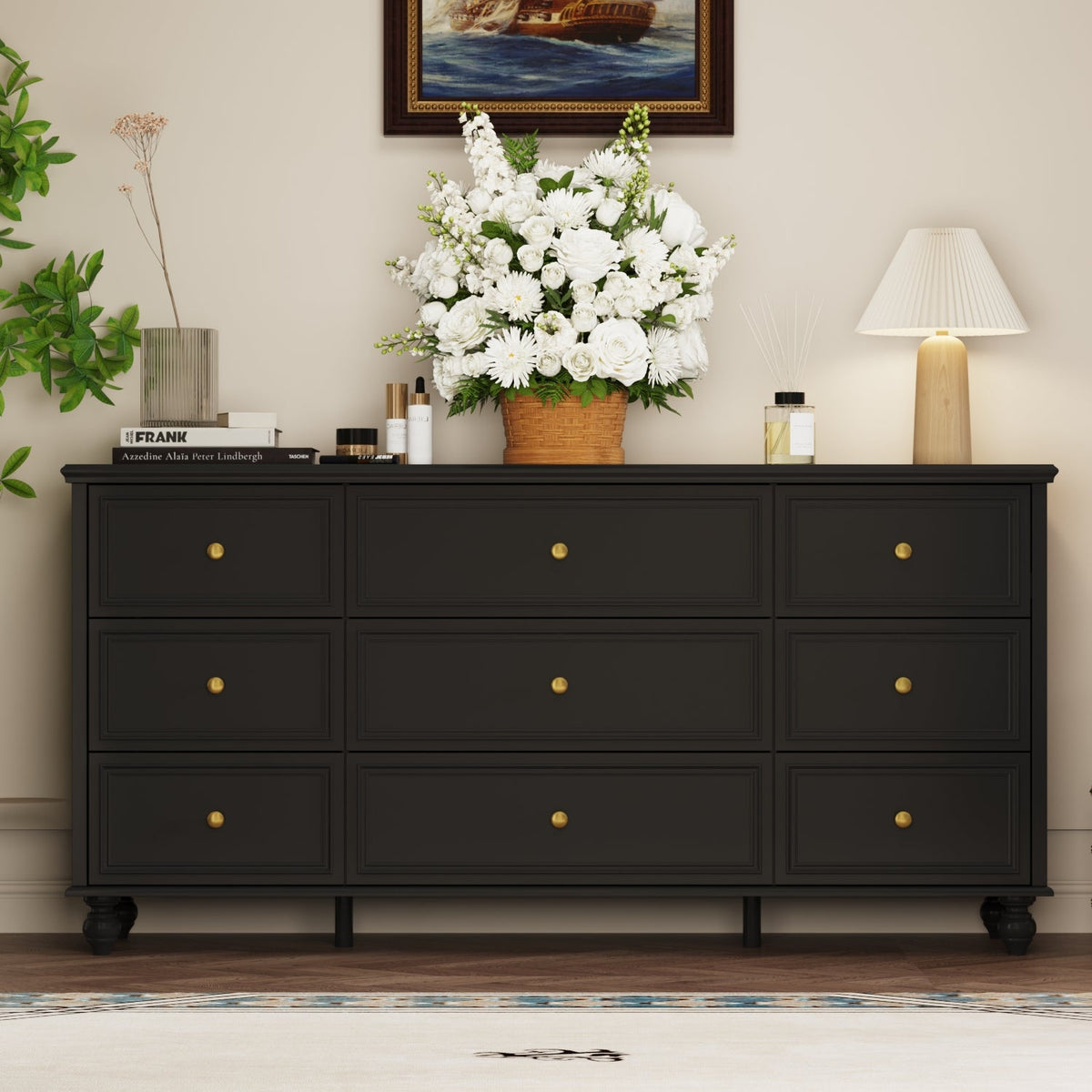
Standard dresser dimensions, in short: a standard horizontal dresser is about 30–36" tall, 16–20" deep and 48–72" wide, depending on how many drawers it has. A tall chest of drawers is narrower (about 24–40" wide) but taller, usually 40–60". Plan at least 30–36" of open floor in front of any dresser so the drawers open fully and you can stand in front of them.
Those are typical ranges; real furniture varies by brand and style. Below you'll find a dresser dimensions guide by type and drawer count, drawer depth, clearance and bed-to-dresser spacing, plus real measurements from the FUFU&GAGA dressers and chests collection so you can compare numbers against your room.
Standard Dresser Dimensions by Type
| Type | Typical height | Typical width | Typical depth | FUFU&GAGA range |
|---|---|---|---|---|
| Small dresser / 3-drawer chest | 28–32" | 28–36" | 15–18" | 29.7–32.3" H, 30.3–31.5" W |
| Double dresser (6–8 drawers) | 30–36" | 45–64" | 16–20" | 30.1–39.2" H, 45.3–63.4" W |
| Triple / 9-drawer dresser | 30–37" | 55–72" | 16–20" | 24.1–39.8" H, 47.2–70.9" W |
| Tall chest / vertical dresser | 40–60" | 24–40" | 15–20" | 39.8–47.4" H, 23.6–31.5" W |
| Low dresser (lowboy style) | 24–30" | 45–60" | 15–18" | 24.1" H, 47.2" W |
Almost all FUFU&GAGA dressers are about 15.7" deep, a little shallower than many traditional pieces, which helps in tight rooms. Not sure which type you need? Start with our guide to dresser vs. chest of drawers.
Average Dresser Height by Style
The average dresser height for a standard horizontal dresser is about 30–36". That puts the top surface near waist height for most adults, which is why dressers work well with a mirror above and why you can reach the top drawers without bending. In the FUFU&GAGA range, the median height is 32.1".
- Shorter dresser (24–30"): fits under a window sill, below a wall-mounted TV or in a kids' room where children should reach the top drawers. The 47.2" 9-drawer dresser with LED lights is only 24.1" tall.
- Standard (30–36"): the comfortable middle. A 63" 9-drawer dresser at 31.5" tall is the most common size in our range.
- Taller horizontal dresser (36–40"): more vertical storage on the same footprint. The 70.9" white/gray 9-drawer dresser stands 37" tall.
- Tall dressers and chests (40–60"): best for small bedrooms and rooms with high ceilings, where vertical space is free and floor space is not. Vertical dressers save floor space but put the top drawers at chest height, so they suit adults better than young kids.
Check the height against what sits around it: window sills, light switches, the bottom of wall art and the TV you might place above. A dresser beneath a window should usually sit a few inches below the sill.
Dresser Width by Drawer Count
Standard dresser width is driven by the number of drawer columns. Each column of wide drawers adds roughly 20–30" of width, so a single-column chest is usually 24–36 inches wide while a three-column triple dresser is 60 inches wide or more. Combination dressers that add a cabinet door follow similar widths.
| Drawers | Layout | Typical width | Example |
|---|---|---|---|
| 3 drawers | One column | 28–36" | 30.3" 3-drawer small dresser |
| 5 drawers | One column (vertical) | 24–40" | 31.5" W x 47.2" H vertical dresser |
| 6 drawers | Two columns of 3, or one tall column | 45–63" (horizontal) | 47.2" 6-drawer double dresser |
| 8–9 drawers | Two or three columns | 55–72" | 63" 9-drawer dresser |
| 12+ drawers | Three or four columns | 60–72" | 61–63" models with 12 drawers |

A common rule of thumb: a horizontal dresser should take up no more than about two-thirds to three-quarters of the wall it stands on, so it does not look crammed. On a 10-foot (120") wall, even a 70.9" dresser leaves plenty of breathing room. On a 6-foot (72") wall, aim for roughly 47–54" wide.
Dresser Depth and Dresser Drawers
Standard dresser depth runs about 16–20", with some traditional pieces up to 22–24". Deeper dressers hold more per drawer but stick further into the room. Most FUFU&GAGA models are 15.7" deep; a few run 12.3–13.8" for narrow spaces, and some accent chests reach 20–23.6".
The inside matters as much as the outside. Interior drawer depth (front to back) is usually a few inches less than the overall depth. In our range, main drawer interiors are mostly 11.3–13.8" deep, and interior drawer heights fall into two groups:
- Shallow drawers, about 3.5–5" tall: socks, underwear, jewelry, accessories, t-shirts folded flat.
- Deeper drawers, about 6–8.4" tall: sweaters, jeans, bulkier items and extra blankets. The Modern 9-Drawer Triple Dresser has main drawers 8.4" tall inside.
Check each listing's "Main Drawer Interior" spec before you buy; two dressers with the same outside dimensions can have very different drawer space.
How much storage space does a dresser really provide?
Multiply a drawer's interior height x depth x width to compare storage capacity. Two 9-drawer dressers show why the number of drawers alone is misleading:
| Dresser | Main drawer interior | Volume per main drawer |
|---|---|---|
| 63" triple dresser | 8.4" H x 12.3" D x 27.2" W | about 2,810 cu in (1.6 cu ft) |
| 47.2" LED 9-drawer dresser | 3.5" H x 12.4" D x 14.2" W | about 616 cu in (0.36 cu ft) |
The first suits sweaters, jeans and taller items; the second is closer to an accessory organizer with standard drawers for socks, jewelry and personal items. If you need to increase storage for bulky clothes, deeper drawers beat more drawers.
How Much Clearance Do You Need Around a Dresser?
Clearance is where most dresser dimensions mistakes happen. A drawer that is 12–14" deep needs that much room to pull out, plus space for you to stand.
| Space | Minimum | Comfortable |
|---|---|---|
| In front of the dresser (drawers open, person standing) | 30" | 36" |
| Between the bed and a dresser across from it | 30" | 36" or more |
| Main walkway past the dresser | 24" | 36" |
Also check door swings. Bedroom doors, closet doors and wardrobe doors should open fully without hitting the dresser, and a dresser should not block a closet door from opening.
Pairing a Dresser with Your Bed and Other Furniture
A dresser rarely stands alone, so check how its dimensions relate to the other furniture pieces in the room:
- Across from the bed: a horizontal dresser is often centered on the wall facing the bed. Keep 30" between the foot of the bed and the open drawers at minimum, and 36 inches if two people use the room at the same time.
- Next to the bed: a small 3-drawer chest can replace a nightstand. Pick one close to the height of your mattress top so a lamp and phone are in easy access.
- Beside a wardrobe or closet: leave the full swing of wardrobe doors clear, and keep similar depths so the pieces line up.
- Under a TV or mirror: a wider dresser gives more surface space for a mirror, lamp and tray. See what to put on top of a dresser for layout and safety tips.
How to Measure for a New Dresser
- Pick the wall. Note windows, outlets, vents and radiators. Use a tape measure for the full open width.
- Measure depth into the room. From the wall, measure out to the bed, door swing or walkway. Subtract 30–36" for drawer clearance; what's left is your maximum dresser depth.
- Measure height limits. Window sill, light switch, art or a mounted TV.
- Check the path in. Most dressers ship flat-packed, so boxes fit through doors easily, but a fully assembled dresser has to clear doorways and stair turns.
- Tape it out. Mark the footprint on the floor with painter's tape and open a nearby drawer or door to test the space.
Common Dresser Size Mistakes
- Measuring only the wall. Measuring dresser dimensions against available space has to include depth plus drawer clearance, not just width. How much floor space a dresser needs is its depth plus about 30–36".
- Choosing a dresser that is too deep. In compact spaces and smaller rooms, a 15–16" deep dresser can leave enough room for a walkway where a 20" one would not.
- Ignoring wall space around windows and outlets. A dresser that blocks an outlet or overlaps a window frame looks and works worse.
- Buying by looks or drawer count only. Check interior drawer sizes against your storage needs.
- Forgetting future needs. If you expect to need additional storage, a wider double dresser or a matching tall chest is easier than buying again later.
Choosing the Right Dresser Size for Your Room
- Small bedrooms (about 10' x 10'): a 30–40" wide dresser or a tall chest. The 31.5" W x 40.4" H 6-drawer vertical chest gives six drawers on a small footprint.
- Medium bedrooms (about 11' x 12'): a 47–60" double dresser.
- Large rooms and primary bedrooms (12' x 14' and up): a 60–72" triple or 9-drawer dresser, or a dresser plus a tall chest. Large rooms can also take wider dressers on one wall and a chest of drawers on another.
Room size is only a starting point; the best dresser dimensions are the ones that fit your wall, your clearance and your clothes. Comparing several dresser options side by side against those three numbers is the fastest way to find the perfect dresser.

Taller furniture tips more easily when drawers are open, so anchor every dresser, especially tall ones. Federal rules for clothing storage units apply to free-standing pieces 27" or taller (CPSC), and the CPSC's Anchor It! campaign recommends anchoring all furniture with drawers. Our guide on how to anchor furniture to the wall walks through the hardware.
Once you have your numbers, filter the FUFU&GAGA dressers and chests by width and drawer count to find a well chosen dresser for your space.
FAQ
Is a 30 inch dresser too small?
Not for a small bedroom, a kids' room or as a nightstand-style chest. A 30" wide dresser usually has three or four drawers in one column. If it's your only clothing storage for two people, choose a wider double dresser or add a tall chest.
What is the typical size of a 5-drawer dresser?
Most 5-drawer dressers are vertical chests about 30–40" wide, 15–20" deep and 40–50" tall. FUFU&GAGA 5-drawer chests measure about 31.5" wide and 39.8–47.2" tall.
What is the standard size of a 6 drawer dresser?
A horizontal 6-drawer double dresser is usually about 45–63" wide, 30–33" tall and 15–18" deep. A vertical 6-drawer chest is narrower, about 30–32" wide, and 40–48" tall.
What are the typical dimensions of a 3-drawer dresser?
A 3-drawer dresser or chest is usually 28–36" wide, 28–32" tall and 15–18" deep, sized to work as a nightstand, hallway chest or small bedroom dresser.


Laisser un commentaire
Ce site est protégé par hCaptcha, et la Politique de confidentialité et les Conditions de service de hCaptcha s’appliquent.