
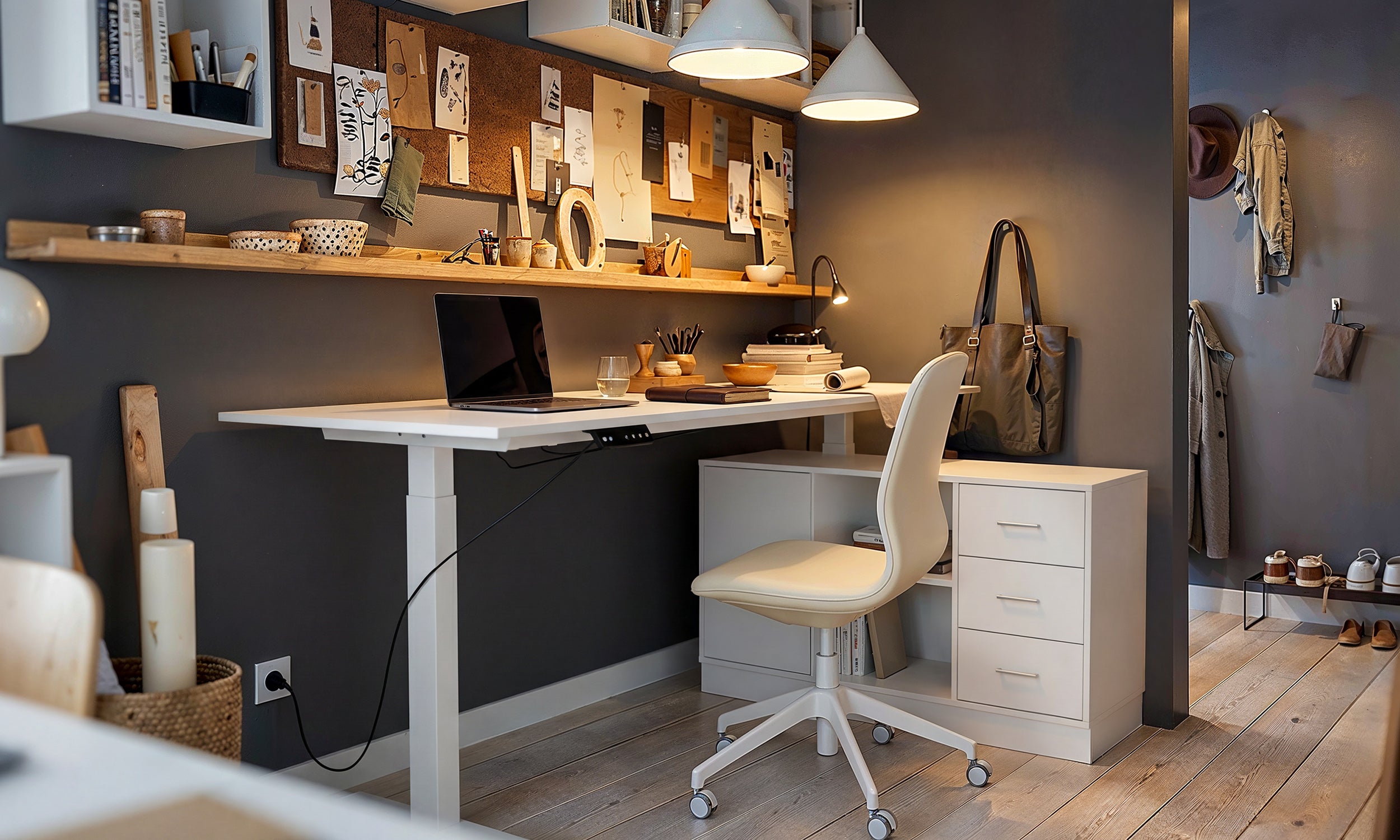
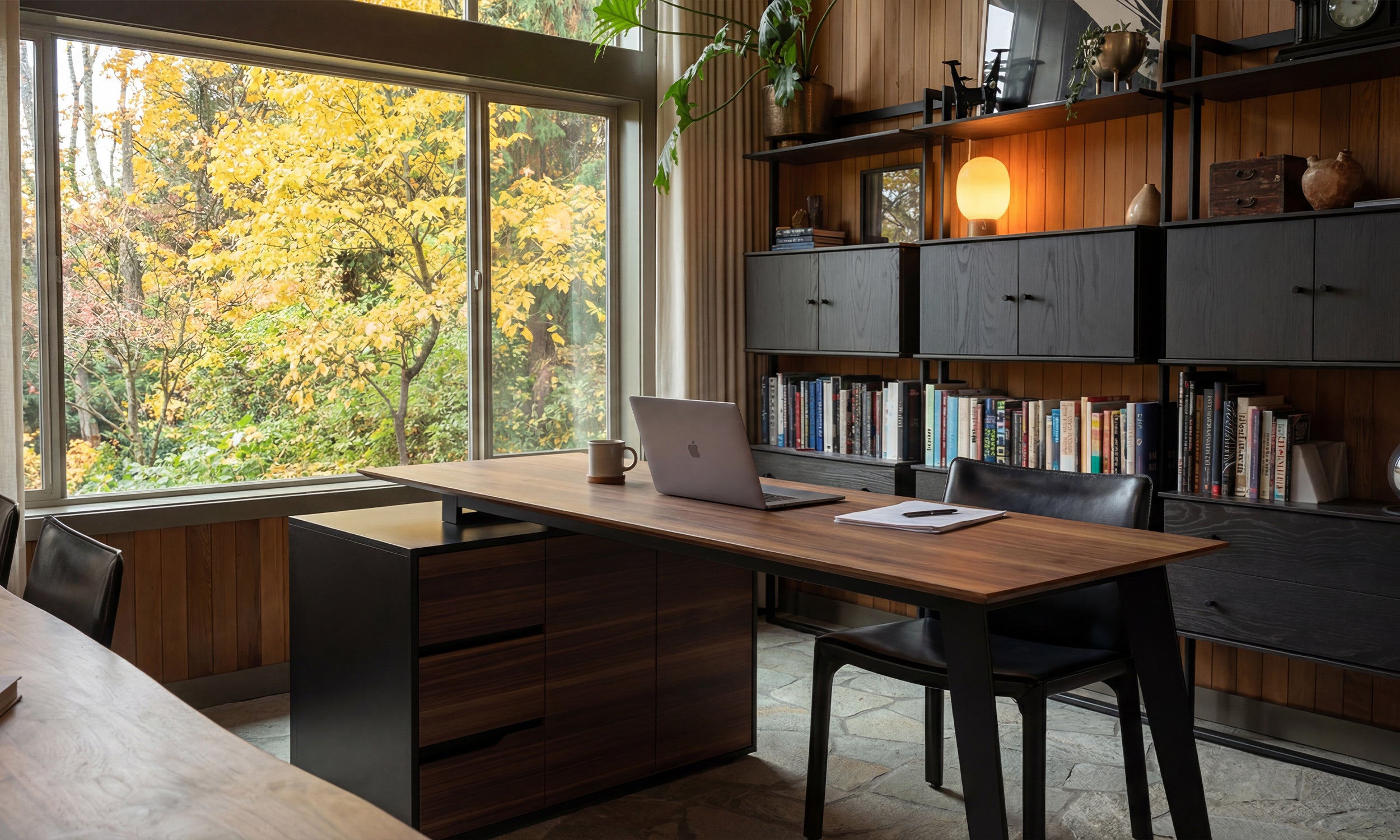

A good sewing table with storage does four jobs: it holds the machine steady on a top wide and deep enough for the machine plus the fabric feeding past it, it puts the work at a height that keeps your elbows relaxed and wrists straight, it keeps thread, pins and tools within arm's reach, and it sits in good light. Measure your machine and your own elbow height before you shop; those two numbers decide more than any feature list.
This guide covers size, sitting and standing heights from OSHA and CCOHS guidance, the chair, stability, lighting, storage and cutting space, then takes an honest look at the craft sewing cabinet in the FUFU&GAGA home office and study storage collection.
Key takeaways
- Measure the machine. Compare its width, depth and weight with the listed maximum machine size and platform capacity.
- Leave room for the fabric. Fabric gathers to the left of the needle and behind the machine. A top that only just fits the machine suits small projects or parking the machine.
- Work at elbow height. OSHA's sewing station guidance puts the work at elbow height with wrists straight. If the surface can't come down, raise the chair and add a footrest.
- Steady before speed. Lock the casters and keep heavy items low.
- Store by how often you reach. Everyday tools go next to the machine; bulk fabric goes behind doors.
What is a sewing table with storage?
It is a work surface built to carry a sewing machine, combined with space for thread, bobbins, pins, scissors, patterns and fabric. The name covers several different pieces of furniture, and the right one depends on how much you sew, how big your projects get and whether the setup has to disappear afterward.
| Type | Good for | Watch for |
|---|---|---|
| Sewing cabinet with doors | Shared rooms, a tidy look between projects | Whether your knees fit under the top |
| Folding table with leaves | Quilts, curtains and other large pieces | Open and closed sizes, and what holds each leaf up |
| Craft cart or cabinet on casters | Small rooms, moving the machine between rooms | Caster locks and the height of the top |
| Table with a lift or drop-in platform | Long sessions and quilting; the machine bed sits level with the table | The platform must suit your machine |
| Desk plus separate storage | Flexible and shared work-from-home rooms | Desk depth and room for the foot pedal |
How big should a sewing table be?
Start with the machine. Measure its width from the handwheel to the end of the free arm, its depth including any knobs or thread stand at the back, its height to the top of the spool pin, and its weight (the manual usually gives it). Then look for a table whose listed maximum machine width and depth are larger than yours and whose platform capacity is well above the machine's weight.
Next, add room for the work. As you sew, the bulk of the fabric sits to the left of the needle and in front of you, and the finished seam moves away behind the machine. When fabric hangs off the edge, its weight pulls on the stitching and you end up holding it up with one hand.
Plain arithmetic shows how fast space runs out. A machine 16 inches wide on a 27.3-inch top leaves 11.3 inches of free surface beside it (27.3 minus 16); on a 48-inch table it leaves 32 inches. Depth works the same way: an 18-inch-deep machine on a 19-inch-deep top leaves 1 inch, so the machine fits but your hands and the fabric are already at the front edge.
| What you sew | Surface to plan |
|---|---|
| Mending and small items | Machine footprint plus a small margin |
| Garments | Machine plus clear space to the left, so sleeves and skirts don't drag |
| Quilts, curtains, bags | Large support to the left and behind, often a second table at the same height |
| Cutting | A separate flat surface larger than your pattern pieces |
If you already own a sturdy table, a compact sewing cabinet often works best beside it: the cabinet holds supplies and the machine between sessions, and the table gives the fabric somewhere to go.
What height should a sewing table be?
There is no single correct number, because it depends on your body and your machine. OSHA's sewing station design guidance says "Tables should be adjusted so the work is at elbow height and wrists are kept straight." A table that is too low makes you hunch; one that is too high raises your shoulders. The same page says "Chair height is correct when the work surface is at elbow height."
The work is not the table top. A portable machine's bed, where the fabric runs, sits above the surface it stands on, so the needle area is higher than the table. That is why lift and drop-in platforms exist: they lower the machine until its bed is level with the table.
Sitting to sew
Sit on the chair you will use, feet flat and upper arms relaxed, and have someone measure from the floor to the underside of your elbow. Then measure the height of the machine bed on the table you are considering. If the bed is well above your elbow, you will lift your shoulders to sew.
When the surface can't be lowered, OSHA's computer workstation desk guidance says to "raise the chair to accommodate the user" and, if needed, "provide a footrest to support the user's feet." It adds that leg clearance under a desktop "should generally be between 20-28 inches (50-72 cm) high." Sewing needs room for the foot pedal too: OSHA's sewing page notes that "Workers who use a treadle need more room than those who don't."
The Canadian Centre for Occupational Health and Safety (CCOHS) page on working in a sitting position recommends "Providing materials at or slightly below elbow height," with elbows bent between 90 and 120 degrees and feet on the floor or a footrest.
Standing to cut or use a craft machine
CCOHS's page on working in a standing position puts precision work "about 5 cm above elbow height" with elbow support, light work "about 5-10 cm below elbow height," and heavy work "from 20-40 cm below elbow height." In inches, 5 cm is about 2 and 10 cm about 4. Rotary cutting, where you press down along a ruler, is closer to light work than to precision work. So if your standing elbow height is 40 inches, a cutting surface about 36 to 38 inches high falls in the light-work range (40 minus 4, and 40 minus 2).
The chair
OSHA's sewing guidance asks for "easily adjustable height, seat tilt, and backrest position," a "padded back rest with rounded edges that supports worker's lower back," and "a cushioned/contoured seat." It adds that "the back of the knee should be slightly higher than the seat of the chair," and that "The seat may be slightly lower when the worker uses a treadle or pedal." A chair on casters lets you slide to a cutting spot, but one that rolls away when you press the pedal is a nuisance, so try it on your floor.
Stability and vibration
A machine running at speed shakes whatever it stands on. A light table, a wobbly leg or an unlocked caster turns that into uneven stitches and a machine that creeps across the top. Before you sew, lock every caster, check that the table sits level, and set the machine back from the front edge. Weight down low helps: a cabinet with fabric or boxes on its lower shelf is steadier than an empty one. Check the listed capacity of the top against your machine's weight, and the overall capacity against the machine plus everything stored inside.
Lighting the needle area
A machine's built-in light covers the needle and not much else. Add a task lamp you can aim at the presser foot, placed so your hands don't shadow the stitching. Window daylight helps when matching thread to fabric, but sun shining across the machine causes glare, so set the table beside a window rather than facing into it. Run cords along the wall, away from the pedal and the casters.
Storage that works for sewing
Store by how often you reach. Thread, bobbins, pins, a seam ripper and small scissors belong within arm's reach of the chair. Patterns and interfacing can sit behind doors, and bulk fabric is best kept closed away from dust and strong light.
| Storage type | Best for | Tip |
|---|---|---|
| Pull-out baskets or bins | Notions, thread, project kits | Lift a basket onto the table, then put it back; label the fronts |
| Shallow drawers | Scissors, rotary blades, needles | Keep sharp tools out of children's reach |
| Shelf behind doors | The machine between sessions, boxed supplies | Measure the shelf against the machine first |
| Wall rack or pegboard | Spools, rulers, cutting tools | Hang it beside or above the table |
One basket per project keeps a half-finished piece together: pattern, cut pieces, thread and notions in one bin, so the top can be cleared without losing anything.
Where do you cut and press?
Most sewing tables are sized for the machine, not for cutting. Cutting needs a flat area larger than your pattern pieces, a self-healing mat if you use a rotary cutter, and a height that lets you press down without bending over. A dining table, a counter or a second table often does that job better. For pressing, use an ironing board or a pressing mat; never set a hot iron on a bare laminate, painted or manufactured wood top.
A sewing corner in a small room
A compact cabinet on casters rolls out for a session and back against a wall afterward. Two layouts work well: sew at a desk at seated height with the cabinet parked beside it for supplies, or use the cabinet top as a standing station for cutting small pieces or a craft cutting machine and sew at a separate table. Leave room to pull the chair back and open the doors fully. Our small home office dimensions guide works through chair clearance and room sizes, and our desk wall ideas guide covers racks and lighting above a work surface.
Buying checklist
- Compare your machine's width, depth and weight with the listed maximum machine size and platform capacity.
- Work out the free surface left beside and behind the machine (top width minus machine width; top depth minus machine depth).
- Compare your seated elbow height with the height of the machine bed on that table.
- Check knee space and pedal room if you will sit at it; OSHA gives 20 to 28 inches of leg clearance height for desks.
- If the top is fixed and too high, plan for an adjustable chair and a footrest.
- Confirm the casters lock and the listing gives an overall weight capacity.
- Match storage to supplies: baskets for notions, a shelf for the machine, closed space for fabric.
- Decide where you will cut and press.
Our pick: a craft sewing cabinet with 8 baskets
Our range has one sewing and craft cabinet, so this section looks at it closely rather than ranking several. Every size and feature below is as the FUFU&GAGA listing states it.
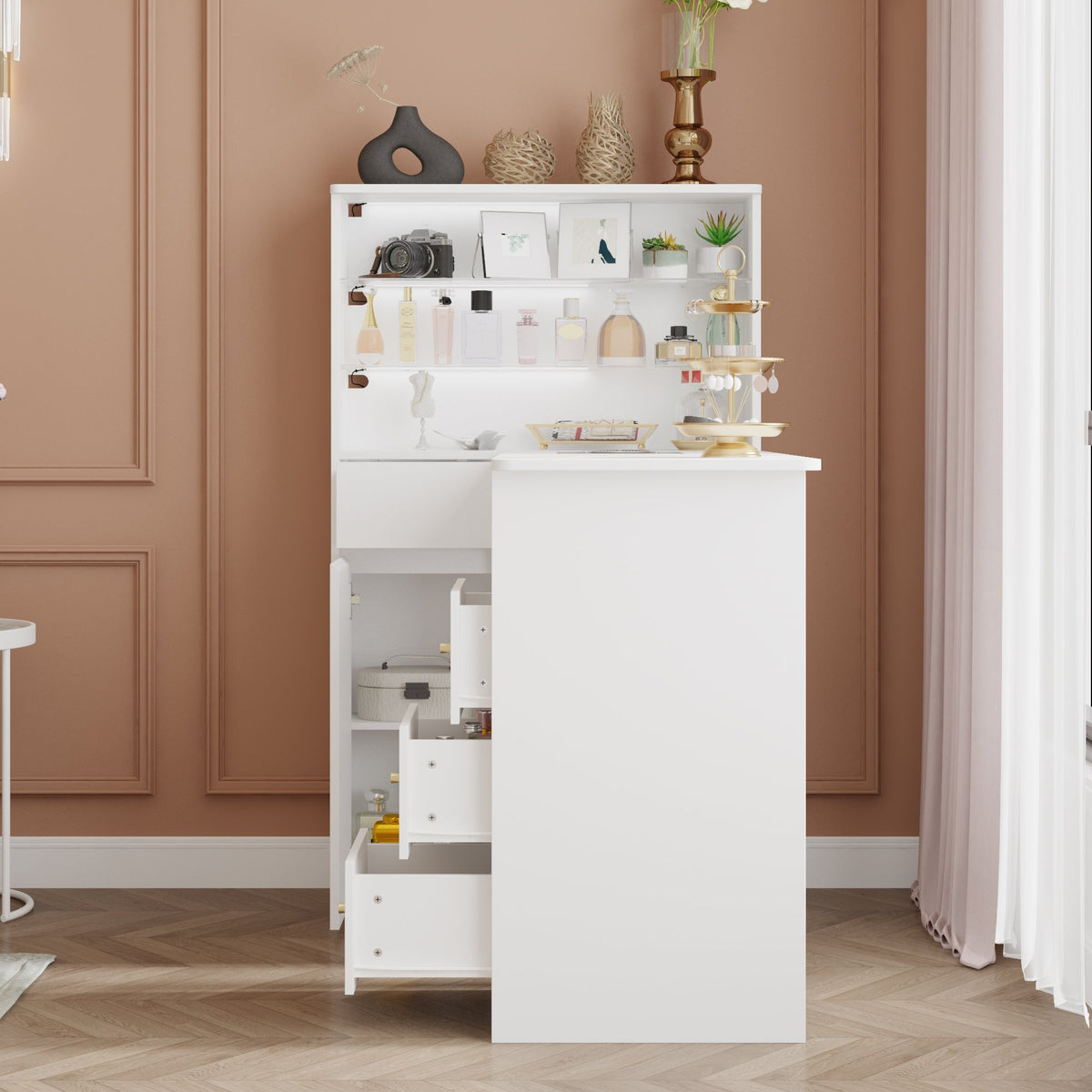
27.3" Two-Door Craft Sewing Table with 8 Baskets
A compact, mobile storage cabinet with a top for a sewing or craft machine. The listing gives 34.4" H x 27.3" W x 19" D and says the top takes a sewing machine up to 27" wide and 18" deep, with a platform capacity of 130 lb and an overall capacity of 200 lb. The platform is not adjustable, and the width and depth are fixed: there are no leaves.
Behind two doors with metal hinges and magnetic closures there is an adjustable shelf, listed at 22.9" W x 15.9" D, and eight plastic baskets for tools, fabric and small accessories. It rolls on four wheels that lock. The cabinet is white manufactured wood with black metal hardware, listed as fade-, stain- and water-resistant, and wipes clean with a damp cloth. It weighs 65 lb and needs a screwdriver for assembly.
Be clear about how it fits a sewing routine. A machine at the listed maximum size takes nearly the whole top, leaving little surface for fabric. The top is fixed at 34.4 inches, and the listing photos show the doors running from the top almost to the casters, with no knee clearance given, so long seated sessions at it are awkward. The photos show it as a craft station, with a cutting machine on top and a printer on the shelf, rather than with a sewing machine.
Best for: keeping a machine and its supplies in one tidy, rolling cabinet beside a desk or table, a standing craft or cutting-machine station, or a small room where everything has to hide behind doors.
Skip it if: you want to sit with your knees under the machine, need room for quilts on the same top, or want a lift platform or folding leaves.
What the listing gives, and what to check
| Feature | As listed | Check for your setup |
|---|---|---|
| Overall size | 34.4" H x 27.3" W x 19" D | Room to open both doors |
| Machine fit | Up to 27" W x 18" D | Your machine's size, plus fabric room |
| Capacity | Platform 130 lb, overall 200 lb | Machine weight plus stored supplies |
| Storage | Adjustable shelf 22.9" W x 15.9" D, 8 plastic baskets | Whether your machine fits on the shelf |
| Mobility and height | 4 locking wheels; fixed height, no leaves | Your elbow height against the machine bed |
FAQ
What size table do I need for a sewing machine?
At minimum, one whose listed maximum machine width and depth exceed your machine's, with capacity well above its weight. For comfort, add clear space to the left of the needle and some depth behind the machine. Quilts and curtains need a much larger surface or a second table at the same height.
How high should a sewing table be?
High enough that the work is at your elbow height while you sit with feet flat and wrists straight, as OSHA's sewing guidance says. Because the machine bed sits above the table, the table itself usually needs to be lower than your elbow. If it can't be lowered, raise the chair and use a footrest.
Can I use a regular desk as a sewing table?
Yes, if it is sturdy, doesn't wobble when the machine runs, and leaves room for your knees and the foot pedal. Many people sew at a desk and keep supplies in a rolling cabinet beside it.
What is the difference between a sewing table and a sewing cabinet?
A sewing table is mainly an open work surface, sometimes with leaves or a lift platform. A sewing cabinet adds doors, shelves and bins so the machine and supplies can be closed away. Cabinets are tidier in shared rooms but often have less knee space and surface.
Compare cabinets, desks and storage for a sewing or craft corner in the home office and study storage collection.


Laisser un commentaire
Ce site est protégé par hCaptcha, et la Politique de confidentialité et les Conditions de service de hCaptcha s’appliquent.