


A run-in shed for horses should give each horse about 72 to 144 square feet of roofed floor (University of Minnesota Extension; Purdue Extension uses 100), or 240 square feet for two horses plus 60 for each extra horse, with a roof 8 to 10 feet high so a horse can raise its head. Face the open side away from the prevailing wind, build on high, well-drained ground, and anchor the frame exactly as its manual says.
By those figures, a 12 x 12 foot shelter suits one horse, not two. Below: the arithmetic, siting, footing, herd order, snow and wind, feeding, and an honest look at the corral shelter and hay feeder in the FUFU&GAGA farm animal housing collection.
Key takeaways
- Floor space: 72 to 144 square feet per average horse (UMN); 100 per horse (Purdue); 240 for two plus 60 for each extra (UMN and the Canadian equine Code of Practice).
- Height: 8 to 10 feet (Purdue); for barns, the Code recommends the roof at least 2 feet above the horse's head.
- Siting: high, well-drained ground, closed back to the prevailing wind, a firm pad where hooves churn the ground.
- Herd order: a dominant horse can keep others out, so size for every horse at once.
- Snow: UMN says shelters should have truss certificates for at least 30 pounds per square foot of snow load.
What is a run-in shed, and does a horse need one?
A run-in shed is a roofed shelter in a pasture or dry lot, usually closed on three sides and open on the fourth, that horses walk in and out of as they please. Michigan State University Extension's bulletin Behavioral Considerations When Housing Horses describes the simple three-sided shed as protection from harsh weather that still gives good ventilation.
Shelter is not optional. Canada's Code of Practice for the Care and Handling of Equines (NFACC, 2013) requires that horses have access to shelter, constructed or natural such as trees, that protects them from the harmful effects of extreme weather. It names foals, older, injured, sick or thin horses, horses with a wet coat, body-clipped horses, horses not used to cold, and donkeys as the most vulnerable to cold, damp weather.
Horses use a shed mostly when the weather turns. University of Minnesota Extension's winter horse care page reports shelter use from less than 10 percent in mild weather to 62 percent when it was snowing with wind above 11 miles per hour.
How big should a run-in shed be per horse?
The sources agree on the idea and differ on the number. University of Minnesota Extension's Horse dry lots and shelters gives 72 to 144 square feet per average-sized horse in a herd that gets along, and its winter page calls a 12 x 20 foot (240 square foot) shed ideal for two horses, plus 60 square feet for each additional one. Purdue Extension's Introduction to Housing for Horses allows 100 square feet per horse. The NFACC Code gives 120 square feet each for the first two horses in an open-front shed and 60 for each additional horse. MSU asks for 80 square feet per 1,000 pounds of horse in shared shelters.
Run-in shed size chart
The MSU column assumes 1,000-pound horses; the last column is the smallest common footprint that meets every figure.
| Horses | Purdue (100 each) | UMN and NFACC (240 for two, +60 each) | MSU (80 per 1,000 lb) | Footprint that meets all |
|---|---|---|---|---|
| 1 | 100 sq ft | 72 to 144 sq ft (UMN) | 80 sq ft | 10 x 10 ft = 100 sq ft |
| 2 | 200 sq ft | 240 sq ft | 160 sq ft | 12 x 20 ft = 240 sq ft |
| 3 | 300 sq ft | 240 + 60 = 300 sq ft | 240 sq ft | 12 x 25 ft = 300 sq ft |
| 4 | 400 sq ft | 240 + 120 = 360 sq ft | 320 sq ft | 12 x 34 ft = 408 sq ft |
Round up. Every figure assumes horses that get along, and UMN says horses that do not, or larger horses, may need more.
Worked example: a 12 x 12 foot shelter
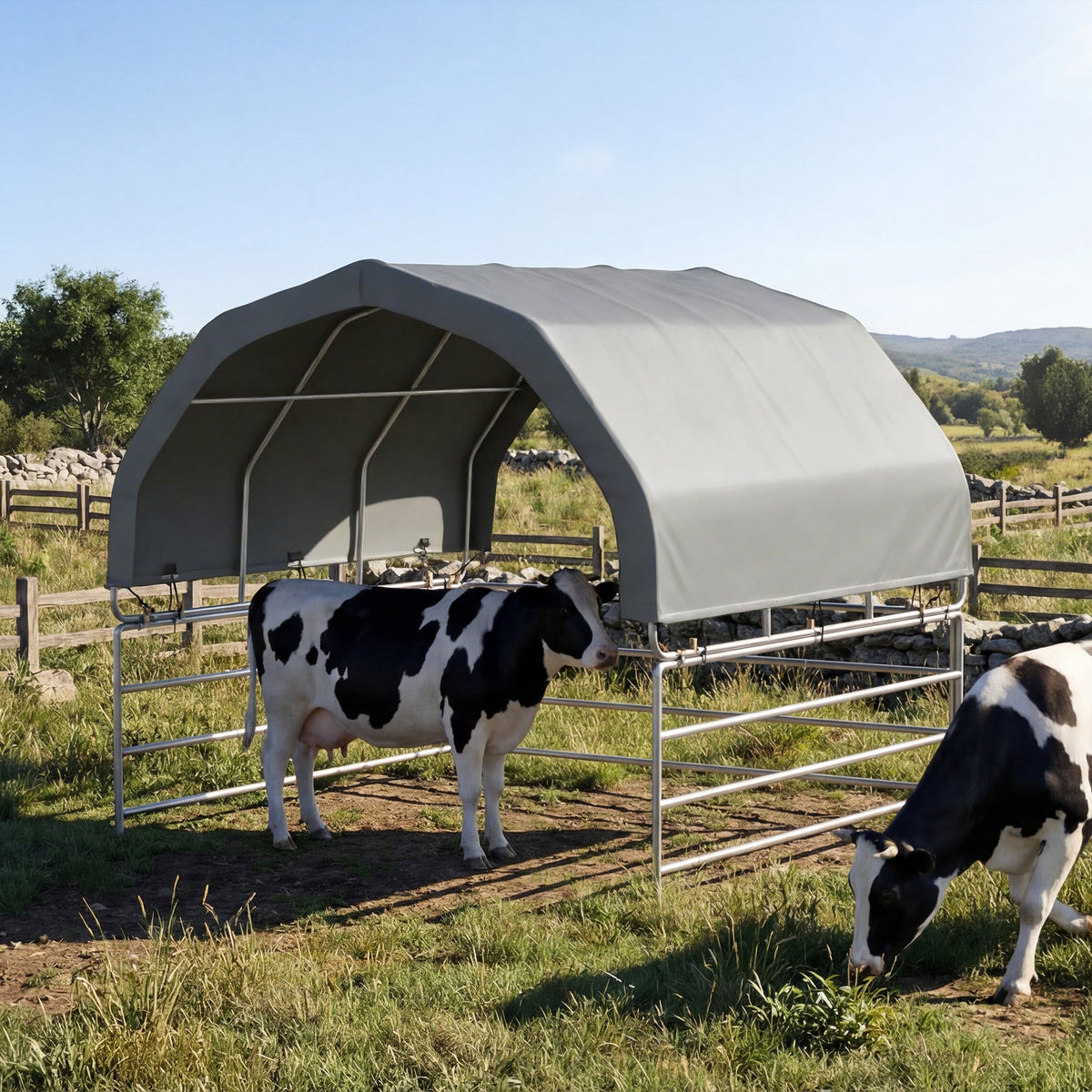
Our corral shelter below measures 141.7 x 141.7 inches: 20,079 square inches / 144 = about 139 square feet. For one horse, that is above Purdue's 100 and inside UMN's range. For two, it is about 70 square feet each, below UMN's lowest figure of 72 and far short of the 240 that UMN and NFACC give for a pair; MSU's figure allows about 1,740 pounds of horse in total. On floor area, it is a one-horse shelter.
How tall should a run-in shed be?
Purdue says three-sided horse shelters are normally 8 to 10 feet high for adequate head clearance. For barns, the NFACC Code recommends the ceiling at least 2 feet above the horse's head when standing (ideally more than 3.3 feet) and entrances at least 1 foot above head height.
To check a shelter, measure from the ground to the top of your tallest horse's head as it stands normally, add 1 foot for the opening and 2 feet for the roof, and compare with the lowest point a horse will stand under, not the peak. A dome or sloped roof is lower at its edges, so a listed overall height is the best case. A 76.8-inch (6.4 foot) shelter is 19.2 inches short of Purdue's 8 feet.

Where to put a run-in shed: siting and drainage
Purdue's bulletin says a horse barn should sit at least one foot above the surrounding terrain, because flooding and excess moisture cause hoof problems. UMN Extension's Managing mud on horse farms says to place buildings, feeding areas and shelters on higher ground, gives four to six degrees as the ideal slope, and recommends gutters that send roof water to ditches and swales.
- Back to the wind. Purdue says to place three-sided sheds for protection from the prevailing winds (north or west in Indiana), and UMN says shelters should be placed to block winds.
- Local rules. Purdue advises checking with the zoning board about placement relative to lot lines.
- Call before you dig. For ground anchors or posts, 811 Before You Dig, the free national service, asks you to contact 811 a few business days before digging.
Floor, footing and bedding
The NFACC Code requires that in muddy conditions horses have access to a mud-free, well-drained area on which to stand and lie down. A run-in shed is often that place.
- Base: for stall floors, Purdue suggests crushed rock covered with clay or field lime; sand or soil drain but develop holes. It calls concrete and asphalt slippery and hard on legs, so use plenty of bedding and rubber mats on them.
- High-traffic pad: UMN suggests pads under feeding areas, gates and shelters: remove 8 inches of topsoil, lay woven geotextile, add 4 inches of crushed limestone sized 1.5 to 1.75 inches, a second geotextile layer and 4 inches of footing.
- Bedding: the Code's stall rules make a good standard: a dry lying area that will not bruise or cut, no bare concrete or hard mats without bedding, bedding as dust-free as possible, and wet or soiled bedding removed at least once a day.
- Manure: UMN says to pick manure frequently, and the Code recommends building shelters so wastes are easy to remove.
Ventilation, heat and shade
The open front is the ventilation. Problems start when owners close a shed in for winter. The NFACC Code's barn section says ammonia should ideally stay below 10 ppm and must not exceed 25 ppm, and that if a person can smell it, it is likely 20 ppm or higher. If a closed-in shed smells of ammonia, open it up and remove wet bedding. In summer the roof is shade; the Code lists weakness, muscle tremors and shallow or rapid breathing among the signs of heat stress and says to help such a horse promptly, so call your veterinarian.
Herd order: room and a way out for every horse
MSU explains that a horse's rank can decide its access to a shelter, and that a dominant horse may keep another away from the feed bin or the shelter. It suggests partitions inside the shed may let more horses use it, and if a horse cannot get adequate shelter, providing more than one shelter or regrouping. The NFACC Code recommends enough shelter space for all horses at the same time and requires space for subordinate horses to escape aggression. For barns, it suggests doorways about 4 feet wide, twice that where two horses pass at once. Neither source gives a width for a shed opening, so keep the front open rather than narrowing it with partial walls. If one horse is always outside in the rain, the shed is too small or too crowded.
Snow, wind and anchoring
UMN's winter page says barns and shelters should have truss certificates of at least 30 pounds per square foot of snow load, and that paddocks should be cleared in heavy snow so horses can reach feed, water and shelter. A shelter with no listed snow rating has not shown it meets that, so in snow country keep it clear or choose a rated building.
A light steel frame with a fabric cover depends entirely on its anchors, and the right anchor depends on the surface. Follow the manual's method and check anchors after storms. Our patio gazebo buying guide explains anchoring on decks, pavers, concrete and soil. If a listing gives no wind rating, treat it as unknown.
Feeding in and around a run-in shed
The NFACC Code says hay racks or troughs giving 1 meter (3.3 feet) of feeding space per animal are generally appropriate, and that one more feeding site than the number of horses helps reduce aggression. Purdue adds that if horses are group fed inside the shelter, all of them need room to eat.
- Get hay off the ground. UMN's Ten ways to stretch your horse's hay supply reports that small square bales fed outdoors waste 13 percent without a feeder and 1 to 5 percent with one; round bales up to 57 percent without and 5 to 33 percent with. In UMN's small square-bale feeder trial, the slat feeder wasted least but was hardest to eat from.
- Head-down when possible. The Code recommends it for natural dental wear and fewer respiratory problems, and says feed should not touch ground contaminated with sand or manure.
- Forage first. The Code says forage should be most of the ration, fed at least twice daily without pasture or free-choice hay; UMN says to feed extra hay in bad winter weather. Ask your veterinarian or an equine nutritionist about the ration.
A feeder about 3.6 feet wide gives one horse a full share, so two horses need two feeders, plus the Code's extra one. Set them on a pad, apart from each other and from the shed opening.
Run-in shed buying checklist
- Multiply: at least 100 square feet per horse, or 240 for two plus 60 for each extra.
- Measure your tallest horse's head height; add 1 foot for the opening and 2 for the roof; compare with the lowest roof point.
- Choose high, well-drained ground with the closed back to the prevailing winter wind.
- Plan a firm floor, a pad at the entrance and an open front wide enough for manure removal.
- Look for a listed snow rating (UMN: at least 30 pounds per square foot) and wind rating.
- Follow the manual's anchoring steps; contact 811 before digging.
- Plan one feeder per horse plus one, about 3.3 feet of space each.
Our picks: a corral shelter and a hay and grain feeder
FUFU&GAGA has two products for this job. By the figures above, the corral shelter covers one horse at most and is shorter than Purdue's height for full-size horses; the feeder suits one horse eating at a time.
141.7" corral shelter with galvanized steel frame

A fabric-covered livestock shelter with a 12' x 12' footprint, 141.7 inches on each side, and an overall height of 76.8 inches. A galvanized steel frame carries a gray polyester cover with a dome-shaped roof, and a rain fly is included. It weighs 103.07 lb, is freestanding, and the listing says it works with standard corral fence panels, which are sold separately along with the gate. Two people are recommended for assembly, with a screwdriver; care is wiping with a dry cloth.
The photos show the roof both set over corral panels with cattle underneath and standing on its own base over poultry and hay. The listing gives no head clearance for either setup, no anchoring hardware and no wind or snow rating, so read the User Manual tab before you plan the base.
Best for: a single pony or small horse whose head height you have measured against the shelter's clearance, or as shade, a small-livestock shelter or a hay cover inside an existing corral.
Skip it if: you need shelter for two or more horses (its floor is below every per-horse figure for two), your horse needs more headroom than the 76.8-inch overall height allows (Purdue's guide is 8 to 10 feet), or you need a listed snow or wind rating.
43.6" dual-compartment hay and grain livestock feeder

A steel feeder with a 45-gallon hay rack and angled grid above a 24-gallon removable feed pan, 69 gallons in all, so hay and grain come from one spot, with less of either on the ground by the listing's account. It measures 43.6 inches wide, 21.7 inches deep and 36.1 inches tall and weighs 44 lb. The frame is galvanized steel with a black powder coat, which the listing says resists kicking, chewing, rust and weather. Assembly is tool-free, under 15 minutes by the listing, and it is listed for goats, calves, cows and horses.
Best for: one horse fed hay and a grain ration outdoors, on a firm pad beside a run-in shed.
Skip it if: several horses must eat at once (it gives about one horse's feeding space, so plan one per horse plus one) or you want horses eating head-down, since the hay sits in a raised rack. The listing gives no anchoring method.
Picks compared
| Pick | Size (W x D x H) | Frame and cover | Suits | Not listed |
|---|---|---|---|---|
| Corral shelter | 141.7 x 141.7 x 76.8 in | Galvanized steel, gray polyester dome roof, rain fly | One pony or small horse after you measure; small livestock; hay cover | Head clearance, anchoring, wind and snow ratings |
| Hay and grain feeder | 43.6 x 21.7 x 36.1 in | Galvanized steel, black powder coat | One horse at a time, hay plus grain | Anchoring method |
For other animal housing, browse the FUFU&GAGA farm animal housing collection.
FAQ
How big should a run-in shed be for one horse?
University of Minnesota Extension gives 72 to 144 square feet per average-sized horse in a herd that gets along; Purdue Extension allows 100. A 10 x 10 foot shed meets Purdue's figure, and a 12 x 12 shed (144 square feet) reaches the top of UMN's range. Larger horses need more.
What size run-in shed do I need for two horses?
UMN calls a 12 x 20 foot shed, 240 square feet, ideal for two horses that get along, adding 60 square feet for each extra horse. The NFACC Code gives the same total, 120 square feet each for the first two. A 12 x 12 shelter is too small for two.
Which way should a run-in shed face?
Put the closed back toward the prevailing wind so the open side faces away from it. Purdue gives north or west as the prevailing winds in Indiana; check your own site's winter wind, and build on high, well-drained ground.
How tall should a run-in shed be for horses?
Purdue Extension says horse shelters are normally 8 to 10 feet high for head clearance. The NFACC Code's barn guidance recommends the roof at least 2 feet above the horse's head and entrances at least 1 foot above it. Measure your tallest horse and check the lowest point of the roof.

Laisser un commentaire
Ce site est protégé par hCaptcha, et la Politique de confidentialité et les Conditions de service de hCaptcha s’appliquent.