


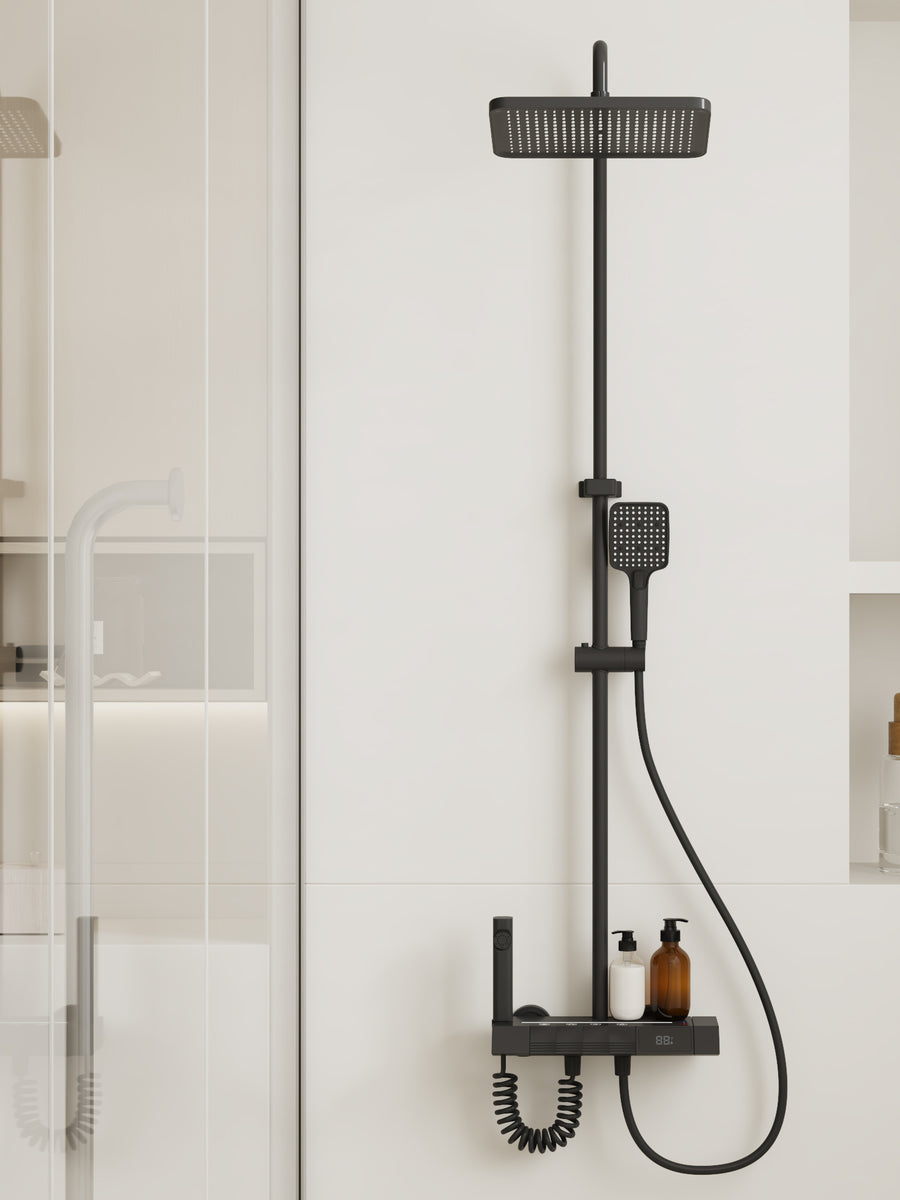
A rain shower system pairs a wide overhead rain head with a handheld spray on a slide bar, plus a diverter that switches between them, so one wall setup covers a slow, soaking shower and quick rinses. Before you buy one, check that the head will hang above the tallest user and below your ceiling, that your water pressure and hot water supply suit its flow rate, that the valve behind it is pressure-balancing or thermostatic for scald protection, and, for a model with a temperature display, how that display is powered. Then have a licensed plumber install it.
Below: head height and ceiling clearance, flow and water pressure, anti-scald valves, displays and handheld sprays, then the matte black shower system in the FUFU&GAGA bathroom collection.
Key takeaways
- Height: the rain head should sit above the tallest user's head. Compare the listed head height with that person's height in inches.
- Ceiling: the International Residential Code asks for at least 6 feet 8 inches (80 inches) of ceiling over a 30 by 30 inch area at a showerhead.
- Flow: the EPA says standard showerheads use 2.5 gallons per minute (gpm); WaterSense labeled showerheads use no more than 2.0 gpm.
- Scald protection: codes based on the IRC call for a balanced-pressure, thermostatic or combination shower valve limited to 120°F. A display shows the temperature; it does not limit it.
- Installation: supply lines and valves are work for a licensed plumber; any wiring near a shower is work for a licensed electrician.
What is a rain shower system?
A rain shower system is a set of shower fittings on one wall: a large, flat overhead head that lets water fall straight down, a handheld spray on a hose, a riser with a slide bar that holds the handheld at different heights, and a diverter that sends water to one outlet or another. Some add body jets, and some put the controls on a panel with buttons and a temperature readout.
The rain head is the reason most people buy one. The handheld does the jobs a rain head cannot: rinsing hair without wetting your face, washing a child or a pet, rinsing the walls and washing while seated.
| Setup | What you get | Watch for |
|---|---|---|
| Rain head only | Overhead spray from a wall or ceiling arm | No easy way to rinse the walls or wash seated |
| Rain head plus handheld on a slide bar | Overhead and movable sprays, switched by a diverter | The riser fixes the head height |
| System with jets | More spray patterns from one panel | What the valve can supply |
| System with a digital display | A live temperature readout | How the display is powered; it is not a scald limiter |
How high should a rain shower head be?
A rain head works best when water falls onto the top of your head rather than into your face, so it should hang higher than the tallest person who uses the shower. On a wall-mounted system with a fixed riser, the head height is set by where the plumber places the water connections, so decide it before the wall is closed.
Compare the head height in the system's instructions with the people in your home. In inches, 6 feet is 72 (6 x 12), 6 feet 4 inches is 76 and 6 feet 8 inches is 80.
| Rain head height | In feet | What it means |
|---|---|---|
| 72 in | 6 ft 0 in | Users over 6 feet stand with their head at or above the rain head |
| 76 in | 6 ft 4 in | Clears users up to 6 ft 4 in |
| 80 in | 6 ft 8 in | Clears users up to 6 ft 8 in, but needs a ceiling above 80 in at the head |
If a tall adult and a child share the shower, set the rain head for the adult and let the handheld on its slide bar serve the child.
Rain shower head height and your ceiling
The International Residential Code's ceiling-height section, as reproduced in a City of Boise code handout, requires bathrooms to have a ceiling height of at least 6 feet 8 inches, and a shower or tub equipped with a showerhead to have at least 6 feet 8 inches of ceiling above an area of at least 30 by 30 inches at the showerhead (City of Boise, IRC R305 handout).
That minimum is 80 inches, the top of the range in the table, and the head and its arm need room above that. A standard 8-foot ceiling is 96 inches (8 x 12), which leaves 16 inches over an 80-inch head. Under a sloped ceiling or a soffit, measure at the exact spot where the head will hang, and ask your building department about local rules.
How big should a rain shower head be?
A bigger head covers more of your shoulders but spreads the same flow more thinly. Size it to the shower: the spray should land on you, not on the glass or the curtain. If a listing gives no head size, ask for it before you buy.
Water pressure and flow: will a rain shower feel strong enough?
The U.S. Environmental Protection Agency says standard showerheads use 2.5 gallons per minute (gpm), and WaterSense labeled showerheads must use no more than 2.0 gpm. It also says its spray force test was revised to accommodate water-efficient rain showers, and that labeled showerheads must keep a minimum flow across a range of household water pressures (EPA WaterSense, showerheads).
A rain head spreads its water over a wide face, so each stream lands more softly than from a small, focused head. For a harder spray, use a massage or jet setting on the handheld.
Flow also decides how fast you use hot water. A 10-minute shower at 2.5 gpm uses 25 gallons of mixed water (2.5 x 10); at 2.0 gpm it uses 20 gallons. If your water heater already runs short, ask your plumber to check it before you upgrade.
Pressure matters too. The City of Tustin, California, says you may need a pressure reducing valve (PRV) if your water pressure is more than 80 pounds per square inch (psi), that sustained pressure above 80 psi can damage on-site plumbing, and that most plumbing professionals recommend a PRV setting between 35 and 60 psi (City of Tustin, High Water Pressure). A plumber can measure your pressure with a gauge before the new system goes in.
Anti-scald valves: pressure-balancing or thermostatic?
For safety, the valve that mixes hot and cold water matters more than the head. South Carolina's adopted version of the International Residential Code, section P2708.4, is typical: individual shower and tub/shower valves shall be balanced-pressure, thermostatic or combination valves conforming to ASSE 1016 (or the other standards it lists), with a means to limit the maximum setting to 120°F (49°C), and in-line thermostatic valves shall not be used to comply (S.C. Code Regs. 8-1243, IRC P2708.4).
ASSE International's scald awareness white paper describes these as automatic temperature and/or pressure compensating valves, in three types: pressure balancing, thermostatic (mechanical and electronic) and combination. It says they provide both scald and thermal shock protection, that the temperature limit stop must be set at installation, and that the showerhead flow rate must not be less than the manufacturer's published minimum flow rate for the valve (ASSE International, Guidelines for Temperature Control Devices). It also warns that a mixing valve at the water heater does not, on its own, provide adequate scald protection.
| Valve type | Compensates for | Ask your plumber |
|---|---|---|
| Pressure balancing | Changes in hot or cold water pressure | Does its minimum flow suit the new heads? |
| Thermostatic | Changes in water temperature | Is it a shower valve, not an in-line device? |
| Combination | Both | Where will the limit stop be set? |
The U.S. Consumer Product Safety Commission says most adults will suffer third-degree burns if exposed to 150 degree water for two seconds, and that even at 120 degrees a five minute exposure could result in third-degree burns. It urges users to lower water heaters to 120°F and notes that most tap water scald injuries and deaths involve the elderly and children under five (CPSC, Avoiding Tap Water Scalds). Hand-test the water before a child steps in.
Shower systems with a digital display
A digital display shows the water temperature while the water runs, so you can see when it is ready before stepping under the rain head. It reports the temperature but does not cap it: the valve and its limit stop do that, so a display adds to scald protection and never replaces it.
Before you buy, find out how the display and any electronic control unit are powered. If the listing does not say, ask the seller and read the installation guide with your plumber. Any wired power near a shower is work for a licensed electrician.
Rain shower head with handheld: why the slide bar matters
A slide bar lets each user park the handheld at their own height. The ADA 2010 Standards, which govern public places rather than private homes, give a useful benchmark: section 608.6 calls for a shower spray unit with a hose 59 inches long minimum, delivering water at 120°F maximum (ADA.gov, 2010 Standards). If someone sits to shower, compare the hose length with that figure.
Matte black shower systems
A matte black shower system draws a strong outline against light tile and matches black pulls, mirror frames and lighting. Check what the body is made of, and whether the finish suits the fittings you are keeping.
Installing a rain shower system
Have a licensed plumber install it. The job involves the hot and cold supply, the valve, the diverter and watertight seals through the wall, and a mistake stays hidden until it leaks. Ask your building department whether the work needs a permit. Give the plumber the connection size, required valve type and installation height from the listing and guide, the tallest user's height, and the ceiling height where the head will hang.
A system made for an indoor shower is not automatically suitable outdoors. Our outdoor shower enclosure guide covers drainage, permits and frost for a backyard shower and the cedar outdoor shower room, which comes without a shower head or hose; choose fittings rated for outdoor use for it.
Rain shower system checklist
- Head height: above the tallest user's height in inches.
- Ceiling: at least 80 inches over a 30 by 30 inch area at the head, plus room for the head and arm.
- Head size: listed, and it fits your shower.
- Flow: maximum gpm listed, and your water heater can keep up.
- Pressure: measured; above 80 psi, ask about a pressure reducing valve.
- Valve: pressure-balancing, thermostatic or combination, limit stop set at installation.
- Display power: known before you buy.
- Handheld: on a slide bar, with a hose long enough for seated use if needed.
- Installer: a licensed plumber, with the listing and guide in hand.
Our pick: a matte black rain shower system with a display
The FUFU&GAGA range currently has one rain shower system. The facts below come from its product listing; the guide is in the User Manual tab on the product page.
41" Modern Matte Black Shower System with Rain Shower Head, Handheld Spray and Digital Display

A wall-mounted shower system about 41 inches tall (41.3 inches in the spec), with a lightweight, corrosion-resistant aerospace aluminum body in matte black. It pairs a wide rain shower head with a handheld spray on a slide bar and includes jets, with rain, full/standard and massage/jet spray patterns and adjustable water flow. A four-way piano-key panel switches between the rain head, the handheld and other flow combinations, and an LED display on the panel shows the water temperature in Fahrenheit in real time, with soft ambient lighting.
The listing gives a maximum flow rate of 2.5 GPM, standard 1/2" NPT connections and thermostatic control with an electronic control unit. It says the system is designed to install 42 to 48 inches above the floor, which places the shower head 72 to 80 inches from the floor, and that it needs a thermostatic or pressure-balanced valve with a one-valve diverter. Included: shower head, shower arm, hand shower, slide bar, jets, handles and electronic control unit.

What the listing does not give: the rain head size, the handheld hose length, and how the display and control unit are powered. It also lists thermostatic control on the panel while saying the system needs a separate thermostatic or pressure-balanced valve, and its two height ranges do not move in step: moving the panel within a 6-inch range cannot move the head all the way from 72 to 80 inches. Show the listing and guide to your plumber before rough-in, so they can confirm how it connects and measure the real head height on the parts.
Best for: an indoor shower where you want a rain head, a handheld on a slide bar and a temperature readout on one matte black panel, with a plumber who will confirm the valve and connections from the guide.
Skip it if: you need a WaterSense-level flow (its listed maximum is 2.5 GPM), you need the rain head size or hose length before buying, you cannot get a clear answer on how the display is powered, the tallest user is over 6 feet and your ceiling or connections will not allow the head near the top of its range, or you want it outdoors (the listing gives no outdoor or freeze rating).
| Feature | From the listing | What you check |
|---|---|---|
| Size and finish | About 41 in tall, aluminum, matte black | Wall space and your other fittings |
| Heads and sprays | Rain head, handheld on a slide bar, jets | Rain head size (not listed) |
| Diverter | Four-way piano-key panel | Valve and diverter set-up with your plumber |
| Display | LED Fahrenheit readout with ambient light | How it is powered (not listed) |
| Flow and connections | Max 2.5 GPM, 1/2" NPT | Water pressure and heater capacity |
| Height | Installs 42 to 48 in above the floor; head 72 to 80 in | Tallest user and ceiling at the head |
FAQ
What is the best height for a rain shower head?
Above the tallest user's head, so water falls onto them rather than into their face. A head at 72 inches clears users up to 6 feet; 80 inches clears users up to 6 feet 8 inches. The International Residential Code asks for at least 80 inches of ceiling over a 30 by 30 inch area at a showerhead.
Do rain shower heads need high water pressure?
They need steady, normal pressure. WaterSense labeled showerheads must keep a minimum flow across a range of household pressures. The City of Tustin says a pressure reducing valve may be needed above 80 psi, and that most plumbing professionals recommend a setting between 35 and 60 psi.
Is a thermostatic shower valve better than a pressure-balancing one?
Both meet ASSE 1016, along with combination valves, and ASSE International says these valves provide both scald and thermal shock protection. A pressure-balancing valve compensates for pressure changes; a thermostatic valve for temperature changes. Either way, have the limit stop set at installation; codes based on the IRC cap it at 120°F.
Can I install a rain shower system myself?
Leave it to a licensed plumber. The job involves the hot and cold supply, the shower valve and its limit stop, and watertight connections through the wall.
See more for the bath in the bathroom collection.


Laisser un commentaire
Ce site est protégé par hCaptcha, et la Politique de confidentialité et les Conditions de service de hCaptcha s’appliquent.