


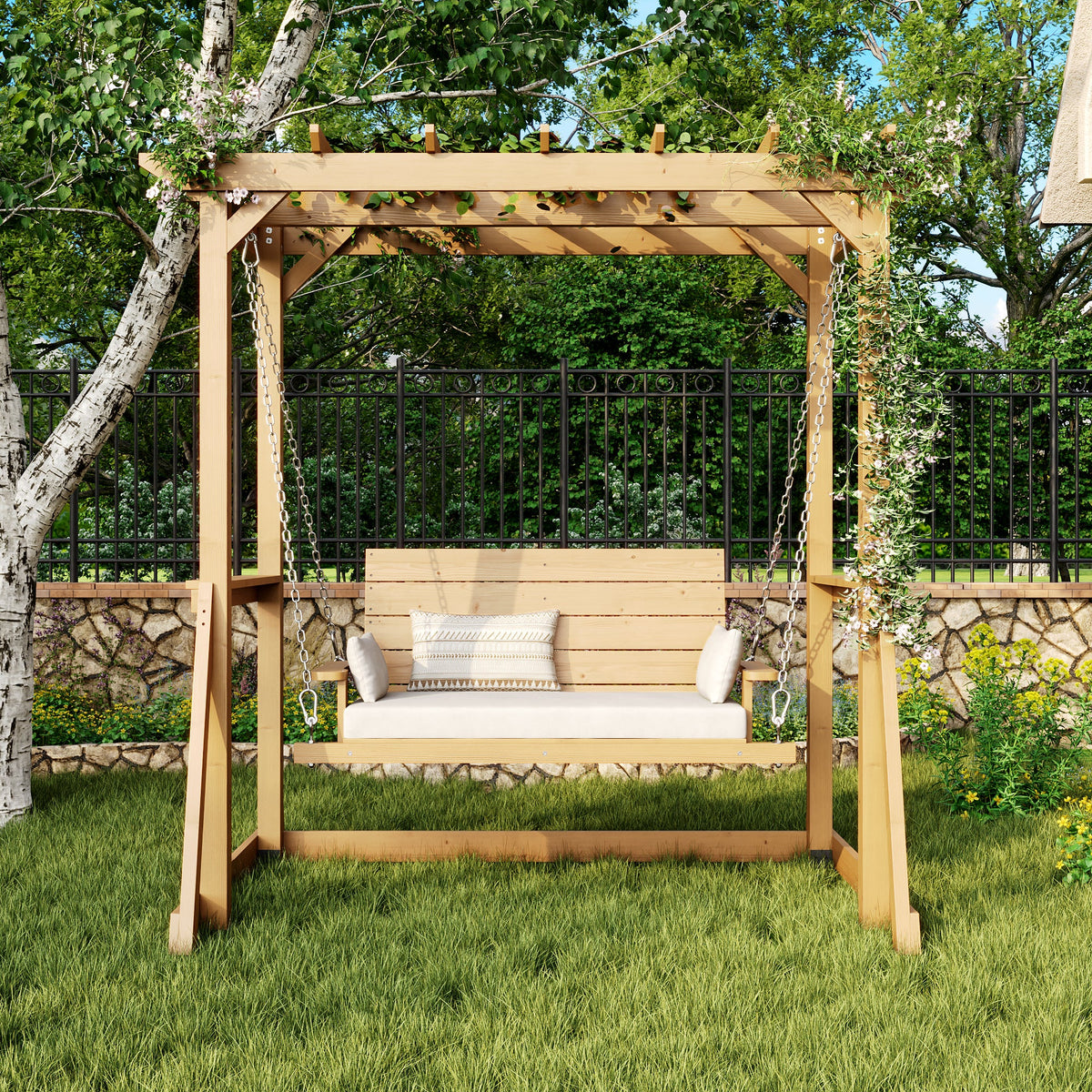
A patio swing is only as safe as where and how it stands. A freestanding swing with its own frame needs level, firm ground, clear space in front and behind for the seat to move, a listed weight capacity that covers everyone who sits on it at once, and regular checks of its chains, hooks, bolts and wood. Keep children supervised around any swing, and treat a heavy wooden bench swing as a seat for sitting, not as play equipment.
Below: the main types of patio swing, how much space and what surface each needs, what a weight rating means, a seasonal safety check, cedar care and shade, then our solid cedar gazebo swing for two. More outdoor seating is in the FUFU&GAGA outdoor chairs and benches collection.
Key takeaways
- Level ground first. The CPSC's home playground handbook says a level location reduces the chance of equipment tipping over.
- Leave room for the arc. This Old House suggests allowing at least a 4-foot arc for a hanging porch swing. For children's swings, the CPSC wants structures kept clear in front and behind by twice the height of the top bar.
- Capacity is a total for everyone on the seat, plus cushions.
- Check the hardware often. The CPSC recommends checking swing seats, chains and cables monthly and closing S-hooks to a gap smaller than the thickness of a dime.
- Plan the wood finish. In a 14-year Forest Products Laboratory study on western red cedar, clear water-repellent finishes had the shortest service life; stains and paints lasted longer.
Types of patio swings
What holds the seat up decides where a patio swing can go and what you have to check.
| Type | What holds the seat | Where it goes | Watch for |
|---|---|---|---|
| Hanging porch swing | Chains or rope from the porch ceiling | Covered porch with sound ceiling framing | It must hang from structure (joists or beams), not ceiling boards |
| Porch swing with stand | Its own A-frame of wood or metal | Patio, deck or lawn | The frame's footprint is wider than the seat; needs level ground |
| Canopy swing | A metal frame with a fabric canopy over the bench | Sunny patios and lawns | Fabric catches wind; check whether the canopy tilts or comes off |
| Gazebo or pergola swing | A post-and-beam frame with a roof or open rafters | Garden corner, lawn or patio | Heavier to move; open rafters give dappled shade, not rain cover |
Porch swing with stand or hung from the porch?
A hanging porch swing uses no floor space beyond its arc, but everything depends on what it hangs from. "The biggest thing in installing a porch swing is to make sure it goes into something structural," says Tom Silva in This Old House's porch swing guide, which checks joist condition and strength, lists 4 to 6 inch screw eyes or eyebolts, and describes adding reinforcement where needed. The same guide suggests hanging the seat about 17 inches off the floor as a starting point and adjusting from there.
A swing with its own frame skips the ceiling question; as This Old House puts it, freestanding frames let you place a swing anywhere in your yard. Choose one if your ceiling framing is unknown, you rent, or you want the swing on the lawn. The trade-off is floor space and the need for flat, firm ground.
How much space does a patio swing need?
Plan the frame's footprint (the listed width and depth) and the space the seat moves through. Our gazebo swing, for example, is 82 inches wide and 63 inches deep, which is 6 ft 10 in by 5 ft 3 in, or about 35.9 square feet (82 x 63 = 5,166 square inches, divided by 144).
The arc depends on who uses the swing. This Old House suggests at least a 4-foot arc for rocking a porch swing. The CPSC's Outdoor Home Playground Safety Handbook, written for children's play swings, is stricter: play equipment at least 6 feet from any structure, and swings farther away to the front and rear, by twice the height of the top bar.
| What you plan for | Space to leave | Source |
|---|---|---|
| The frame itself | Overall width x depth from the listing (82 x 63 in for our gazebo swing) | Product listing |
| Adults rocking gently | At least a 4-foot arc | This Old House, hanging porch swings |
| Children swinging like a play swing | Front and back: twice the height of the top bar | CPSC, children's swings |
| Other play equipment nearby | At least 6 feet from structures or obstacles | CPSC |
Worked example: measured against our swing's 81-inch overall height, twice the height is 162 inches, or 13.5 feet in front and behind. The chains hang from a beam a little below the top, so the real figure is somewhat less. Either way, keep walls, fences and walkways out of the swing's path.
Deck, patio or lawn: where to put a freestanding swing
One of the CPSC handbook's placement rules for play equipment is a level location, which reduces the chance of tipping; some sites need regrading. Lay a long level across the spot before you assemble a swing frame.
Also think about load. Our gazebo swing's frame weighs 143 lb and its listed capacity is 600 lb, so up to 743 lb (143 + 600) can rest on the frame's feet when two people sit down.
| Surface | Why it works | What to check |
|---|---|---|
| Concrete or pavers | Firm and easy to keep level and clean | Slope for drainage; set loose pavers so no foot rocks |
| Wood deck | Close to the house and the door | Board and joist condition; if the deck is old, bouncy or has soft boards, ask a contractor before putting a loaded frame on it |
| Lawn | Plenty of room for the arc | Soil can settle unevenly after rain; firm, level pads under the feet help |
Wind. Many listings give no wind rating or anchor kit. Before storms, the Federal Alliance for Safe Homes (FLASH) advises securing outdoor furniture and playground equipment and attaching items to decks or patios with ground anchors with cables or chains. Follow the manual for anchoring, and before driving a ground anchor into a lawn, contact 811: the 811 Before You Dig site says every digging project, regardless of depth, requires contacting the free service a few days in advance.
Patio swing weight capacity: what the number means
The weight capacity is the total load the swing is rated to hold at one time. Add up everyone who will sit together, then add cushions, pillows and anything else on the seat. A 2 person patio swing rated 600 lb, like ours, is listed for two adults or an adult with a child.
- The rating describes sitting. Standing on the seat, swinging hard or piling on a third person is outside what the number tells you.
- Hanging swings load the ceiling. When choosing rope for a porch swing, This Old House uses 600 pounds as a reasonable estimate of the maximum load at one time, including the swing's own weight. The hooks, chains and framing all have to carry it.
Chains, hooks, bolts and wood: a seasonal safety check
The CPSC handbook is written for children's play sets, but its hardware advice fits any swing. It says to use the bolts the manufacturer provides or recommends, tighten every fastener, and keep bolt ends from protruding past the nut by more than the bolt's diameter. It recommends closing S-hooks and other hooks so the gaps are less than the thickness of a dime, although open-ended hooks may be used at the uppermost attachment points of swinging parts.
For maintenance, the CPSC recommends checking nuts and bolts twice a month and tightening as needed, checking swing seats, ropes, chains and cables monthly for deterioration, and looking for splintering wood. This Old House recommends steel chain (stainless or galvanized) or marine-grade rope, and inspecting chains or ropes for wear and replacing them if necessary.
In practice: tighten everything and look over the chains, hooks and seat slats at the start of the season, repeat the chain and hook check monthly while the swing is in use, check that the frame still sits level after storms, and replace worn or rusted parts with the ones the manual names.
Children and patio swings
The CPSC notes that children are injured when they are hit by swings or other moving equipment, and its handbook advises lightweight swings for children to minimize injuries if a child is struck, avoiding heavy seats of metal or wood. A wooden bench swing is exactly that kind of heavy seat. Let children sit on it beside an adult, and keep them from running in front of or behind a moving seat.
The handbook also warns that hanging cords on play equipment are a strangulation hazard and says never to attach ropes, cords, clotheslines or similar loop-forming items. If you hang string lights on a swing frame that children use, keep the cords high, taut and fastened down. For a swing built for play, with lighter seats, surfacing and a separate use zone, see our outdoor playset buying guide.
How to care for a cedar patio swing
Cedar is a common choice for outdoor wood: the CPSC handbook names cedar and redwood as examples of naturally rot- and insect-resistant wood for outdoor play equipment. Cedar still weathers, and the finish on it decides how much upkeep you face.
A 14-year USDA Forest Products Laboratory study of 35 finishes on western red cedar siding (Williams and Feist, published 2007) found service life increased in this order: clear water-repellent preservatives, lightly pigmented water-repellent preservatives, semitransparent stains, solid-color stains, then paints. Many of the clear finishes failed within one year, mainly from mildew, which was worse at the warm, humid Gulfport, Mississippi site. This Old House suggests applying a water-resistant sealant to wooden swings every year, which fits that finding: clear finishes need frequent renewal. Before refinishing, check the manual for the factory finish and test on a hidden spot.
- Wash once a season. Iowa State University Extension advises washing outdoor furniture at the start of each outdoor season and tightening loose nuts, bolts and screws. For wood, it says to replace rusting fasteners before sealing, because they stain the wood.
- Use a mild cleaner. The Western Red Cedar Lumber Association's care page says a periodic cleaning with a mild, non-phosphate detergent solution usually restores the surface finish.
- Treat mildew first. The same page says re-staining does not solve a mildew problem: clean it off with a mild bleach solution (oxygen bleach preferred), then refinish with a coating that contains a mildewcide.
- Winter. This Old House suggests storing a swing indoors during harsh winters if possible.
Canopies, cushions and shade
A fabric canopy blocks sun while it is up, a solid roof also keeps rain off, and open rafters give dappled shade and a frame for vines or lights. Check whether a canopy tilts, comes off or is included at all.
Our gazebo swing's listing describes a canopy roof and lists "Adjustable Canopy: No", and its photos show open rafters, so expect dappled shade rather than rain cover. If you want a covered roof over seating, our patio gazebo buying guide compares roof types and anchoring. Also check whether cushions are included or only shown in photos.
Patio swing buying checklist
- Decide where it goes, and measure the spot: the frame's width and depth plus room for the arc in front and behind.
- Check the ground with a level; plan pavers or a pad if it is soft or sloped.
- For a hanging swing, confirm the ceiling framing can carry the load, or choose a swing with its own frame.
- Read the weight capacity and the seat count, and compare both with who will sit there together.
- Check what is included: frame, chains, hooks, cushions, canopy, anchors.
- Look for a wind rating or anchor kit; if none is listed, plan your own way to secure it, and contact 811 before staking.
- Know the wood and finish, and plan its care.
Our pick: a solid cedar gazebo swing for two
One FUFU&GAGA swing fits this guide: a freestanding two-seat swing on its own cedar frame.
82" solid wood gazebo swing chair for 2

A two-seat porch swing with its own stand, built as a small pavilion. The frame is 81 inches high, 82 inches wide and 63 inches deep, in solid natural cedar inside and out, with natural grain color variation. The bench has a 23-inch-high backrest, seats 2 and has a 600 lb weight capacity; the listing says that fits two adults or an adult with a child. Zinc and steel hanging chains come with the frame. The listing rates it water-, UV-, rot-, warp-, mold- and mildew-resistant and describes an eco-friendly water-based paint finish; its care line is to avoid abrasive cleaners. It weighs 143 lb, assembly is required, and you need a screwdriver, power drill and hammer.
Best for: a lawn, garden corner or patio where a full gazebo would be too much, and for two adults who want a shaded seat to sit and talk.
Skip it if: you need rain cover (the photos show open rafters and the canopy is not adjustable), you want a listed wind rating or anchor kit (the listing includes only the frame and chains), or you want cushions included; the photos show them, but they are not included.
| Spec | As listed |
|---|---|
| Overall size | 81 in H x 82 in W x 63 in D |
| Seats and capacity | 2 seats, 600 lb |
| Backrest | 23 in high, seat to top of back |
| Material | Solid cedar, natural wood color |
| Included | Frame and hanging chains (zinc, steel); no cushions |
| Top | Pavilion-style top; canopy not adjustable |
| Product weight | 143 lb |
| Assembly | Required: screwdriver, power drill, hammer |
For tips on building a tall frame safely, see our flat-pack assembly guide, and follow the swing's manual for every step. More benches and chairs are in our outdoor chairs and benches collection.
FAQ
How much clearance does a patio swing need?
The frame's listed footprint plus room for the arc: at least a 4-foot arc for a porch swing, per This Old House, and front and back space equal to twice the top bar's height for children's play swings, per the CPSC.
What weight capacity does a 2 person patio swing need?
Enough for both people plus cushions at the same time. Our cedar gazebo swing seats 2 and is rated for 600 lb, listed for two adults or an adult with a child.
How often should you check swing chains and hooks?
The CPSC recommends checking swing seats, chains and cables monthly and nuts and bolts twice a month, and closing S-hooks so the gap is less than the thickness of a dime.
Does a cedar swing need to be sealed?
A maintained finish helps. In the Forest Products Laboratory study, clear water repellents on cedar had the shortest service life; This Old House suggests resealing wooden swings yearly. Check your manual first.



Laisser un commentaire
Ce site est protégé par hCaptcha, et la Politique de confidentialité et les Conditions de service de hCaptcha s’appliquent.