


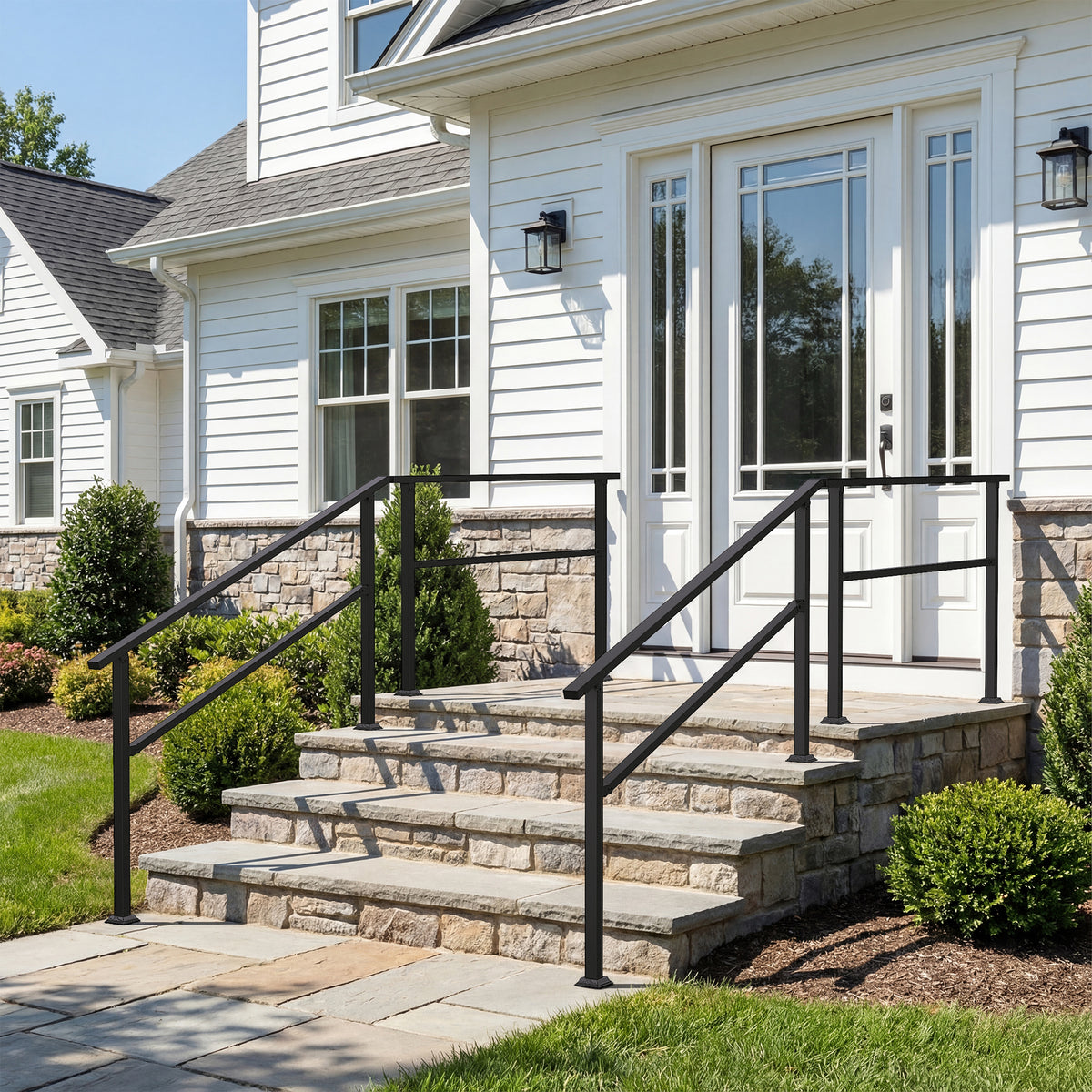
An outdoor stair railing for a home is usually a handrail set 34 to 38 inches high, measured straight up from the sloped line that runs along the front edges (nosings) of the steps. Under the International Residential Code (IRC), a handrail is required on at least one side of any flight with four or more risers, it should run the full length of the flight, and a round rail should be 1-1/4 to 2 inches across so a hand can close around it.
This guide is for homeowners adding a rail to porch, garden or garage steps, where wet leaves, rain and ice make a solid handhold a real safety issue. It covers the rules in plain terms, handrail vs guard, how to measure your steps, mounting and rust, then five adjustable banister kits from the FUFU&GAGA garden furniture collection.
Key takeaways
- Height: 34 to 38 inches above the nosings (IRC); the ADA uses the same range for public buildings.
- When required: four or more risers in a residential flight (IRC).
- Grip: a round rail 1-1/4 to 2 inches in diameter, or a non-round rail 4 to 6-1/4 inches around with no side over 2-1/4 inches.
- Angle: riser height divided by tread depth over 0.58 is steeper than 30 degrees; over 0.70 is steeper than 35. Adjustable kits only fit inside their listed range.
What are the code rules for an outdoor stair railing?
Most US homes fall under a local version of the IRC. Plain-language summaries from the Town of Timnath, Colorado and Knox County, Tennessee (both 2018 IRC) give the core rules below. Codes vary: California, for example, adopts its own residential code, and many places amend the model text. Check with your building department, and ask whether a permit applies.
| Rule | What the IRC summaries say |
|---|---|
| When a handrail is required | At least one side of each flight with four or more risers |
| Handrail height | 34 to 38 inches, measured vertically from the sloped plane along the tread nosings |
| Continuity | Full length of the flight, from above the top riser to above the lowest riser |
| Rail ends | Returned (turned back toward a wall or post) or ending in newel posts or safety terminals |
| Round grip | 1-1/4 to 2 inches outside diameter |
| Non-round grip | Perimeter 4 to 6-1/4 inches, largest cross section 2-1/4 inches or less |
| Space from a wall | At least 1-1/2 inches between the wall and the handrail |
| Load (Knox County notes) | Handrails and guards built to resist a 200 lb concentrated load applied at any point, in any direction |
The IRC also caps risers at 7-3/4 inches with a 10-inch minimum tread, which sets the steepest stair it allows (see the angle table below).
Is there a different code for a business entrance?
Yes. The 2010 ADA Standards (section 505) require handrails on both sides of stairs, 34 to 38 inches to the top of the gripping surface, continuous along each flight, 1-1/4 to 2 inches across if round, and with extensions: 12 inches level past the top of the flight, and, at the stair slope, one tread depth past the bottom riser nosing. Workplaces also fall under OSHA 1910.29, which allows handrails 30 to 38 inches high and requires them to hold a 200 lb force. For a shop, rental or hotel entrance, involve a professional and your building department early.
Handrail vs guard: which does your staircase need?
A handrail is the functional rail you grip for support. A guard is a barrier on the open side of a raised surface that keeps people from falling off it. They serve a different function and follow different rules.
| Handrail | Guard | |
|---|---|---|
| When required (IRC) | Flights with four or more risers | Porches, decks and floors more than 30 inches above the ground below; open sides of stairs (see note) |
| Height | 34 to 38 in above the nosings | 36 in minimum on porches and decks; 34 in minimum on stair sides, measured from the nosings |
| Openings | No limit | A 4-inch sphere must not pass through (4-3/8 inches at the sides of stair treads; 6 inches in the triangle under the bottom rail) |
Note: Timnath's handout ties the stair guard to a total rise of more than 30 inches; Knox County's says open sides of stairs with four or more risers. Your local office has the final word.
The "4-inch ball rule" is that guard opening limit. Banister kits like ours have a top rail and one mid rail (on the matte black kits, the diagram puts the mid rail 23.9 inches up, 12.9 inches below the top), so the gaps are far wider than 4 inches. They are handrails, not guards. If your stairs or stoop need a guard, hire a licensed contractor for a full railing system.
Is railing height 36 or 42 inches?
Both, for different things. In the IRC summaries, 36 inches is the minimum guard height on a home porch or deck more than 30 inches above grade. OSHA sets 42 inches, plus or minus 3, for workplace guardrails. A handrail on home steps is the 34 to 38 inch case.
Important considerations for outdoor steps
How steep are your steps? Check the angle first
Adjustable kits pivot to follow the stair, but only within a listed range: our satin black kits and the set of two list 0 to 30 degrees, the single matte black kits 0 to 35. Divide riser height by tread depth: 0.58 or less fits a 30-degree kit, 0.70 or less a 35-degree kit.
| Riser x tread (in) | Rise / tread | Approx. angle | 0 to 30 degree kit | 0 to 35 degree kit |
|---|---|---|---|---|
| 6 x 12 | 0.50 | 26.6 degrees | Fits | Fits |
| 6 x 11 | 0.55 | 28.6 degrees | Fits | Fits |
| 7 x 12 | 0.58 | 30.3 degrees | Just outside | Fits |
| 7 x 11 | 0.64 | 32.5 degrees | No | Fits |
| 7.5 x 10.5 | 0.71 | 35.5 degrees | No | No |
| 7.75 x 10 (IRC limit) | 0.78 | 37.8 degrees | No | No |
Angles are the arctangent of rise divided by tread. Measure several steps, since old concrete and stone steps are often uneven; the steepest one counts.
How long does a handrail need to be for 3 steps?
Work it out from your own staircase. The required handrail runs from above the lowest riser to above the top riser, so for a flight with N risers:
- Horizontal run = (N - 1) x tread depth
- Vertical rise = (N - 1) x riser height
- Length along the slope = the square root of (run squared + rise squared)
Example 1: four risers of 6 inches with 12-inch treads: run = 3 x 12 = 36 in, rise = 3 x 6 = 18 in, length = the square root of (1,296 + 324) = about 40.2 inches. With three risers, the IRC does not require a handrail, but the same method gives about 26.8 inches.
Example 2: five risers of 7 inches, 11-inch treads: run 44 in, rise 28 in, length about 52.2 inches.
Then check where the posts will land: usually one at the bottom and one on the landing, each on solid, flat concrete, stone or framing. A tilted rail covers less ground: multiply its length by about 0.87 at 30 degrees or 0.82 at 35 degrees to estimate its horizontal reach. Dry-fit with a helper before drilling.
Where will the handrail height end up?
The product "H" in our listings (36.2, 36.4 or 36.8 inches) is the frame height from base plate to top rail when the rail is level, not the finished height above your nosings. Because the posts stand on a tread, the ground or the landing, that height changes with the angle and post positions. After dry-fitting, measure straight up from several nosings to the top of the rail; the IRC target is 34 to 38 inches all the way along.
Mounting a railing system on concrete vs wood steps
All five kits below list concrete, brick and wood steps as mounting surfaces. The anchor is crucial: it is what makes a railing safe, so match the hardware to the material at each post location.
- Concrete and brick: the listings name only a screwdriver as an extra tool, but setting anchors in masonry normally means drilling holes, so read the user manual for the drill and bit size first. Drill into sound material, not into cracked, crumbling or hollow spots, and keep anchors well back from the edge of a step (check the anchor maker's edge distance).
- Wood steps and decks: fix into solid framing such as a stringer, a solid tread or blocking, not into thin trim or decking alone.
- Stone and pavers: loose pavers and dry-laid stone can't hold an anchor; set the post on a solid slab or footing instead.
After installation, push and pull on the rail at several points to ensure it is solid. Any movement at a base plate is a sign to fix the anchor before anyone relies on it.
Metal, wood or glass: choosing materials for outdoors
Selecting materials for an outdoor staircase means balancing durability, upkeep, your local code and the style of the house.
| Material | Look | Upkeep outdoors |
|---|---|---|
| Steel or iron | Sleek, slim profiles | Needs a protective coating such as galvanizing or powder coat; touch up chips |
| Aluminum | Light, modern | Lightweight and does not rust like iron |
| Wood (cedar, treated lumber) | Warmth and natural beauty | Regular sealing or staining; cedar resists decay but still needs care |
| Composite | Wood-like | Resists rot and splintering |
| Glass or stainless cable | Open, minimalist views | Frequent cleaning; usually a professionally installed guard |
For a few porch steps, a powder-coated metal kit is the simplest DIY design. Iron rusts where its coating is broken, so check the base plates, drilled holes and scratches each season, touch up chips with exterior metal paint at the first sign of rust, and rinse off de-icer salt after winter.
Adjustable kit or custom welded rail?
An adjustable kit comes in fixed lengths and fits only within its listed angle, and you check height, grip and ends yourself. A custom welded rail offers full customization (any length, angle, landing or turn) and can be built to your local code with precision. Choose custom for long or steep stairs, guards, curves and commercial entrances.
Do black banisters still work for a home exterior?
Style is personal, but a black metal rail is a stylish, easy match for dark window frames, lights and doors, and it reads well against white, gray and stone. An existing metal banister can be painted black: clean it, remove loose rust, prime bare metal and use exterior metal paint per the paint maker's directions.
Outdoor stair railing buying checklist
- Count your risers. Four or more means the IRC requires a handrail on at least one side.
- Divide riser height by tread depth: 0.58 or less for a 30-degree kit, 0.70 or less for a 35-degree kit.
- Work out the sloped length, plus room for the posts.
- Check the grip: round 1-1/4 to 2 inches, or non-round 4 to 6-1/4 inches around.
- Measure 34 to 38 inches above the nosings after dry-fitting.
- Confirm the surface is sound, and read the manual for drill and anchor sizes.
- If the stair or porch is over 30 inches high, ask a contractor whether you need a guard.
- Call your building department for guidance on permits and local amendments.
Our picks: adjustable outdoor stair railing kits
Five banister kits from the FUFU&GAGA range, by length and finish. All are powder-coated iron with a mounting kit and a level in the box. Facts come from each listing.

40.4" Minimalist Satin Black Stair Banister
A straight, minimalist rail 40.4 inches end to end and 36.2 inches high, 11 lb. The listing gives a 2-inch rod diameter, 0 to 30 degree adjustment and a 440 lb weight capacity. That is about the length of example 1 above, so dry-fit it to check where the posts land. A 2-inch round rod would sit at the top of the IRC grip range; the listing doesn't describe the rail's cross-section, so check the profile if you follow the code.
Best for: two to four shallow porch, garage or garden steps.
Skip it if: your steps are steeper than 30 degrees (rise divided by tread over 0.58) or longer than about 40 inches along the slope.
68.5" Minimalist Satin Black Stair Banister
The same clean design in a longer 68.5-inch rail, 36.2 inches high and 16 lb, with a 2-inch rod, 0 to 30 degree adjustment and a listed 440 lb weight capacity. The listing describes it for residential and commercial use.
Best for: a longer, gentle flight, such as four or five low risers with deep treads.
Skip it if: your stair is steeper than 30 degrees; the matte black scroll kits below adjust to 35.
68.5" Modern Matte Black Stair Banister
A scroll-end design in matte black, 68.5 inches long and 36.8 inches high, 21 lb. It adjusts from 0 to 35 degrees, the widest range here, and the listing says the powder coat is lead free. The diagram shows the posts 61.8 inches apart and a mid rail 23.9 inches up when the rail is level.
Best for: standard steps around 7-inch risers and 11-inch treads (about 32.5 degrees), such as the five-riser example above (about 52 inches along the slope).
Skip it if: you want a stated weight capacity; this listing doesn't give one.

82.3" Modern Matte Black Stair Banister
The longest kit: 82.3 inches overall and 36.8 inches high, 23 lb, with the same scroll ends, lead-free matte powder coat and 0 to 35 degree adjustment. The diagram puts the posts 75.4 inches apart when level. For seven 7-inch risers with 11-inch treads (run 66 in, about 78.2 inches along the slope), it reaches about 69 inches horizontally at 32.5 degrees (82.3 x 0.84), just over the run, so dry-fit first.
Best for: a full flight of six or seven standard steps up to a raised porch.
Skip it if: the porch is more than 30 inches above the ground and the open side needs a guard, or you need a stated weight capacity (none is listed).
68.5" Modern Matte Black Stair Banister (Set of 2)
Two matte black rails, so you can fit one on each side of the steps. Each is 68.5 inches long and 36.4 inches high, 32 lb in total. The listing gives a 0 to 30 degree adjustment and a 500 lb weight capacity, the highest stated in this group. Its photos show square-ended rails on stone and concrete stoops.
Best for: wide front steps where you want a matching rail on each side.
Skip it if: your steps are steeper than 30 degrees, or you want the scroll ends of the single matte black kits. Confirm the anchors in the box suit your surface: its spec list shows a mounting kit, rods and a level.
Compare the picks
| Kit | Length x H | Angle | Listed capacity | Best for |
|---|---|---|---|---|
| 40.4" satin black | 40.4 x 36.2 in | 0 to 30 degrees | 440 lb | 2 to 4 shallow steps |
| 68.5" satin black | 68.5 x 36.2 in | 0 to 30 degrees | 440 lb | Longer gentle flights |
| 68.5" matte black | 68.5 x 36.8 in | 0 to 35 degrees | Not listed | Standard steps |
| 82.3" matte black | 82.3 x 36.8 in | 0 to 35 degrees | Not listed | Full porch flights |
| 68.5" set of 2 | 68.5 x 36.4 in | 0 to 30 degrees | 500 lb | Rails on both sides |
Listed capacities are each product's weight rating as its listing states it, not code load ratings, and they depend on correct anchoring. None of these kits is sold as code compliant: your installed height, grip, ends and anchors decide that.

Can I install stair railings myself?
For a few low steps and a handrail-only kit, often yes. The listings say one person can install these kits with the included hardware; plan on a helper for dry-fitting and a drill for masonry, and read the guide in the User Manual tab first. Call a professional when the steps are tall or uneven, a guard is needed, the concrete is cracked, or it is a business entrance.
When you're ready to compare lengths and finishes, explore the full range of outdoor stair railings in our garden furniture collection.
FAQ
What are the requirements for handrails on outside steps?
Under the IRC, a residential flight with four or more risers needs a handrail on at least one side, 34 to 38 inches above the nosings, continuous for the flight, with returned or post-terminated ends and a graspable profile. Business entrances follow the ADA Standards, which add rails on both sides and extensions. Local codes vary, so check with your building department.
What type of handrail is best for outdoor steps?
A metal rail with a weather-resistant finish, such as powder-coated iron or aluminum, keeps upkeep low. Pick one that matches your stair angle and length, has a graspable profile, and is anchored into solid concrete or framing. Tall stairs that also need a guard call for a custom railing system.
Do I need a handrail for 3 steps?
Count risers, the vertical rises you step up. With three risers, the IRC does not require a handrail; with four or more, it does. A rail still adds support for older adults, children and anyone carrying groceries in rain or snow.


Laisser un commentaire
Ce site est protégé par hCaptcha, et la Politique de confidentialité et les Conditions de service de hCaptcha s’appliquent.