
Good outdoor dining chairs are made of a material that suits your weather, put the seat about 8 to 14 inches below the tabletop, have arms low enough to clear the table if you want to push them in, and list a weight capacity per chair. For rain, sun and snow with little upkeep, solid high density polyethylene (HDPE) is the easy choice; wood and metal need more regular care.
Below, each choice is worked through with real measurements and plain arithmetic, followed by five sets of two from our outdoor chairs and benches collection, all HDPE according to their listings, with seats 16 to 17 inches high.
Key takeaways
- Material: HDPE needs no finish; wood needs a decay-resistant species and refinishing; metal needs washing and rust touch-ups.
- Seat height: usually 8 to 14 inches below the tabletop.
- Arms: armchairs slide under only if the arms are lower than the table's underside.
- Spacing: 24 inches of table edge per diner minimum, 30 for comfort.
- Capacity: our five sets list 300 to 360 lb per chair.
Which outdoor dining chair material suits your climate?
Your weather decides how much care a chair will need. Our HDPE outdoor furniture guide covers the plastic itself in depth, so here the focus is climate.
| Material | Rain and humidity | Weak point | Upkeep |
|---|---|---|---|
| HDPE (solid poly boards) | Does not rot; slatted seats drain | UV can make plastic brittle over time; check the listing for UV resistance | Soap and water or a hose rinse |
| Wood (teak, cedar, others) | Depends on species; sapwood decays fast | Turns gray and can split without care | Clean, sand and reseal on a schedule |
| Aluminum | Does not rust | Pits and dulls without regular washing | Wash often; wax every few months |
| Steel or wrought iron | Rusts where bare metal shows | Chips in paint or coating | Touch up chips with rust-resistant primer and paint |
Wet or humid climates
Wood is most affected by damp. The USDA Forest Products Laboratory's Wood Handbook chapter on biodeterioration says untreated sapwood of essentially all species has low resistance to decay. Among heartwoods, old-growth teak is very resistant, cedars are resistant and young-growth teak is only moderately resistant, and resistance may be lower in warm, humid climates. HDPE and aluminum cannot rot, so they suit humid patios.
Hot, sunny climates
Sun ages both wood and plastic. A 1996 Iowa State University Extension article on outdoor furniture care notes that redwood will likely turn gray within a year without care. In a NIST study, HDPE samples exposed to UV light became brittle, and the changes came faster at higher UV intensity and temperature. A listing that states UV resistance tells you the maker planned for this.
Snowy and windy climates
Two of our listings say their HDPE chairs can stay out through rain, snow and changing seasons. Light chairs move more easily in wind. Before a big storm, Ready.gov's hurricane checklist says to bring in outside furniture.
What seat height do outdoor dining chairs need?
Seat height only makes sense against table height. Dimensions.com's dining clearances list a table height of 28 to 32 inches, a seat height of 18 to 20 inches and a minimum chair-to-table clearance of 7.5 inches. Subtracting one range from the other, the seat ends up 8 to 14 inches below the tabletop. Common combinations:
| Table height | 16 in seat | 17 in seat | 18 in seat | 20 in seat |
|---|---|---|---|---|
| 28 in | 12 in | 11 in | 10 in | 8 in |
| 29.4 in | 13.4 in | 12.4 in | 11.4 in | 9.4 in |
| 30 in | 14 in | 13 in | 12 in | 10 in |
| 32 in | 16 in | 15 in | 14 in | 12 in |
What decides whether your thighs fit is the space between the seat and the underside of the table. Our 70.9-inch HDPE dining table lists 26.8 inches from the floor to the table bottom, so a 16-inch seat leaves 10.8 inches and a 17-inch seat leaves 9.8 inches, both above the 7.5-inch minimum.
All five of our sets below have seats of 16 to 17 inches, a little under that 18 to 20 inch range, which suits a table at the lower end of 28 to 32 inches. A cushion raises the seat by its compressed thickness: 2 inches turns a 17-inch seat into a 19-inch one. For table sizes and seat counts, see our patio table size guide.
Armchairs or armless: what fits under the table?
Armchairs are more comfortable for long meals and easier to get out of. Armless side chairs take less room and tuck fully under the table. Two checks decide which works on your patio.
1. Arm height against table clearance. An armchair slides under only if its arm height is lower than the table's floor-to-underside clearance. At our 70.9-inch table's 26.8 inches, our 24-inch arms clear by 2.8 inches and our 23.6-inch arms by 3.2 inches. Higher arms stop the chair at the table edge.
2. Chair width against table length. Dimensions.com gives 24 inches as the minimum width of a place setting and 30 inches as the optimum. That spacing, not the chair width, sets how many people fit along a side. Count only the length between the table legs if they sit inside the corners.
| Length of one side | Diners at 24 in each | Diners at 30 in each |
|---|---|---|
| 48 in | 2 | 1 |
| 60 in | 2 | 2 |
| 72 in | 3 | 2 |
| 84 in | 3 | 2 |
| 96 in | 4 | 3 |
Chair width then decides how much room is left between neighbors. At 24-inch spacing, 24-inch armchairs touch arm to arm, 23-inch armchairs leave 1 inch, and 17-inch side chairs leave 7 inches. That is why a common mix is armless chairs along the sides and armchairs at the ends.

Depth matters too: Dimensions.com allows an 18 to 24 inch sitting zone behind the table edge and 36 to 60 inches of total clearance where people also walk behind the chairs. On a narrow deck, a shallower chair leaves more room to stand up.
How much weight should an outdoor dining chair hold?
Weight capacity is the maker's figure, so check whether it is per chair or per set. Our five sets list 300, 350 or 360 lb per chair. One title says 700 lb while its spec sheet says 350 lb per chair; plan on 350 lb for each chair.
There is a test standard for plastic outdoor chairs: ASTM F1838, Standard Performance Requirements for Adult and Children's Plastic Chairs for Outdoor Use. It covers residential (Class A) and nonresidential (Class B) chairs and tests weathering, impact, static load and the rear legs; it replaced ASTM F1561, withdrawn in 2019. None of our listings say they were tested to it, so treat each capacity as the maker's rating.
Set all four feet on level ground and do not rock back on the rear legs.
Stacking, storage and assembly
The Iowa State article notes that plastic resin pieces often break down or stack, which makes storage easier. None of our five sets is listed as stacking or folding. If they will go into a shed for winter, measure the floor space:
A 17 x 20 inch side chair takes about 2.4 square feet (four take about 9.4), a 23.6 x 18.9 inch armchair about 3.1, and a 23 x 26 inch armchair about 4.2.
All five sets need assembly with a screwdriver. See our flat-pack assembly guide.
How to clean outdoor dining chairs and care for them in winter
Follow each listing's care line first, because they differ. Among our five: two say clean with soap and water, two say to avoid abrasive cleaners, one adds a hose-down, and one says wipe clean only.
- Start of the season: Iowa State advises washing with mild detergent and water, drying thoroughly, tightening loose bolts and screws, and replacing rusted fasteners with aluminum, galvanized or stainless steel ones.
- Mildew: the EPA's guide to mold and moisture says to scrub mold off hard surfaces with detergent and water and dry completely, and never to mix chlorine bleach with cleaners that contain ammonia.
- Aluminum: wash often to prevent pitting and dullness; Iowa State suggests a light coat of automobile wax every few months.
- Wrought iron: Iowa State says to touch up bare metal promptly with a rust-resistant primer, then repaint.
- Wood: for redwood, Iowa State suggests a light sanding and one or two coats of a sealer made for redwood.
- Winter: brush snow off seats, bring cushions in, and check fasteners again in spring. HDPE chairs whose listings say they handle rain, snow and changing seasons can stay out; wood and metal chairs avoid a winter of wet and frost if stored dry or covered.
Outdoor dining chair checklist
- Pick the material for your climate: HDPE or aluminum for damp patios, decay-resistant heartwood if you want real wood.
- Measure your table height and subtract the seat height: aim for a gap of about 8 to 14 inches.
- Measure the table's floor-to-underside clearance and keep at least 7.5 inches above the seat.
- For armchairs, check that the arm height is lower than that clearance if you want them to tuck in.
- Count diners at 24 inches of table edge each (30 for comfort).
- Read the weight capacity per chair, not per set.
- Read the care line and confirm the chairs can stay out in your winter, or measure where they will be stored.
Our picks: outdoor dining chairs, sets of 2
All five are sets of two with slatted seats and backs, HDPE according to their titles or spec sheets. Mix sets to suit your table.
24" HDPE outdoor dining armchairs, set of 2
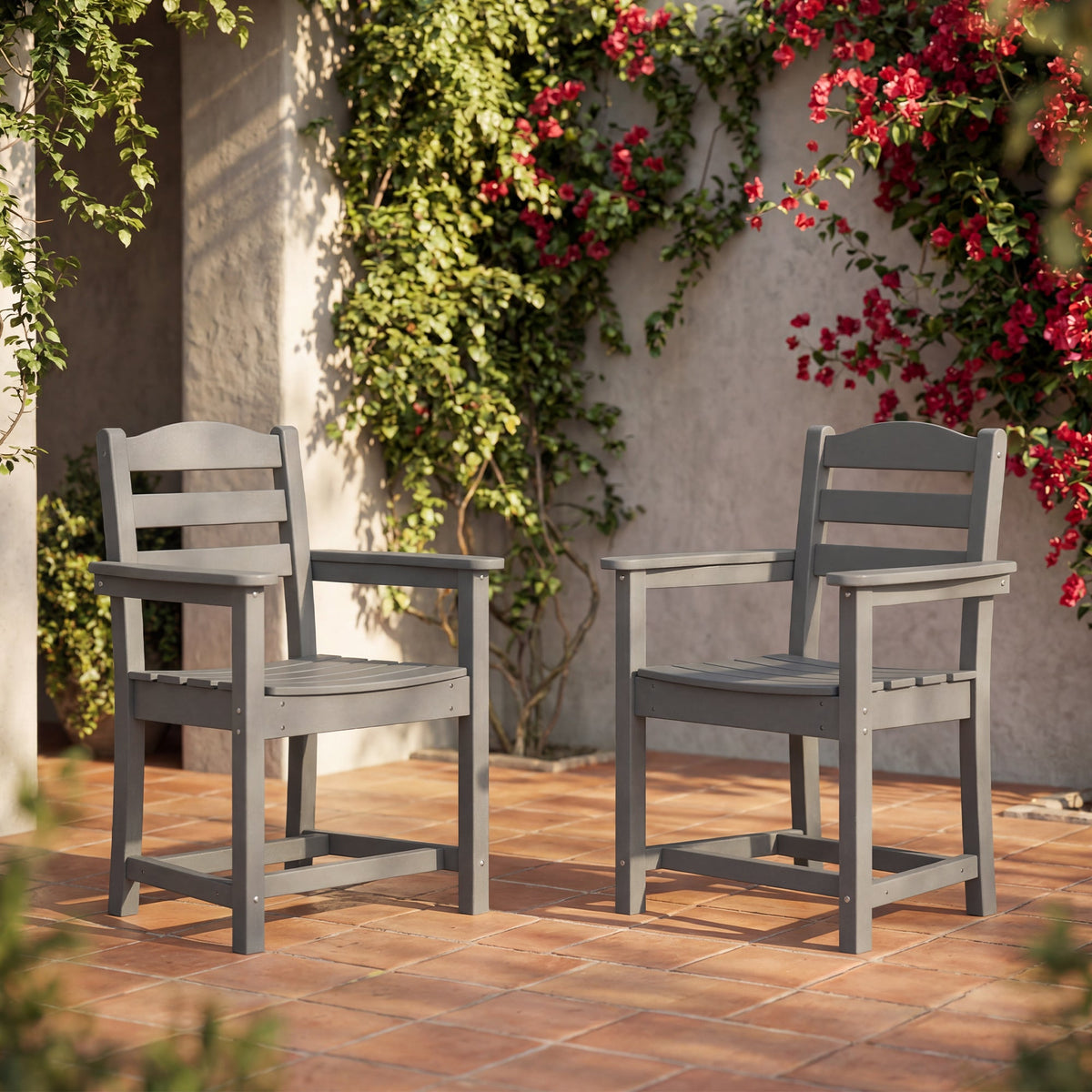
The widest seat of the five, 20 inches wide and deep, with a curved back and wide arms. Each chair is 34 inches high and 24 inches wide, with the seat 16 inches high and the arms at 24 inches. The listing gives 360 lb per chair and says to wipe clean only. Colors are gray, black, navy and brown, which match our 70.9-inch HDPE table.
Best for: armchairs at the ends or long sides of a 70.9-inch table, and anyone who wants the roomiest seat.
Skip it if: you want three per side on our 70.9-inch table (3 x 24 = 72 inches), your table's underside is lower than the 24-inch arms, or you are planning a tight deck: the listing's overall depth figure looks out of line with the 20-inch seat, so confirm it before you buy.
20" armless HDPE patio dining chairs, set of 2
Armless side chairs that tuck fully under a table. Each is 34 inches high, 17 inches wide and 20 inches deep, with a 17-inch-high seat and a 360 lb capacity per chair. The title and description say HDPE made from recycled plastic and call it waterproof and UV-resistant; the spec sheet simply says plastic. Clean with soap and water. Colors are gray, black, navy and brown.
Best for: the long sides of a table, round tables, and small patios where chairs must push all the way in.
Skip it if: you want arms to lean on, or you need the spec sheet itself to confirm HDPE before you buy.
23.6" wood-grain HDPE patio dining armchairs, set of 2
Wood-grain armchairs, the shallowest of our armchairs. Each is 33.5 inches high, 23.6 inches wide and 18.9 inches deep, with a 16.7-inch-high seat, 18.5 inches wide and 18 inches deep, and arms at 23.6 inches. The listing gives a 300 lb capacity per chair, HDPE with plastic legs, natural wood-grain color variation and no cushions, and says the chairs need no protective cover in bad weather. Choose gray or black.
Best for: armchairs on a narrow deck or balcony where every inch of depth counts.
Skip it if: you want the highest weight rating (300 lb is the lowest of the five) or a color other than gray or black.
23" teak-color HDPE armchairs with wide arms, set of 2

Teak-color wood grain on HDPE, with wide arms that hold a drink. Each chair is 36 inches high, 23 inches wide and 26 inches deep, with a 17-inch-high seat, 19 inches wide and 19 inches deep, and a 350 lb capacity. The listing says to hose down or wipe with soap and water, avoid abrasive cleaners, and that the chairs are GRS certified. Cushions are not included.
Best for: a wood look without refinishing, and relaxed meals where a drink rests on the arm.
Skip it if: you need the arms to slide under your table (the listing's arm height figure is unclear, so measure first), or your patio is tight: at 26 inches deep this is the deepest chair here.
19" teak-color HDPE dining side chairs, set of 2

Despite "natural wood" in the title, the spec sheet lists HDPE in a teak color, so there is no staining or sealing. Each chair is 36 inches high, 19 inches wide and 23 inches deep, with a 17-inch-high seat, 19 inches wide and 19 inches deep. The spec gives 350 lb per chair; the title's 700 lb appears to be both chairs together. The description says it uses GRS-certified recycled materials. Avoid abrasive cleaners.
Best for: the long sides of a table, matched with the 23-inch teak-color armchairs at the ends.
Skip it if: you want real wood, or you want arms.
Compare the picks
| Set of 2 | Arms | Seat (H x W x D) | Overall W x D | Capacity per chair | Best for |
|---|---|---|---|---|---|
| 24" HDPE armchairs | Yes, 24 in high | 16 x 20 x 20 in | 24 in wide (depth unclear) | 360 lb | Roomiest seat |
| 20" armless chairs | No | 17 x 17 x 20 in | 17 x 20 in | 360 lb | Tucking in, more seats |
| 23.6" wood-grain armchairs | Yes, 23.6 in high | 16.7 x 18.5 x 18 in | 23.6 x 18.9 in | 300 lb | Narrow decks |
| 23" teak-color armchairs | Yes, wide | 17 x 19 x 19 in | 23 x 26 in | 350 lb | Wood look, drink on the arm |
| 19" teak-color side chairs | No | 17 x 19 x 19 in | 19 x 23 in | 350 lb | Wood look, sides of a table |
For six at our 70.9-inch table: two sets of side chairs along the long sides and one set of armchairs at the ends. Browse the full FUFU&GAGA outdoor chairs and benches collection for benches too.
FAQ
What is the standard height of an outdoor dining chair?
There is no single standard. Dimensions.com gives 18 to 20 inches for dining seats and 28 to 32 inches for tables, so the seat sits about 8 to 14 inches below the top. Our outdoor chairs have 16 to 17 inch seats.
What is the best material for outdoor dining chairs?
It depends on your climate and how much care you will give. HDPE does not rot and needs only soap and water. Wood needs a decay-resistant heartwood such as old-growth teak or cedar plus refinishing. Aluminum should be washed often, and steel needs rust touch-ups.
Can outdoor dining chairs stay outside in winter?
HDPE chairs whose listings say they handle rain, snow and changing seasons can stay out. Wood and metal chairs can be stored dry or under a cover, and Ready.gov advises bringing outside furniture in before a hurricane.

Laisser un commentaire
Ce site est protégé par hCaptcha, et la Politique de confidentialité et les Conditions de service de hCaptcha s’appliquent.