


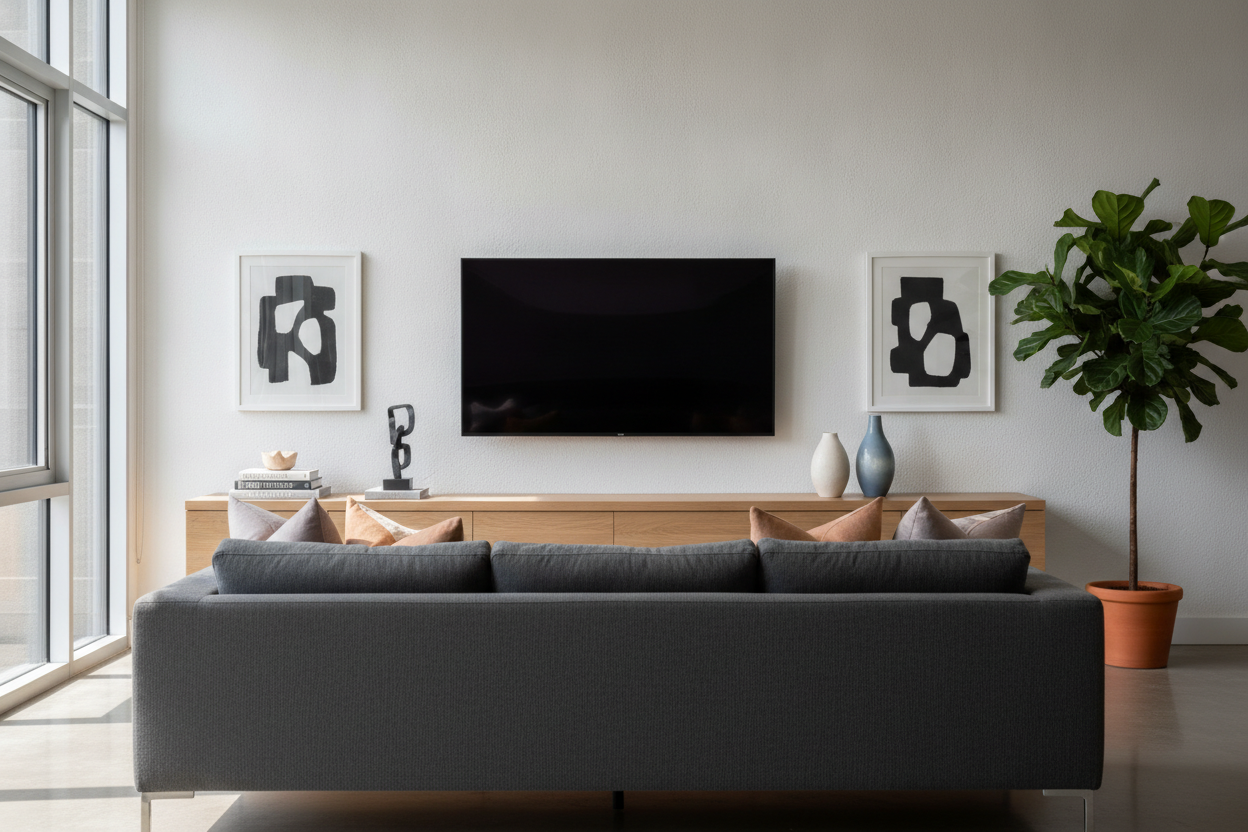
I spent six months staring at my 55-inch OLED mounted on a white wall, wondering why my living room felt like a sterile waiting room. I’d done the hard part—drilled the holes, leveled the bracket, and hidden the power cable—but the result was just this lonely black rectangle floating in a sea of drywall. It looked unanchored, like a piece of tech that hadn't finished downloading into the room's design.
The mistake most of us make is thinking that mounting the screen is the final step. In reality, it’s just the beginning. To make a room feel finished, you need to ground that screen with some clever under the tv ideas that don't necessarily involve a massive, 150-pound piece of furniture that eats up your entire walkway.
Quick Takeaways
- Visual weight matters: Use items with texture to 'anchor' the screen to the floor.
- Asymmetry is your friend: Don't feel the need to center everything perfectly.
- Cable management is 90% of the battle: If the cords are visible, the design fails.
- Low-profile is better: Keep items below the TV under 18 inches to maintain a sense of space.
The 'Hovering Void' Problem (And Why It Bothers You)
There is a specific kind of visual tension that happens when a TV is mounted too high or left completely alone on a large wall. Designers call it 'visual weight.' A television is essentially a heavy, dark void when it’s turned off. If there is nothing beneath it to catch the eye, the screen feels like it’s falling or, worse, just drifting aimlessly. It makes the ceiling feel lower and the room feel smaller because your eye doesn't have a clear path to the floor.
I tried to ignore it in my last apartment, but every time I sat on the sofa, my brain focused on that awkward 24-inch gap of nothingness. You don't need a bulky cabinet to fix this. You just need to break up the line of the floor and the wall so the transition feels intentional rather than accidental. Even in a tiny studio, ignoring the space below the screen is a missed opportunity for character.
My Go-To Under the TV Ideas (That Aren't Just 'Buy a Stand')
If you’re a renter or just someone who hates the look of traditional media centers, there are plenty of below tv ideas that feel much lighter. The goal is to create a 'landing zone' for the eyes. I’ve found that mixing heights and materials—like wood, woven fibers, and ceramic—breaks up the 'techy' vibe of the screen and makes the room feel lived-in.
Floor Poufs and Oversized Baskets
This is the easiest, cheapest fix in the book. A pair of large, chunky knit floor poufs or two oversized seagrass baskets tucked underneath the screen instantly grounds the wall. I use a pair of 22-inch woven baskets to hold my extra throw blankets and that mountain of dog toys that usually ends up under the coffee table. It adds organic texture which balances the cold, hard glass of the TV. Plus, if you have guests over, the poufs pull double duty as extra seating.
The Asymmetrical Gallery Wall
If you want the TV to disappear, surround it with art. I’m a huge fan of the asymmetrical look—place a larger framed print to the bottom left and a few smaller ones staggered to the right. This makes the TV look like just another frame in the collection. You can even incorporate some viral TV stand decor styling by placing a small stack of books or a sculptural vase on a tiny pedestal near the base of the wall. It shifts the focus from the 'appliance' to the 'art.'
Floating Shelves and Low Benches
For a more architectural look, I love a single, long floating shelf or a very low-profile wooden bench. These underneath tv ideas work because they provide a horizontal line that mimics the shape of the TV without the bulk of a cabinet. A 12-inch deep bench is perfect for leaning a few framed photos or placing a single potted snake plant. If you're looking for more storage-heavy alternatives, you might want to look at bookshelf TV stand ideas that use verticality to their advantage.
The Elephant in the Room: Hiding the Cords
Nothing ruins a 'minimalist' wall faster than a cluster of black cables dangling like vine roots. If you can't go behind the wall (renter life, I get it), buy a paintable cord raceway. It’s a plastic channel that sticks to the wall. Paint it the exact same color as your wall—not just 'close enough,' but the actual leftover paint from the hardware store. It disappears. If you’re using baskets or a bench, you can also use a simple cable management box to house the power strip and all those bulky adapters.
When You Actually Do Just Need a Console
I’ll be honest: if you have a PS5, an Xbox, a soundbar, and a cable box, baskets aren't going to cut it. You’ll end up with a 'rat’s nest' of wires that no amount of styling can hide. In that case, you need a dedicated piece. I personally love a slatted wood media console because the slats allow infrared signals from your remote to pass through while keeping the messy tech hidden. It’s the best of both worlds. If you’re realizing your space needs more structure, you can browse modern TV stands that offer that slim, mid-century profile without looking like a 1990s entertainment center.
FAQ
How high should my TV be above the floor?
The center of the screen should be at eye level when you're sitting down. Usually, that means the bottom of the TV is about 25 to 30 inches off the floor. If it's higher, you're going to get a sore neck and a bigger 'void' to fill.
Can I put a plant under the TV?
Yes, but be careful with moisture. Use a saucer and choose low-light plants like Pothos or Snake Plants if your TV wall doesn't get direct sun. Just don't put a humidifier right under the electronics.
What if my TV is in a corner?
Corner TVs are tricky. I usually suggest a single large, round basket or a tall floor plant to soften the angle. Avoid square furniture that sticks out into the room at weird angles.

Laisser un commentaire
Ce site est protégé par hCaptcha, et la Politique de confidentialité et les Conditions de service de hCaptcha s’appliquent.