


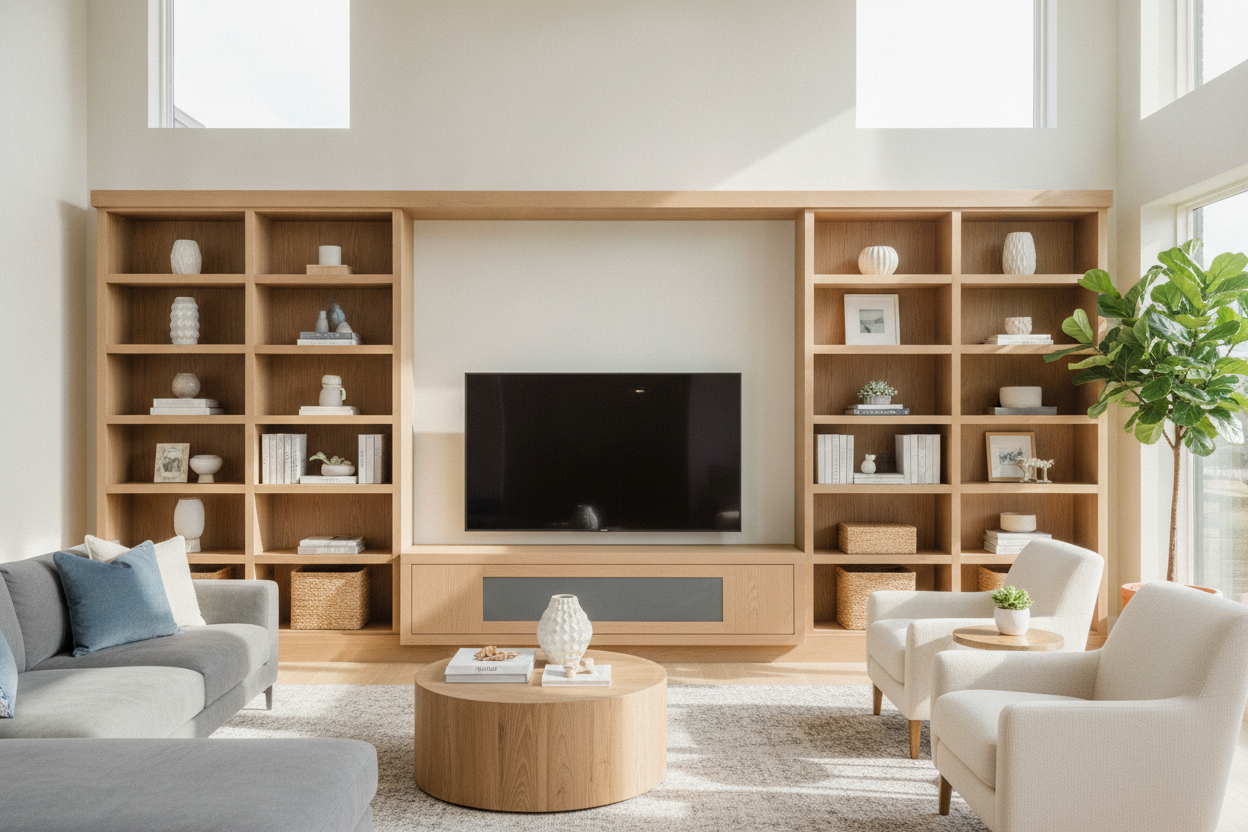
I have spent too many nights staring at a 65-inch screen that looked like a giant, brooding monolith in a living room that just couldn't handle it. You know the feeling: you buy the big TV, put it on a standard console, and suddenly the whole room feels lopsided. It is the interior design equivalent of wearing a belt that is two sizes too small for your jeans.
The fix isn't a smaller TV—who wants that?—it is a tv stand with shelves on side. By extending the horizontal footprint of the furniture beyond the screen itself, you stop the TV from swallowing the room whole. It turns a piece of tech into a piece of architecture.
- Side shelves create a visual bridge that anchors the TV to the wall.
- Open shelving prevents the 'heavy furniture' look in small apartments.
- Asymmetrical options are a lifesaver for off-center fireplaces or weird corners.
- Integrated storage helps hide the inevitable mountain of plastic remotes and controllers.
The 'Heavy Middle' Effect (And Why It's Ruining Your Room)
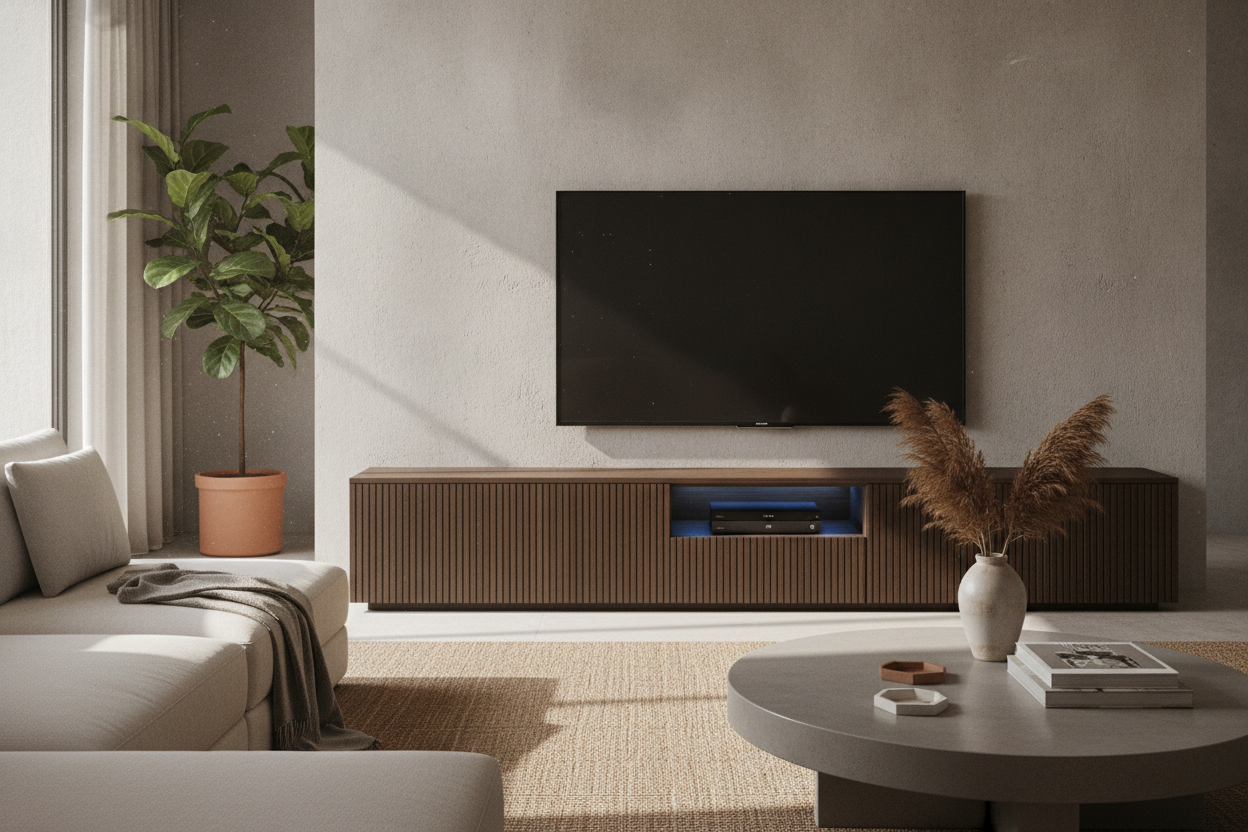
Most people make the mistake of buying a stand that is barely wider than the TV itself. This creates a 'top-heavy' look where the screen feels like it is about to tip the furniture over. It creates a visual black hole. When you use a tv console with side shelves, you are essentially stretching the base of that focal point. You want the eye to travel across the wall, not just get stuck on the bright glowing rectangle in the middle.
I once tried to mount a massive screen over a tiny, closed-off cabinet in a 12x14 room. It looked ridiculous. The room felt cramped because all the 'visual weight' was packed into a three-foot span. Moving to a wider unit with side storage immediately made the wall feel intentional rather than cluttered.
How Side Storage Diffuses the Visual Weight
Adding width through an entertainment center with side shelves draws the eye outward. This is a classic staging trick: horizontal lines make a room feel wider, while vertical lines make ceilings feel higher. By framing the screen with shelves, you are softening the edges of the TV. It becomes part of a larger composition rather than a standalone appliance.
I am a big fan of units that offer an adjustable center shelf and dual side cabinets because they give you the flexibility to mix open and closed storage. You can hide the ugly router behind a door while using the side shelves to display things that actually have personality.
Asymmetry is Actually Okay (For Off-Center Walls)
We are obsessed with symmetry, but real houses are weird. You have a window on one side, a radiator on the other, or a fireplace that isn't centered. In these cases, a tv stand with shelves on one side is your best friend. It allows you to 'cheat' the placement of the TV so it aligns with your sofa, while the extra shelving fills the gap toward the corner.
A Rustic Entertainment Center With Shelves works particularly well here. The natural wood grain and varied shelf heights break up the monotony of a flat wall. It adds architectural interest to a boring 'builder-grade' room without requiring a contractor and a sledgehammer.
My Rules for Styling the Shelves Without Adding Clutter
The danger of a tv stand with shelves on each side is that it can quickly become a graveyard for mail and random charging cables. Don't let that happen. Follow the 'rule of three': group items in threes of varying heights—like a tall vase, a medium stack of books, and a small bowl.
Always leave some negative space. If every inch is packed, the room will feel loud. I also suggest choosing a model with open shelves and cable management. If I can see your tangled HDMI cords through the back of your beautiful open shelving, the whole aesthetic is ruined. Keep the tech hidden and the decor intentional.
Finding the Right Dimensions for Your Space
Measure twice, buy once. The golden ratio for a tv stand with side shelves is that the stand should be at least 20-30% wider than the TV itself. If you have a 55-inch TV (which is usually about 48 inches wide), you want a console that is at least 60 to 70 inches wide to look balanced. Anything less and you are back to that 'heavy middle' problem.
Before you start browsing for new tv stands, use blue painter's tape to mark the dimensions on your wall. It sounds extra, but it is the only way to realize that a 70-inch unit might actually block your walkway or overlap a power outlet you need.
Is a TV stand with side shelves hard to assemble?
Usually, yes. More shelves mean more cam-locks and screws. Set aside two hours, grab a real screwdriver (not the flimsy one in the box), and have a drink ready. It is worth the effort for the stability you get.
Will side shelves make my small room look smaller?
Actually, no. If you choose a unit with open legs and airy shelving, it can make the room feel larger by showing more of the floor and wall. Avoid 'chunky' solid-to-the-floor pieces in tight spaces.
How do I hide wires on open side shelves?
Use adhesive cable clips along the back of the shelf supports. If the unit doesn't have a back panel, run the wires down the 'leg' furthest from sight. It takes ten minutes and makes a massive difference.


Laisser un commentaire
Ce site est protégé par hCaptcha, et la Politique de confidentialité et les Conditions de service de hCaptcha s’appliquent.