


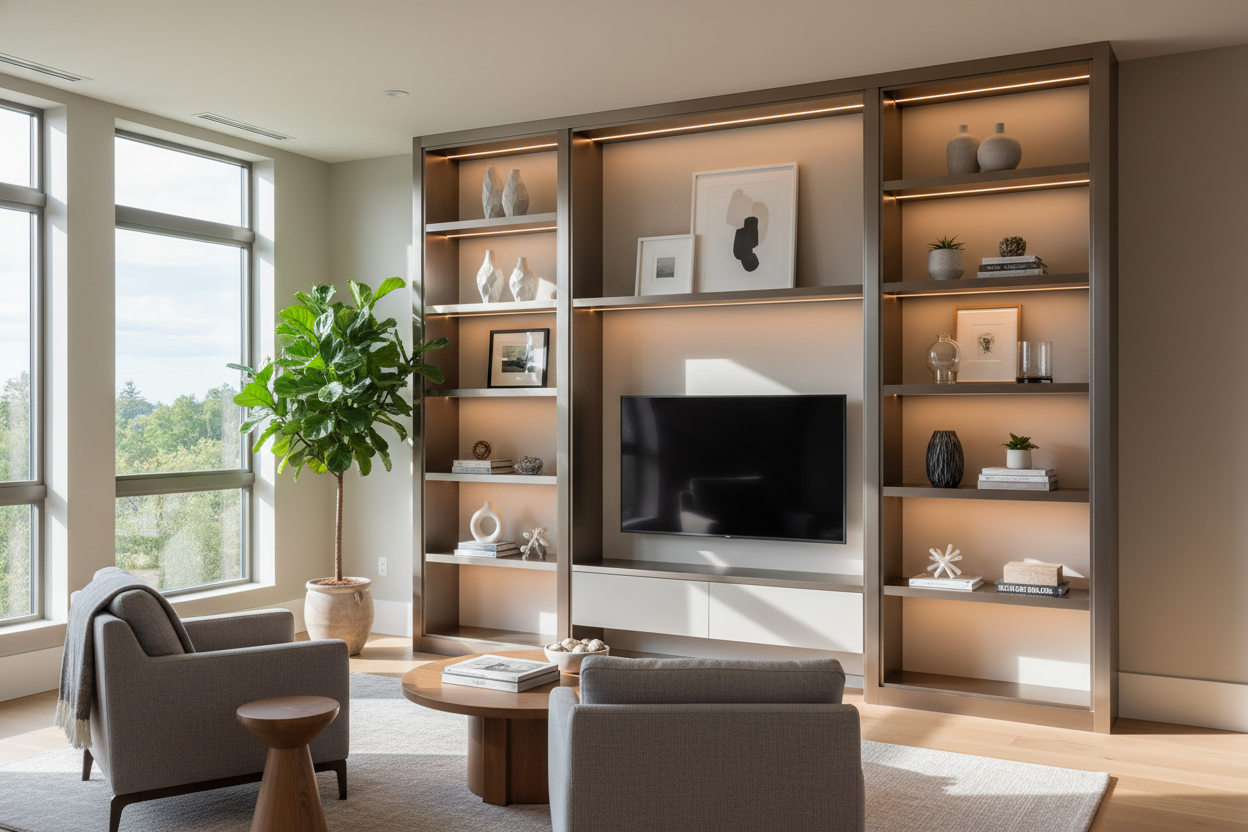
I used to be a chronic 'shelf-stuffer.' I’d spend my weekends hunting for vintage cameras and handmade ceramics, only to bring them home and watch them disappear into the gloomy shadows of my basic bookcases. My living room didn't look like an curated sanctuary; it looked like a thrift store that was about to go out of business. I realized that my problem wasn't the objects themselves—it was the lack of intention. The moment I brought home a display shelf with lights, the entire energy of the room shifted from chaotic to curated.
Quick Takeaways
- Shadows are the enemy of high-end decor; lighting creates visual hierarchy.
- LEDs act as a frame, turning ordinary objects into 'pieces.'
- Glass doors are a lifesaver for keeping illuminated dust at bay.
- Adjustable shelving is mandatory for styling items of different scales.
The 'Thrift Store' Effect of Unlit Open Shelving
Standard open shelving is basically a black hole for your stuff. I used to have these deep, dark walnut units that I thought looked sophisticated. In reality, any item placed further than three inches from the front edge was lost to the void. Even my most expensive art books looked like dusty bricks because there was zero light hitting the spines. This is what I call the 'thrift store' effect: when everything is visible but nothing is highlighted, it all just becomes visual noise.
I eventually got tired of the clutter and realized my minimalist wall setup wasn't cutting it. I ended up swapping to a floor display shelf because those flimsy floating planks were starting to sag, and they did nothing to help the 'dark corner' vibe of my apartment. Without integrated lighting, you’re just storing things, not displaying them. You need that glow to separate your treasures from the background.
Enter the 'Museum Effect': Why Illumination Changes Everything
The difference between a regular shelf and a lighted display shelf is the 'Museum Effect.' When you walk into a gallery, they don't just throw a painting on a wall; they hit it with a dedicated beam of light. A display shelf with lights does the same thing for your home. It creates a focal point that draws the eye, making the room feel organized even if you have a lot of stuff out. It’s about creating boundaries for the eye to follow.
I finally pulled the trigger on a dedicated display bookcase with led light, and it was a revelation. Instead of a flat wall of wood, I had a glowing architectural feature. The shelf led display didn't just illuminate my collection; it added a layer of ambient lighting to the whole room that felt much warmer than my harsh overhead fixtures. It turned my 'clutter' into a conversation piece.
How I Styled My Lighted Shelves for Display (Without Looking 'Retail')
The biggest fear with an led display shelf is that it will end up looking like a cell phone store or a jewelry kiosk. To avoid that 'retail' vibe, you have to embrace negative space. I follow a strict 60/40 rule: 60% of the shelf is for your objects, and 40% is just air. If you pack a lighted shelf too tight, the light can't 'breathe' and you end up with weird, harsh shadows between items.
I also highly recommend looking for adjustable shelf storage. Nothing kills a curated look faster than having to tilt a tall vase sideways because it doesn't fit the fixed height of a shelf. I like to stagger my heights—place a tall candlestick next to a low, flat bowl. This creates a rhythm that feels residential and lived-in. Use the light to highlight the textures, like the grain in wood or the glaze on a pot, rather than just pointing it at the front of a box.
Glass Doors vs. Open Fronts: The Dust Dilemma
Here is the honest truth: light makes dust look like glowing snow. If you have an open light up display shelf, you are going to see every single speck that settles on your shelves. It can be a maintenance nightmare. That’s why I eventually pivoted toward a box display shelf design with glass doors. It keeps the air still and the dust off your surfaces.
When you have lighted shelves for display, the glass actually works in your favor. It reflects the internal LEDs, creating a layered, sparkling effect that makes the whole unit look more expensive than it actually is. Plus, it protects my vintage cameras from my cat’s 'curiosity,' which is a major bonus in my household.
The Verdict: Is the Pre-Lit Upgrade Worth the Hype?
After a year with my setup, I can’t imagine going back to 'dark' shelving. The transformation from a messy-looking wall to a sophisticated gallery was worth every penny and the two hours I spent on assembly. It’s the single best thing I’ve done to manage my maximalist tendencies without having to throw away the things I love. I’m actually considering getting a matching led lighted display unit to create a symmetrical look on the opposite wall.
FAQ
Do the LEDs get hot?
Not at all. Modern LED lighted wall display shelving uses low-voltage lights that stay cool to the touch. You don't have to worry about them damaging your books or delicate items.
Can I change the brightness?
Most high-quality units come with a remote or a touch-dimmer. I usually keep mine at 100% during the day to fight shadows and drop it to 30% in the evening for a cozy, mood-light effect.
What color light should I look for?
Always aim for 'Warm White' (around 2700K to 3000K). Anything higher will look blue and clinical, like a hospital hallway, which is the opposite of the cozy museum vibe we're going for.

Laisser un commentaire
Ce site est protégé par hCaptcha, et la Politique de confidentialité et les Conditions de service de hCaptcha s’appliquent.