


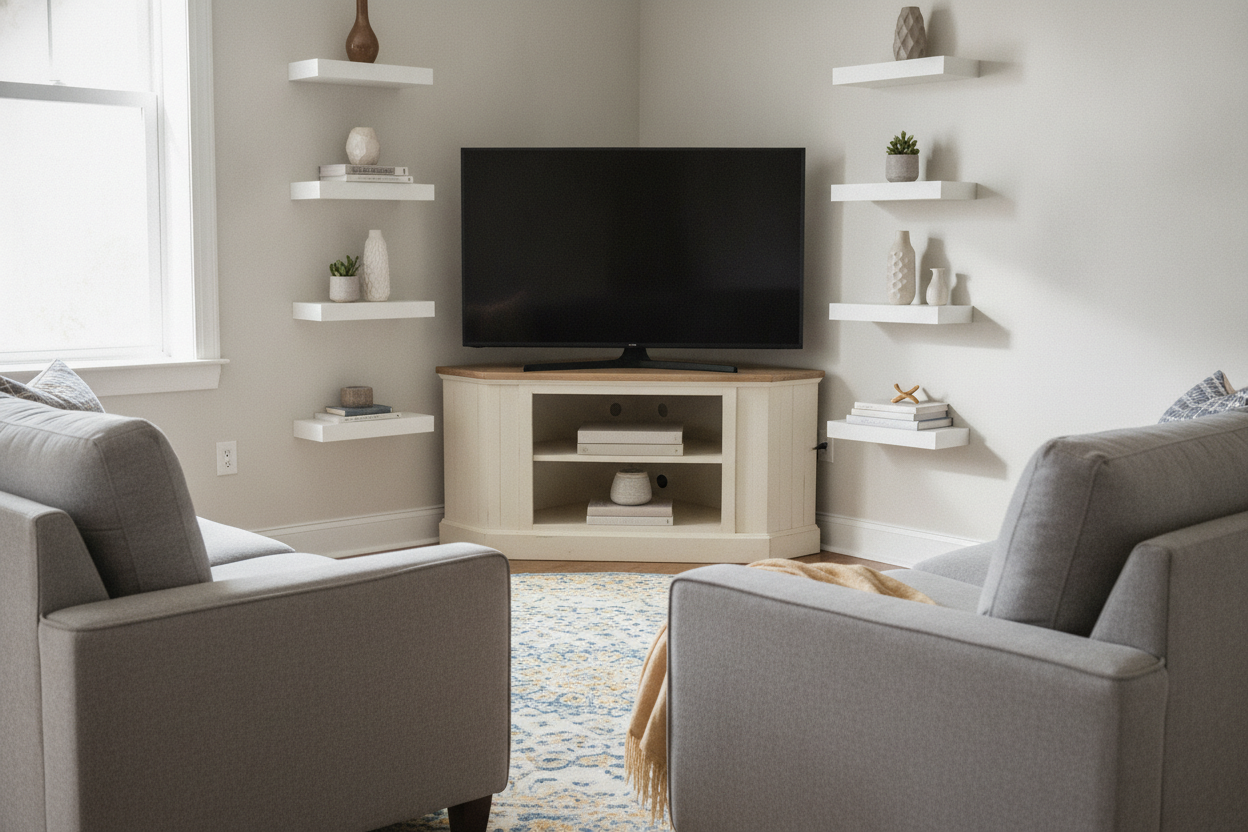
I spent three hours last Tuesday measuring my living room corner with a piece of blue painter's tape and a growing sense of despair. My new 65-inch screen was sitting in its box like a giant monolith, and every corner tv stand wayfair suggested looked suspiciously small in the preview photos. It is the classic spatial trap: you think a corner unit saves space, but if you do the math wrong, you end up with a piece of furniture that juts into your walking path like a misplaced ship's prow.
- 65-inch TVs are significantly wider than most 'corner' units; always check the actual width, not the 'fits up to' label.
- Depth is the silent killer—corner stands require a massive triangle of dead space behind them.
- Solid wood is non-negotiable for heavy screens to avoid the dreaded 'Wayfair sag' over time.
- A 55-inch setup is usually the aesthetic 'sweet spot' for standard 90-degree living room corners.
The Geometry of Corner Layouts (And Why We Always Get It Wrong)
The biggest lie in interior design is that corners are 'free' space. When you shop for standard rectangular tv stands, you're dealing with two dimensions: width and depth. But with wayfair corner stands, you're dealing with a triangle. To get a stand wide enough for a modern TV, the front face has to sit much further out from the wall than a flat console would.
I have seen so many people buy a unit thinking it will 'tuck away,' only to find it sticks out 35 inches into the room. You end up losing more floor real estate than if you had just put a slim console against a flat wall. Measure from the very corner of your room out to where you want the front of the stand to end—if that number is more than 30 inches, you're going to feel the squeeze.
Can a 65-Inch TV Actually Sit in a Corner Without Looking Silly?
We need to talk about the 'floating mushroom' effect. This happens when you buy a wayfair 65 inch tv stand that is technically rated for the weight, but the stand itself is only 50 inches wide. Your 65-inch TV (which is actually about 57 inches wide) will overhang the edges of the stand. It looks top-heavy, precarious, and cheap.
Finding a wayfair tv stand 65 inch that actually matches the scale of the screen is a nightmare. Most manufacturers try to keep corner units compact, but a wayfair tv stand for 65 inch tv needs a wide base to look intentional. If you put a massive screen on a tiny tv stand for 65 inch tv wayfair offers, you aren't saving space—you're just making your expensive tech look like it's about to tip over.
The Golden Rule for a Wayfair TV Stand 65 Inch Setup
The math is simple: your TV should never be wider than the stand it sits on. For a wayfair corner tv stand 65 inch configuration, you need at least 32 to 34 inches of wall clearance on both sides of the corner. This ensures the back corners of your screen don't hit the walls before the TV is centered.
I usually recommend a rustic corner tv stand for 65 inch tv because the chunkier, heavier design styles help balance out the massive visual footprint of the screen. Thin, mid-century modern legs on a corner unit holding a 65-inch monster just look like they are screaming for mercy.
Why 55 Inches is the True Sweet Spot for Corners
If you haven't bought the TV yet, listen to me: get the 55-inch. A wayfair corner tv stand 55 inch setup is almost always structurally and aesthetically superior. The proportions just work. A 55 inch tv stand wayfair sells usually fits perfectly into a standard 90-degree corner without leaving a four-foot gap of dust-collecting dead space behind it.
When the stand fits the corner properly, it feels like a built-in feature of the room. When you try to cram a 65-inch screen into that same space, the stand has to move so far forward to accommodate the width that you lose the 'corner' benefit entirely. It just becomes a stand sitting awkwardly in the middle of a walkway.
Solid Wood vs. Manufactured: Filtering Through the Clutter
Wayfair is a jungle of particle board. If you are putting a heavy screen on a corner tv cabinet wayfair stocks, you have to be ruthless with your filters. Look for 'Solid Wood' or 'High-Grade MDF with Wood Veneers.' If the unit weighs less than 70 pounds in the box, it is likely made of airy honeycomb paper or thin laminate that will sag within six months.
I personally look for units with a center support leg. Even corner units need that middle reinforcement if they're wider than 50 inches. Don't be swayed by a pretty finish if the 'weight capacity' section says 50 lbs and your TV weighs 48. That is a recipe for a warped top shelf and a very sad Tuesday.
My Top Styling Trick for a Wayfair Corner Entertainment Center
A wayfair corner entertainment center can easily look like a '90s relic if you aren't careful. To make it look modern, avoid the ones with those weirdly high side towers. Go for a low-profile unit and use the wall space above it for asymmetrical art. This draws the eye up and away from the 'dead' corner triangle.
If you realize your room layout is just too awkward for any corner unit, stop forcing it. Sometimes the best solution is an electric vertical lift tv cabinet that can sit at the foot of a bed or against a window. But if you're committed to the corner, look for wayfair corner stands with closed cabinetry. Hiding the inevitable rat's nest of wires that accumulates in a corner is the only way to keep the space looking clean.
Frequently Asked Questions
Can a 65-inch TV fit on a 50-inch corner stand?
Physically, yes, if the legs of the TV are centered. Aesthetically, no. The TV will overhang the stand by several inches on each side, which looks unstable and cluttered. Always aim for a stand at least as wide as the TV.
How do I stop cables from showing behind a corner stand?
Corner stands are notorious for cable gaps. Use a cord management box or a stand with a solid back panel. If the stand is open, use zip ties and adhesive clips to run the wires down the back of the stand's legs rather than letting them hang in the 'triangle' gap.
Is assembly hard for Wayfair corner units?
They are trickier than standard consoles because of the 45-degree angles. Expect a lot of cam-bolts and a few confusing diagrams. Budget at least two hours and have a real screwdriver handy—the 'tool' they include is usually garbage.

Laisser un commentaire
Ce site est protégé par hCaptcha, et la Politique de confidentialité et les Conditions de service de hCaptcha s’appliquent.