


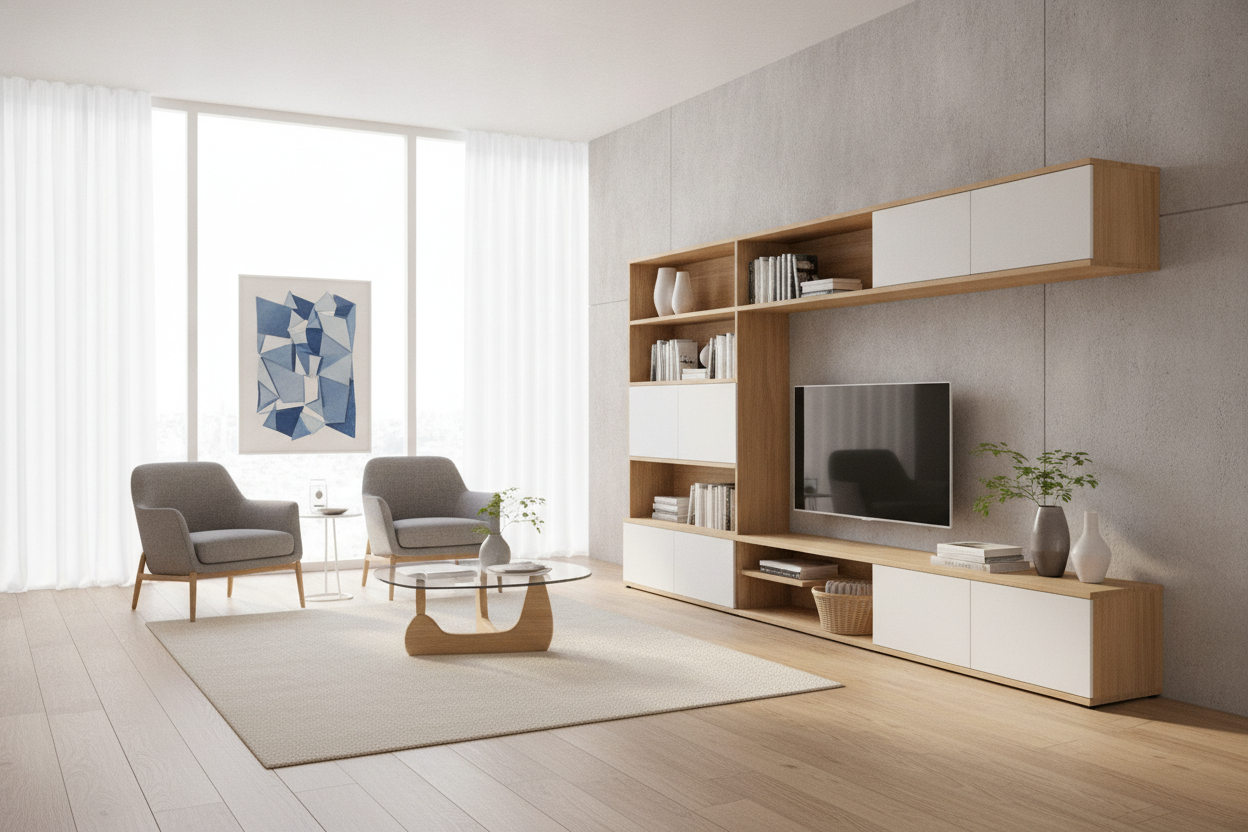
I spent three years pretending a set of $20 floating shelves from a big-box store could hold my life together. It was a lie. Between the tangled nest of HDMI cables and the dust bunnies congregating behind my PS5, my living room looked more like a tech salvage yard than a home. I finally realized that my 'minimalism' was actually just a lack of proper storage, which led me to hunt for a scan design entertainment center that wouldn't swallow my entire floor plan.
Quick Takeaways
- Horizontal lines make narrow rooms feel wider and more expensive.
- Push-to-open doors eliminate 'visual noise' from clunky hardware.
- Cable management is the difference between a designer home and a dorm room.
- High-quality MDF or solid veneers beat flimsy plywood every single time.
I Was Terrified of 'Heavy' Living Room Furniture
I used to have this irrational fear that any furniture larger than a folding chair would make my apartment feel like a claustrophobic tomb. I stuck to spindly legs and glass tops, thinking transparency equaled space. But transparency actually just meant I could see every dust-covered power strip. The shift happened when I realized a substantial, sleek modern entertainment center doesn't actually 'take up' space—it claims it.
Instead of five small pieces of furniture creating a jagged skyline against my wall, one long, low unit created a clean horizon. It grounded the room. I stopped looking at the clutter and started looking at the architecture of the piece. If you are tired of your living room looking like an unfinished Tetris game, you need a unit that hides the chaos behind closed doors.
What Makes a Scan Design TV Stand So Different?
When we talk about a scan design tv stand, we are talking about the 'less but better' philosophy. Unlike traditional American furniture—which loves crown molding, heavy brass handles, and thick, chunky frames—Scandinavian-inspired pieces are stripped down. They rely on proportions rather than decoration.
You will notice handle-less doors that operate on touch-latches and recessed plinth bases that make the unit look like it is hovering an inch off the floor. These pieces are often built with high-pressure laminates or real wood veneers over stable cores. They don't warp under the weight of a 65-inch OLED, and they don't scream for attention. They just sit there, looking expensive and organized.
The Illusion of Space (Even With a Massive Console)
It sounds counterintuitive, but a larger console can make a room feel bigger. This is because of the 'long-line' effect. A 72-inch unit creates a continuous visual path that draws the eye across the room. I recently helped a friend install a stylish black TV stand in a narrow 11-foot living room. We were worried the dark color would be too much.
Surprisingly, the matte black finish acted like a shadow, receding into the wall rather than jumping out. Because it was only 16 inches deep, it left plenty of walkway space. The low profile—usually sitting around 18 to 22 inches high—keeps the sightlines open. You aren't blocking the wall; you are just giving the TV a sophisticated pedestal.
The Big Debate: Giving Up Precious Square Footage
Let's be real: in a small apartment, every square inch is a battleground. You might be asking yourself, is an entertainment center worth the space when you could just wall-mount the TV? I used to be Team Wall-Mount, until I realized I still had a soundbar, a router, and a Nintendo Switch with nowhere to go.
Wall-mounting usually results in 'the dangle'—that single, ugly cord protector running down the drywall. Dedicating that 18-inch strip of floor space to a dedicated media unit solves the cord problem and gives you a surface for 'the pretty stuff' like a ceramic vase or a stack of oversized art books. It turns a utility area into a focal point.
Modern vs. Retro: Which Vibe Wins?
The current market is split between the ultra-sleek European look and the warmer, tapered-leg aesthetic. I love a mid century modern entertainment center for its nostalgia, but those angled legs can sometimes feel a bit 'busy' in a room that already has a lot of furniture legs.
The European Scan design is more monolithic. It feels more permanent and architectural. While the retro look is great for a bohemian vibe, the sleek, handle-less Scan look is what you want if you're aiming for that 'expensive hotel' atmosphere. It’s about choosing between a piece that says 'look at me' and one that says 'look at how organized I am.'
FAQ
Will my remote work through closed doors?
Only if the unit has IR-friendly glass or if you use a small IR repeater. Most Scan designs use solid doors for a cleaner look, so you'll want to check if your devices are Bluetooth-enabled or if you need to keep a door cracked during a movie marathon.
How much wider should the stand be than the TV?
At least 6 to 10 inches on each side. A TV that is wider than its stand looks top-heavy and precarious. If you have a 65-inch TV, aim for a stand that is at least 70 inches long.
Is matte or high-gloss better?
Matte is much more forgiving. High-gloss looks stunning in photos but shows every single fingerprint and speck of dust the second you touch it. If you have kids or pets, go matte or wood grain every time.

Laisser un commentaire
Ce site est protégé par hCaptcha, et la Politique de confidentialité et les Conditions de service de hCaptcha s’appliquent.